BIOC3021 #7 - Proteins (2)
 Call Kai
 Learn
 Practice Test
 Spaced Repetition
 Match
 Flashcards
 Knowt Play
1/25

There's no tags or description
Looks like no tags are added yet.
26 Terms
Tertiary Structure
Globular proteins contain segments of both alpha-helices and beta-strands, while fibrous proteins have a specialized tertiary structure
Examples of Fibrous Proteins
Collagen
Alpha-Keratin
Fibroin & Beta-Keratin
Tertiary Structure: Collagen
Consists of three intertwined polypeptide chains ➡ Main protein of connective tissues (25-35%)

Most Common Types of Collagen
Type 1: most abundant ➡ found in tendons, ligaments, skin, blood vessels, and bone
Type 2: cartilage ➡ found in joints, rib cage, nose, and ears
Type 3
Type 4
Type 5
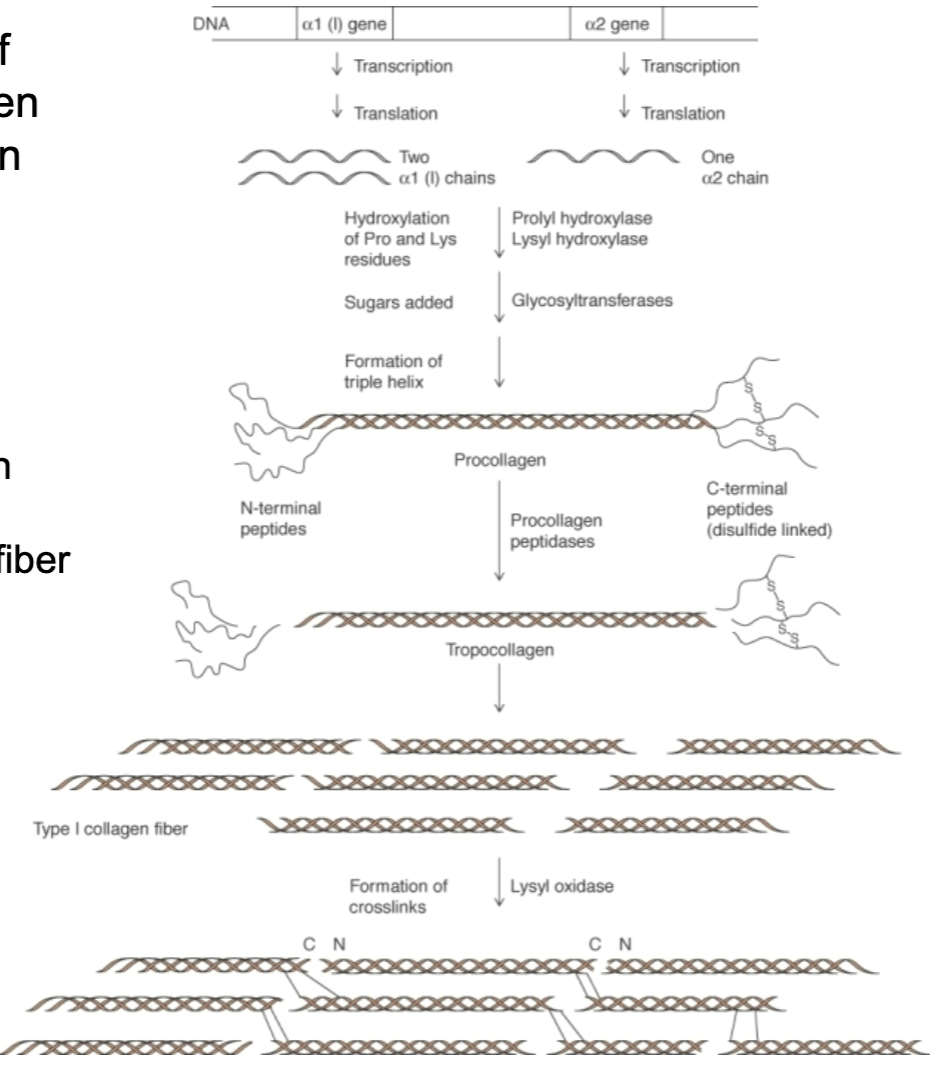
Formation of Tropocollagen
Procollagen ➡ Tropocollagen ➡ Cross-linked Fiber (Collagen Fibril)
Tertiary Structure: Alpha-Keratin
Formed by the coiling of alpha-helices ➡ Structural component of skin, hair, and fingernails
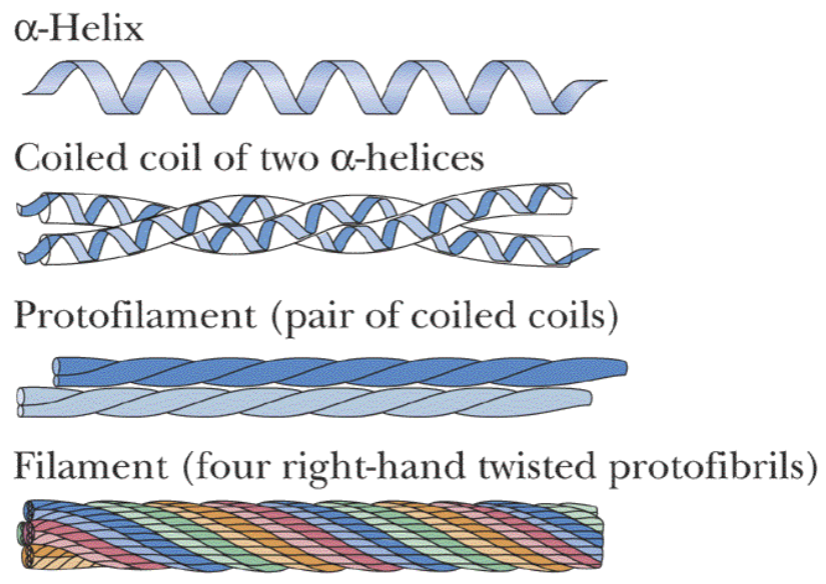
Alpha-Keratin: Protofilament
2 coiled coils (4 alpha-helices)

Alpha-Keratin: Protofibril
2 protofilaments (8 alpha-helices)

Alpha-Keratin: Intermediate Filament
4 protofibrils (32 alpha-helices)

Tertiary Structure: Fibroin & Beta-Keratin
Consist of beta-sheets stacked to produce a 3D structure
Fibroin: main silk protein
Beta-Keratin: component of bird feathers, beaks, and claws

Globular Proteins can be classified according to…
Type & Arrangement of secondary structure
Classes of Globular Proteins
(a): All alpha-helix proteins
Consists of bundles of antiparallel/parallel alpha-helices
(b): All beta-strand proteins
Consists of antiparallel/parallel beta-strands
(c): Alpha-helix / Beta-strand proteins ➡ Most common
(d): Proteins with little secondary structure
Rely on side-chain interactions

Protein Domains/Modules
Amino acid sequences that are used repeatedly in the same protein or found in different proteins

How are Protein Domains/Modules produced?
By either a duplication of a DNA segment within a gene or an insertion of a copy of a DNA segment into another gene

Protein Folding
The process of folding a polypeptide chain into a globular protein with a precise 3D structure

Protein Folding Steps
A newly synthesized polypeptide first forms localized segments of secondary structures (alpha-helix and beta-sheet)
These coalesce into a partially-folded, intermediate globular structure, primarily through hydrophobic interactions
The final, stable tertiary structure is generated by small adjustment to the folded structure
In the cell, some proteins may require assistance from molecular chaperones

Protein Misfolding is caused by…
Amyloid Deposits: misfolded, insoluble, and aggregated proteins in brain cells
Protein Misfolding ➡ Disease
Alzheimer’s Disease: amyloid-beta misfold
Parkinson’s Disease: alpha-synuclein misfold
Quaternary Structure’s Subunit Interactions
Refers to the association of monomeric protein subunits to form multi-subunit complexes

What are the forces driving Quaternary Association?
Hydrophobic Interactions
Hydrogen Bonding
Disulfide Bonds
Ionic Interactions
Structural/Functional Advantages of Quaternary Association
Stability
Genetic Economy & Efficiency
Catalytic Sites
Cooperativity
Quaternary Association: Stability
Subunit association reduces protein’s surface-to-volume ratio, which increases stability
Quaternary Association: Genetic Economy & Efficiency
Less DNA is required to code for a monomer
Single gene coding
Quaternary Association: Catalytic Sites
Formation of a multi-subunit complex may be necessary to bring all catalytic groups together
Increases the rate of chemical reactions
Quaternary Association: Cooperativity
Subunit interactions may produce cooperativity
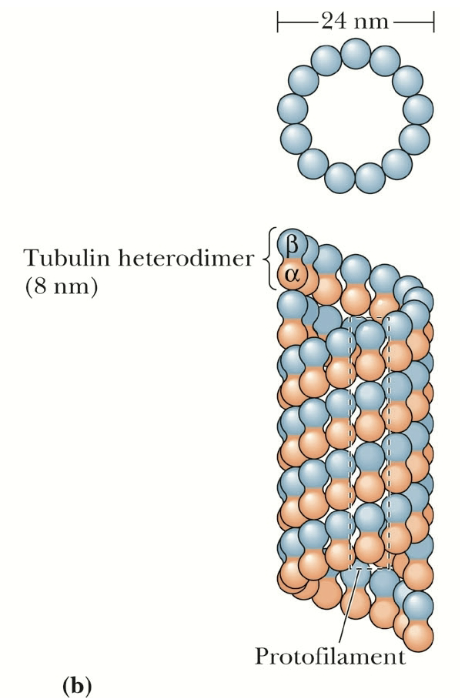
Microtubules
Hollow, helical structures that readily increase/decrease in length ➡ Dynamic, open quaternary structure