Physl 210 CNS Lecture 2
 Call Kai
 Learn
 Practice Test
 Spaced Repetition
 Match
 Flashcards
 Knowt Play
1/27

There's no tags or description
Looks like no tags are added yet.
28 Terms
What is the total number of spinal nerves that convey signals to and from the spinal cord? What is the distribution?
31 nerves, 8 cervical, 12 thoracic, 5 lumbar, 5 sacral, 1 coccygeal

Dermatome
The specific area of skin innervated by a single spinal nerve.

Myotome
The specific set of muscles innervated by a single spinal nerve.
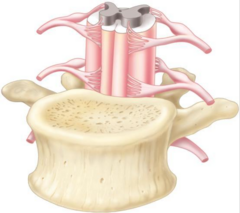
Dorsal Root
The pathway where axons of afferent (sensory) neurons enter the spinal cord.

Dorsal Root Ganglion
The structure containing the cell bodies of afferent (sensory) neurons.

Ventral Root
The pathway where axons of efferent (motor) neurons leave the spinal cord.
Spinal Cord Gray Matter
Brain tissue consisting of neuronal cell bodies, dendrites, short interneurons, and glial cells.

Dorsal Horn
The region of spinal gray matter containing cell bodies of interneurons.
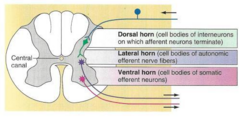
Ventral Horn
The region of spinal gray matter containing motor neuron cell bodies supplying skeletal muscle.
Lateral Horn
The region containing autonomic neuron cell bodies supplying smooth/cardiac muscle and glands.
Spinal Cord White Matter
Bundles of myelinated axons traveling up and down the spinal cord.
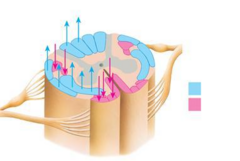
Spinal Reflex
A simple behavior produced by pathways lying entirely within the spinal cord.

Spinal Cord Injury (General Rule)
Sensation and motor control below the level of damage are typically abnormal.
Sensory Areas (Cerebral Cortex)
Cortical regions where sensory input is translated into conscious perception.
Association Areas (Cerebral Cortex)
Cortical regions that integrate information from sensory and motor areas.
Somatic Senses
Receptors associated with the skin, muscles, joints, fascia, and viscera.
Special Senses
Senses including smell, taste, hearing, equilibrium, and sight.
De-afferentation
The loss of sensory inputs, which severely impairs motor control.
Thalamus (Sensory Role)
The brain relay station for all sensory pathways except olfaction.

Sensory Transduction
Converting stimulus energy into electrical information for the nervous system.
Nociceptors
Sensory receptors that respond to noxious or painful stimuli.

Adequate Stimulus
The specific modality of stimulus that normally activates a given receptor.
Labeled Line Code
Specific pathways projecting to specific cortical regions to interpret distinct stimulus modalities.
Meissner's Corpuscle
A skin receptor specialized for detecting light touch.
Pacinian Corpuscle
A skin receptor specialized for detecting vibration and deep pressure.
Frequency Coding (Intensity)
Encoding stimulus intensity via the rate of action potentials per second.
Population Coding (Intensity)
Encoding stimulus intensity by recruiting more sensory receptors into activity.
Temporal Pattern Code
Encoding stimulus properties through the variability of firing rates.