ADVANCING THE LOAN AND COLLECTION OF PAYMENTS
 Call Kai
 Learn
Learn Practice Test
 Spaced Repetition
 Match
Match Flashcards
 Knowt Play
1/6

There's no tags or description
Looks like no tags are added yet.
Name | Mastery | Learn | Test | Matching | Spaced | Call with Kai | Chat |
|---|
No analytics yet
Send a link to your students to track their progress
7 Terms

Interest adjustment period
the period of time between the date the funds are advanced and the beginning of the first payment period
-the first regular payment does not usually fall exactly one period from the date of closing
-For lenders to receive interest during the entire period for which the borrower has use of the funds, it is necessary to introduce an adjustment period
-The objective is to calculate the amount of interest owing on the funds advanced over the interest adjustment period.
-calculated by finding the amount of interest owing on the loan when interest is charged at the daily interest rate equivalent to the contract rate and when the number of compounding periods is equal to the number of days during the adjustment period
-Because the loan will usually be stated as a nominal interest rate with semi-annual compounding (j2) interest rate and the interest adjustment period is specified in days, an interest rate conversion is required – the j2 rate must be converted to its j365 equivalent.
*For the purposes of this course, calculations for interest adjustments are not required; however, students are required to understand the concept of interest adjustments.
Payment Collection
-Upon receipt of a regular mortgage payment, the lender determines the portion of the payment that is interest and the portion that is repayment of principal
-in theory, if the payment is not made on the due date, daily interest on the amount of the payment should, in theory, be charged
-most lenders will not do this until the amount of interest involved exceeds some minimum (usually one dollar
-other formal procedures for private lenders:
• having payments made into a bank account. For a small charge, many banks will do the necessary calculations and issue the appropriate receipts.
• paying a trust company, mortgage broker, or real estate brokerage to look after the mortgages. These agencies will perform the accounting tasks, issue receipts, and take action on arrears in payments.
Arrears Control
-when borrowers default on payments, the lender must then determine the reasons for the default, and decide what action is required.
-the lender may decide to grant extra time, adjust repayment terms, or use legal remedies to recover the amount of the principal, accrued interest, and costs.
-If legal action is necessary for the arrears collection, the lender should leave all discussions to the solicitor and the borrower.
COMMERCIAL MORTGAGE LOAN UNDERWRITING
occurs with residential property that is not owner-occupied (income-producing residential), and all non-residential property (which is predominantly income-producing)
-Lending practice for this category of property (which includes vacant land loans and development financing) is generally referred to as mortgage underwriting
-similar to that for residential borrower qualification except that the income from the property is given emphasis.
-the focus is on the property’s net operating income (NOI): gross potential revenue less vacancy allowance, bad debt allowance, and total operating expenses (amount is calculated excluding income tax, mortgage payments, and depreciation expense or capital cost allowance)
-the particular qualification procedure used will depend upon factors including:
• Applicant’s track record
• Mortgage and real estate market conditions at the time of the application
• Type, age, condition, and location of the property securing the loan
• Strength of the covenants of tenants resident in the property
Lending Policy
-the lender will use two constraints: a loan-to-value constraint and an income constraint – and choose the lower of the two loans indicated.
-two ways of expressing the income constraint; both give the same information but in different forms:
the first way of expressing the income constraint is the safety margin and
the second is the debt coverage ratio.
Safety margin
ensures that the NOI can cover the mortgage payments by expressing the margin between the NOI and mortgage payments as a percentage of NOI
Safety Margin (dollars) = NOI × Safety Margin %
Safety Margin Payment = NOI × (1 – Safety Margin %)
-if a lender set a margin of safety of 20% of NOI, the maximum allowable mortgage payments cannot exceed 80% of NOI → to ensure that income from the property is sufficient to cover required mortgage payments.
-the calculation of NOI is only an estimate. If gross potential income, vacancy rates, operating costs, or bad debts change over time, NOI will also change.
-provides a cushion, or safety valve, limiting the likelihood of arrears or default in response to a decrease in net income.
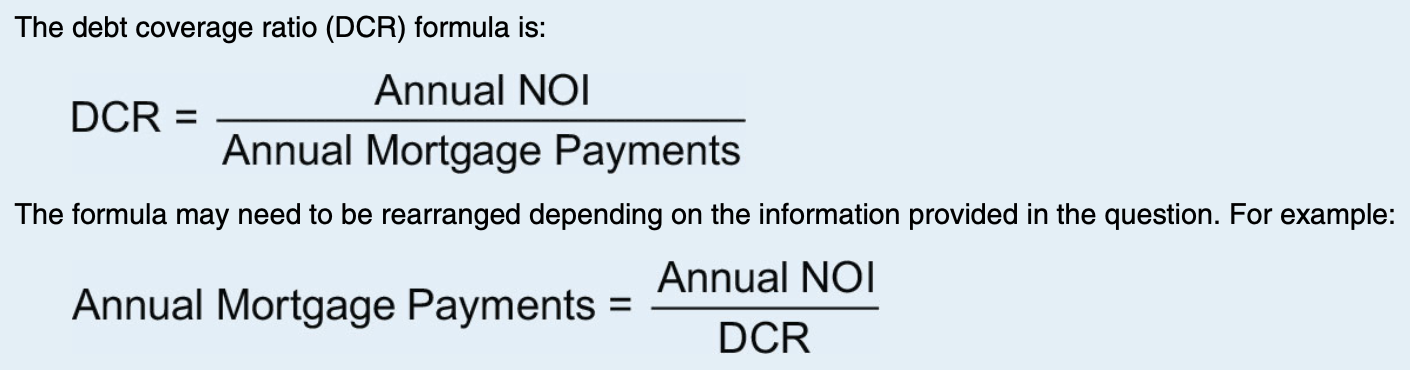
Debt coverage ratio (DCR)
the ratio of the property’s annual NOI to the annual debt service
-the commonly used income constraint is the debt coverage (or debt service coverage) ratio.
-states that annual NOI must cover the annual debt service payments more than once
-e.g., a DCR requirement of 1.2 means that NOI must be 1.2 times the size of the required payments.
-will fluctuate and is affected by factors such as interest rates, property type, vacancy rates, length of term, and economic conditions
-CMHC-insured commercial buildings will have higher debt coverage ratios than non-insured equivalent buildings.
-smaller buildings (e.g., less than 5 units) may have lower DCRs and non-apartment commercial buildings (e.g., warehouses, industrial space) will have higher DCRs (e.g., 1.4-1.5).