Mental health
 Call Kai
 Learn
 Practice Test
 Spaced Repetition
 Match
 Flashcards
 Knowt Play
1/125

There's no tags or description
Looks like no tags are added yet.
126 Terms
A. Splitting
D. Projection
The nurse is planning care for a client with a borderline personality disorder . The nurse recognizes that the client will likely demonstrate which demonstrate which defense mechanism: select all that apply —
A. Splitting
B. Sublimation
C. Altruism
D. Projection
E. Conversion
Splitting.
Hall mark sign of borderline personality disorder —
A. Splitting .
Inability to view both positive and negative aspects of others as part of a whole, results in viewing someone as either a wonder person or a horrible person .
This is define as —
A. Splitting
B. Sublimation
C. Altruism
D. Projection
E. Conversion
Suicidality ( parasucide ) .
Key Interventions for a client with borderline - personality disorders is to assess for —

Border line personality disorder (BPD)
— denial.
— projective identification.
—Splitting.
are commonly seen in which disorder —

border line personality disorder .
Dialectical behavior therapy that focus on emotional regulation and strategies to response to stressor in a mature way . This therapy is used for —
A. triangulation.
The nurse is interviewing a family and observes tension between the two parents, and the child reports that the mother often involves her in deciding who is right. This observation is an example of
A. triangulation.
B. coalition.
C. fusion.
D. differentiation.

B. Depression .
Additional Info
✓ Binge eating is characterized by consuming enormous amounts of food over a relatively short duration (i.e., two hours) with a feeling of losing control during and after the binge.
✓ A binging episode is not followed by an attempt to compensate for the excess food eaten (i.e., the client does not attempt to rid the body of the excessive caloric intake via purging).
✓ This condition differs from anorexia nervosa and bulimia because the individual does not purge. The individual also may have a normal BMI. However, it often increases because of the significant intake of calories.
The nurse is assessing a client with a binge eating disorder. The nurse understands which other comorbidity is commonly found with this disorder?
A. Disorganized behavior
B. Depression
C. Fear of abandonment
D. Perfectionism

B. Displacement
A client in the primary healthcare provider (PHCP) office is observed getting yelled at by their spouse. When the nurse interviews the client, the client is hostile and shouts at the nurse. This client is exhibiting which defense mechanism?
A. Identification
B. Displacement
C. Undoing
D. Compensation

A. increased pulse
C. reports of headache
D. narrowing of the perceptual field.
The nurse in the mental health unit is assessing a client with moderate anxiety.
The nurse would anticipate which signs and symptoms to support this finding? Select all that apply.
A. increased pulse
B. feeling of impending doom
C. reports of headache
D. narrowing of the perceptual field
E. inability to problem-solve or learn
F. pupillary constriction

A. Difficulty with decision-making
E. Feels helpless when alone
The nurse is assessing a client with Dependent Personality Disorder. Which of the following would be an expected finding? Select all that apply.
A. Difficulty with decision-making
B. Flamboyant behaviors
C. Intense and unstable relationships
D. Avoiding social relationships
E. Feels helpless when alone

histrionic personality disorder.
Flamboyant behaviors and provocative dressing are hallmark characteristics of —
avoidant personality disorder.
Avoiding social relationships and situations is a finding with —
D. "I feel really dizzy right now."
The nurse is caring for a client newly admitted to the mental health unit with bulimia nervosa.
Which client statement requires immediate follow-up?
A. "These sores in my mouth hurt."
B. "I feel so bloated after eating."
C. "I barely slept at all last night."
D. "I feel really dizzy right now."

bulimia nervosa,
Frequent episodes of vomiting and laxative use, common behaviors in individuals with ___________________ can lead to significant fluid loss and dehydration, and electrolyte imbalance such as hypokalemia.
These conditions can be life-threatening if not addressed promptly. Dehydration can also result in dizziness, lightheadedness, and a drop in blood pressure, which can contribute to feeling dizzy.
D. Often saves lives when a person is in a severe crisis.
Crisis helplines are highly important due to which of the following?
A. Facilitates the ability of the nurse to visit the home.
B. Allows the caller and the call center to plan follow-up care.
C. Serves as a cost free way to develop new coping strategies.
D. Often saves lives when a person is in a severe crisis.

Rationalization.
A nurse cares for a client who has missed their last appointment with the primary healthcare provider (PHCP). The client states, "I missed my appointment because I overslept, but I knew it would be pointless anyway." The client is demonstrating which defense mechanism?
A. Projection
B. Reaction formation
C. Denial
D. Rationalization

A. "Do not avoid telling the children about the divorce."
B. "Provide physical and emotional reassurance to the children."
E. "Children may react negatively with resentment."
The nurse is teaching parents planning to tell their children about their divorce. Which of the following information should the nurse include? Select all that apply.
A. "Do not avoid telling the children about the divorce."
B. "Provide physical and emotional reassurance to the children."
C. "Try not to cry in front of the children."
D. "Limit the amount of time discussing the divorce."
E. "Children may react negatively with resentment."
B. "I'd like to just sit with you for a while Steve."
C. "Tell me how you're feeling Steve. I'd like to understand."
The nurse is caring for a client who is struggling with severe depression. Which of the following statements would demonstrate effective therapeutic communication with this client?
Select all that apply.
A. "Great work today in group therapy Steve, you were really talkative today!"
B. "I'd like to just sit with you for a while Steve."
C. "Tell me how you're feeling Steve. I'd like to understand."
D. "Why are you feeling depressed today Steve?"
E. "I know exactly how you feel. I've been through the same thing."

B. continuing education for staff regarding limit setting.
C. measures to reduce overcrowding.
The nurse is presenting interventions to reduce violence in the mental health unit to an administrative committee. It would be appropriate for the nurse to recommend Select all that apply.
A. fall risk assessments to be completed every shift.
B. continuing education for staff regarding limit setting.
C. measures to reduce overcrowding.
D. limiting the administration of prescribed antipsychotics.
E. reducing the amount of group therapy sessions.

A. "You are just like my mother, bothering me with these questions."
The nurse supervises a novice nurse interviewing a client with a borderline personality disorder. Which client statement would demonstrate the client using transference?
A. "You are just like my mother, bothering me with these questions."
B. "Instead of breaking objects, I have joined a kickboxing class."
C. "I cannot be an alcoholic because I still go to work every day."
D. "I told my boyfriend if he leaves me, I will kill myself."

F. Reassign the client to a private room
D. Ask if the client hears any voices
The nurse is caring for a client in the mental health unit experiencing psychosis
Item 1 of 1
Nurses' Notes
Medications
Medical History
1300 - Client was banging their food tray and shouting at other clients. De-escalated the situation by escorting the client back to their room. Once back to their room, the client kept shouting 'they are after me!' at the roommate. The client stopped the shouting but resumed several minutes later. The client refused the scheduled by-mouth (PO) olanzapine, stating, 'they don't want me to take that.'
Select two (2) actions the nurse should take
A. Provide therapeutic touch
B. Limit interaction with the client
C. Place the client in seclusion
D. Ask if the client hears any voices
E. Crush the olanzapine in the client's food.
F. Reassign the client to a private room

C. Develop a structured daily schedule with clear expectations and goals.
A nurse is caring for a client with bipolar disorder who is experiencing a manic episode and disrupting the unit's therapeutic environment.
Which action should the nurse take to promote a therapeutic milieu?
A. Assign a staff member to stay with the client at all times.
B. Isolate the client in a separate room until the manic episode subsides.
C. Develop a structured daily schedule with clear expectations and goals.
D. Encourage the client to engage in group therapy sessions with peers.

B. Assist the client in understanding triggering events or feelings that may have lead to the outburst.
The psychiatric nurse is providing care for a patient who has just calmed down after exhibiting inappropriate behaviors related to bipolar disorder. The nurse knows that which of the following is the best way to help prevent another unseemly episode?
A. Identify the consequences of the behavior.
B. Assist the client in understanding triggering events or feelings that may have lead to the outburst.
C. Ensure that the patient's safety is upheld.
D. Offer the patient clear options to deal with their current behavior.

D. post-traumatic stress disorder.
The nurse is assessing a client who reports nightmares, flashbacks to a prior event, and intrusive thoughts. The client is at highest risk of developing
A. panic disorder.
B. bipolar disorder.
C. schizophrenia.
D. post-traumatic stress disorder.

A. Least-restrictive measures used before restraint.
The nurse is planning a staff education program about restraints.
When discussing the documentation of restraints, the nurse should remind the participants of what needs to be documented when a client is initially placed in restraints?
A. Least-restrictive measures used before restraint.
B. Admission status (voluntary or involuntary).
C. Previous time spent in restraints
D. Vital signs

B. Denial
The nurse is caring for a client who has recently arrived at the emergency department after experiencing a very traumatic event. The client appears calm and in control. The nurse assesses this behavior as which of the following defense mechanisms?
A. Projection
B. Denial
C. Rationalization
D. Regression

A. Impaired insight into illness
B. Difficulty with executive functioning
C. Altered level of consciousness
D. Emotional lability
The nurse is assessing a client with delirium. Which of the following would be an expected finding? Select all that apply.
A. Impaired insight into illness
B. Difficulty with executive functioning
C. Altered level of consciousness
D. Emotional lability
E. Insidious onset of symptoms

A. Maintain a calm environment.
B. Set clear, consistent limits.
E. Promote safety measures.
The nurse is caring for a client experiencing a manic episode with delusions of grandeur. Which of the following nursing interventions is appropriate for this client? Select all that apply.
A. Maintain a calm environment
B. Set clear, consistent limits
C. Limit the amount of finger food
and snacks provided to the client
D. Ignore the client's behavior until the delusion passes
E. Promote safety measures

A. the participation of the client.
The nurse is designing a care plan for a client involuntarily admitted with severe major depressive disorder. A critical aspect of this client's plan of care is
A. the participation of the client.
B. a completed medication reconciliation.
C. a review of previously prescribed antidepressant medications.
D. the assignment of a case manager.

A. Difficulty concentrating
B. Poor judgment
D. Forgetfulness
You are performing a thorough assessment of a client to determine all responses to stress. Which of the following are examples of cognitive responses to stress?
Select all that apply.
A. Difficulty concentrating
B. Poor judgment
C. Depression
D. Forgetfulness
E. Lethargy
F. Aggressiveness

D. "A structured setting that positively contributes towards emotional wellbeing and regulation."
notes :
Choice D is correct. The cornerstone of milieu therapy is to provide an all-inclusive (staff and clients) structured environment that fosters routine, safety, and acceptance. This environment enables healing and promotes positive outcomes. Structured aspects of the milieu include activities, rules, reality orientation practices, and environment
nurse is providing a continuing education course for newly hired nurses in the behavioral health unit.
Which of the following statements by a newly hired nurse is accurate regarding a therapeutic milieu?
A. "Developing an environment that is flexible with minimal boundaries that encourages verbal expression."
B. "Assembling a group of clients with the intention to be productive and problem solve."
C. "The use of incentives, motivation, and rewards to help clients control their symptoms and facilitate skills."
D. "A structured setting that positively contributes towards emotional wellbeing and regulation."

B. Notify the primary healthcare physician (PHCP).
C. Obtain a 12-lead Electrocardiogram.
E. Assess vital signs
The nurse is caring for a client who has a factitious disorder. The client reports chest pain. Which of the following actions should the nurse take? Select all that apply.
A. Provide reassurance that this is part of the disorder.
B. Notify the primary healthcare physician (PHCP).
C. Obtain a 12-lead Electrocardiogram.
D. Disregard the symptom as it may be unreliable.
E. Assess vital signs

C. Accompany the client to a vacant room to let the client rest
( remove client from stressful situations or environment) .
A client diagnosed with an anxiety disorder arrives at a busy local mental health clinic. Due to the significant number of individuals moving throughout the clinic, the client unexpectedly suffers an acute anxiety attack. Which nursing interventions would be the most appropriate for the clinic nurse to initiate initially?
A. Administer one tablet of alprazolam to the client immediately
B. Talk to the client to explore their feelings
C. Accompany the client to a vacant room to let the client rest
D. Take the client's vital signs

B. establish a regularly scheduled support group with the other survivors.
( Choice B is correct. A key factor in resilience and recovery is encouraging socialization. Social connections provide emotional, informational, and practical support during difficult times. Feeling connected and supported can buffer the effects of stress and help individuals manage crises.)
The nurse is assisting a group of clients who witness a mass shooting.
To promote recovery and resilience, the nurse should encourage the clients to
A. set up follow-up appointments at the local behavioral health clinic for psychiatric screenings.
B. establish a regularly scheduled support group with the other survivors.
C. suppress memories of the event to minimize reliving the traumatic experience.
D. spend time alone reflecting on the event and journaling.

B. Stay and observe the client.
C. Maintain an environment with low stimuli.
The nurse is caring for a client experiencing an acute episode of severe anxiety. The nurse should plan to take which appropriate action? Select all that apply.
A. Discuss previous coping skills.
B. Stay and observe the client.
C. Maintain an environment with low stimuli.
D. Plan to ambulate with the client in the hallway.
E. Instruct the client to identify what triggered the event.
F. Assess the client for possible hypoventilation.
G. Obtain a prescription for haloperidol.

B. "Has anything happened recently, or is there anything in the past that could have triggered these feelings?"
The nurse is talking with a widower who is complaining of insomnia, shortness of breath, extreme anxiety, and a sense of impending doom. Which response by the nurse is most appropriate?
A. "Just relax. You're in a safe place now. You have nothing to worry about."
B. "Has anything happened recently, or is there anything in the past that could have triggered these feelings?"
C. "The medication that I have given you will help decrease these feelings of anxiety."
D. "Why don't you take some deep breaths to help you calm down?"

B. body mass index (BMI).
The nurse is reviewing eating disorders with a group of students. It would be correct for the nurse to identify that the primary differential between anorexia nervosa and bulimia nervosa is a client's
A. dentition.
B. body mass index (BMI).
C. binging and purging patterns.
D. distorted perception of body weight.

D) lack of motivation.
notes .
Choice D is correct. Avolition is defined as a lack of motivation or inability to initiate and sustain goal-directed activities. and is a key feature in schizophrenia and some depressive disorders. Avolition is categorized as a negative symptom associated with schizophrenia.
Choice A is incorrect. While avolition may affect the client's ability to initiate or maintain physical activities, such as self-care tasks or exercise, it does not directly impact the client's balance or coordination.
Choice B is incorrect. Avolition often results in a flattened effect rather than a full range of emotional expressions. Clients demonstrating avolition may appear emotionally blunted or indifferent, with reduced variability in their facial expressions and emotional responses.
Choice C is incorrect. While diminished expression may be observed in clients with avolition, it is not the primary charact
The nurse is caring for a client demonstrating avolition. The nurse would expect to observe the client have which of the following?
A. Loss of balance
B. Full range of affect
C. Diminished expression
D. Lack of motivation

C. Words or phrases with meaning only for the client.
Choice C is correct. A neologism is when a client invents words or phrases that only have meaning for themselves. This is a positive symptom associated with schizophrenia.
The nurse assesses a client with schizophrenia who appears to be demonstrating neologisms in their speech. Which of the following would be the expected finding?
A. Words that rhyme or have a similar beginning sound.
B. Reduction in speech; short-worded replies.
C. Words or phrases with meaning only for the client.
D. Going off on tangents and never reaching the point.

Clang .
Words that rhyme or have a similar beginning sound are a _______ association (example - 'She went to the bar, and saw some tar').
alogia
A reduction of speech with short-worded replies is ___________ (poverty of speech). This is a negative symptom associated with schizophrenia.
tangentially
Going off on tangents and never reaching the point is the classic definition of __________________.
inability to feel pleasure..
Anhedonia—
A. "I can do this anytime and anywhere when I feel anxious."
The nurse is caring for a 12-year-old client experiencing chronic asthma exacerbations who has chosen to explore guided imagery for managing anxiety associated with frequent asthma attacks. What response from the client demonstrates comprehension of this stress-reduction technique?
A. "I can do this anytime and anywhere when I feel anxious."
B. "I must be lying down to practice guided imagery."
C. "My mom will have to be with me any time I try this."
D. "I will play music every time I do my guided imagery to make sure it works."

A. Arrange for another teenager with cystic fibrosis to video conference with the client
The nurse is caring for a teenager with cystic fibrosis and is upset about missing so many days of school. The teenager appears to be withdrawn and reluctant to participate in the plan of care. Which nursing interventions would be most appropriate for this client?
A. Arrange for another teenager with cystic fibrosis to video conference with the client
B. Obtain a prescription for antidepressant medication
C. Modify future assignments to arrange for a consistent nursing team
D. Have an older adult come and talk to the teenager about living with cystic fibrosis

Depression. ( antidepressants)
citalopram, fluoxetine, or sertraline are all SSRI and use for —
B. word salad
The nurse is caring for a client with schizophrenia, who is speaking words and phrases that are unrelated to one another. The nurse should document this communication pattern as
A. pressure speech.
B. word salad
C. neologism.
D. clang association.

Words and phrases that are unrelated to each other .
Word salad in schizophrenia—
B. Provide opportunities for the client to express their feelings and concerns about their appearance.
A nurse is caring for a client who underwent extensive reconstructive surgery following a severe burn injury. The client expresses distress over their altered appearance and avoids social interactions. Which nursing intervention is most appropriate to address the client's altered body image?
A. Encourage the client to avoid looking at themselves in the mirror to minimize distress.
B. Provide opportunities for the client to express their feelings and concerns about their appearance.
C. Advise the client to focus solely on physical recovery and disregard their emotional state.
D. Suggest the client wear clothing that conceals the surgical scars to avoid drawing attention.

A. Assess the client for suicidal ideation
C. Establish therapeutic boundaries
D. Refer the client for group therapy
The nurse is caring for a client with borderline personality disorder. Which of the following actions should the nurse take?
Select all that apply.
A. Assess the client for suicidal ideation
B. Encourage independent decision-making
C. Establish therapeutic boundaries
D. Refer the client for group therapy
E. Encourage social relationships

Suppression .
The nurse in the mental health clinic has completed an assessment of an adolescent client.
Item 1 of 1
Nurses' Notes
1242: The client presents concerns for anxiety and some depression following the announcement of the divorce of her parents three weeks ago. She stated that she and her siblings are experiencing a "whirlwind" of emotions ranging from sadness, anger, and anxiety. The client initially disbelieved about her parents' divorce. However, she realized the divorce was happening because her father was packing his belongings and moving out of their home. She noticed that in the past few weeks, her grades have dropped. She has final exams coming, stating, "I just want to put this incident aside until after my exams, when I can give it my full concentration."
The nurse recognizes that the client is demonstrating
__________________
to deal with her feelings related to her parent's divorce.

B. Engaging in daily exercise.
C. Increasing social ties.
The nurse cares for a client with major depressive disorder (MDD). Which of the following would indicate that the client is achieving the treatment goals? Select all that apply.
A. Reporting a decreased appetite.
B. Engaging in daily exercise.
C. Increasing social ties.
D. Drinking alcohol with friends.
E. Not attending therapy sessions.

C. severe anxiety.
The nurse is performing discharge teaching to a client who is alert and fully oriented but appears unable to comprehend the teaching. The client presents with signs of forehead sweating, tachycardia, and reports of impending doom.
The nurse suspects that the client is experiencing
A. moderate anxiety.
B. psychosis.
C. severe anxiety.
D. mild anxiety.

A) mild aniexty
• The normal experience of everyday life.
• Still able to problem solve and learn***
• May have slight restlessness and mild irritability
• Tension-relieving behaviors may be present such as nail biting
A) mild aniexty
B) severe anxiety
c) moderate anxiety

C) moderate anxiety
• Narrowing of the perceptual field**
• May have selective inattention
• Learning and problem-solving can occur but is slightly impaired
• Voice tremors, shaking, urinary urgency **
• Increase in respiratory rate and Pulse .
A) mild anxiety
B) severe anxiety
C) moderate anxiety
B) severe anxiety
—The client cannot engage in any learning or problem-solving
—The perceptual field is significantly narrowed.
— Hyperventilation and palpitations are common
A) mild anxiety
B) severe anxiety
C) moderate anxiety
C. "Can you tell me what you have been told about the surgery?"
A client scheduled for hip replacement surgery expresses anxiety to the nurse regarding the upcoming surgery. Which response by the nurse is most therapeutic?
A. "Everyone is nervous before any surgery. What you feel is completely normal."
B. "Here's what's going to happen to you during the procedure. I will explain it to you in detail."
C. "Can you tell me what you have been told about the surgery?"
D. "Let me tell you about the care you will receive and the pain you should anticipate after the surgery."
A. calculate real world probabilities and focus on evidence.
Choice A is correct. Catastrophizing is a cognitive distortion when the individual assumes that the worst is most likely to happen to themselves despite any evidence. Statements such as "If this date does not go well, I will be single forever" are established without any evidence. A remedy for this cognitive distortion is to calculate real world probabilities and focus on evidence. For example, the client should state what evidence they have as a precursor to an event that indicates that a negative outcome will occur. Having the client explore what could go right instead of wrong is also helpful.
The nurse is interviewing a client and notices that the client has made catastrophizing statements. It would be appropriate for the nurse to recommend that the client
A. calculate real world probabilities and focus on evidence.
B. recognize that people and events are evaluated on a continuum, not just good or bad.
C. create and reference a log of successes that they may have forgotten.
D. participate in diversional activities such as physical activity or socializing.
D. Dialectical Behavioral
DBT is the most effective psychotherapy for clients with BPD. It combines cognitive-behavioral techniques with mindfulness strategies to help clients regulate emotions, tolerate distress, and improve interpersonal relationships. DBT is specifically designed to address the core challenges of BPD.
The nurse recognizes which psychotherapy is most effective for individuals with borderline personality disorder (BPD)?
A. Behavioral
B. Psychodynamic
C. Interpersonal
D. Dialectical Behavioral
B. Cognitive behavioral psychotherapy
Which form of therapy would most likely be used to treat a group of clients affected by phobias?
A. Behavioral psychotherapy
B. Cognitive behavioral psychotherapy
C. Psychoanalysis
D. Cognitive psychotherapy

A. Lack of empathy.
E. Disregard for the right of others
The nurse is assessing a client with Antisocial Personality Disorder. Which of the following would be an expected finding?
A. Lack of empathy
B. Grandiosity
C. Preoccupation with orderliness
D. Excessive attention-seeking
E. Disregard for the right of others

C. "Men may be reluctant to report abuse because of a stigma of being abused by a woman."
The nurse plans a staff development conference about intimate partner violence (IPV). Which of the following statements, if made by a participant, would indicate a correct understanding of the conference?
A. "Nurses are responsible for screening select individuals for intimate partner violence."
B. "The nurse should tell the client that information about IPV will not be shared with anyone else."
C. "Men may be reluctant to report abuse because of a stigma of being abused by a woman."
D. "Physical injuries from IPV are usually overtly seen on the face and the hands."

B. Restrict the client from using the restroom for 90 minutes after each meal
A nurse working at an eating disorder treatment center is caring for a client with anorexia nervosa who has recently arrived at the facility. Which intervention should the nurse apply following the client's meals?
A. Instruct the client to exercise by going for a walk following meals
B. Restrict the client from using the restroom for 90 minutes after each meal
C. Ask the client to lie down for two hours after each meal
D. Encourage the client to begin an intense exercise program, with short exercise sessions after each meal

C. denial
Which defense mechanism does the nurse recognize as commonly demonstrated by a client experiencing a myocardial infarction?
A. projection
B. regression
C. denial
D. sublimation

D. forgetfulness
The nurse is assessing a child with suspected attention-deficit/hyperactivity disorder (ADHD). Which of the following findings would support a diagnosis of ADHD?
A. waxy flexibility
B. distorted perception of one's body shape
C. daytime sleepiness
D. forgetfulness

D. "Tell me more about what you mean when you say complementary therapies."
The nurse is caring for a client undergoing chemotherapy for cancer treatment. The client states, "My friend beat cancer using complementary therapies; I think I should try that too." Which of the following responses from the nurse is most appropriate?
A. "Complementary therapies are not safe with your chemotherapy."
B. "Tell me more about what complementary therapies your friend took"
C. "Have you considered discussing this with your family?"
D. "Tell me more about what you mean when you say complementary therapies."

B. "Negative symptoms of schizophrenia are more difficult to treat than positive symptoms."
The nurse is presenting at a conference on the management of mental health disorders.
Which statement would be appropriate for the nurse to make regarding the management of schizophrenia?
A. "Serotonin norepinephrine reuptake inhibitors are the mainstay treatment of schizophrenia."
B. "Negative symptoms of schizophrenia are more difficult to treat than positive symptoms."
C. "Management of schizophrenia can be challenging because a large number of individuals perpetuate violence."
D. "A multidisciplinary treatment approach is not recommended for those with schizophrenia."

anxiety
Serotonin-norepinephrine reuptake inhibitors (e.g., venlafaxine, duloxetine) are primarily used for depression and —-
Orientation phase
The nurse assists the client in developing goals while hospitalized. This phase of the nurse-client relationship is best described as which of the following?
A. Orientation phase
B. Working phase
C. Termination phase
D. Pre-interaction phase

D. Pre-interaction phase
This phase occurs before the nurse and client meet, involving the nurse's preparation and gathering of information. Goal development is not the primary focus in this phase.
A. Orientation phase
B. Working phase
C. Termination phase
D. Pre-interaction phase
termination phase
This phase marks the conclusion of the nurse-client relationship. Goals have typically been addressed and evaluated during the working phase.
phase focuses on summarizing, evaluating progress, and saying goodbyes.
A. Orientation phase
B. Working phase
C. Termination phase
D. Pre-interaction phase
working phase
characterized by the nurse and the client working together to achieve the client's goals. It involves active participation, problem-solving, and implementation of interventions.
A. Orientation phase
B. Working phase
C. Termination phase
D. Pre-interaction phase
A. tangential speech.
The nurse is performing an assessment on a client experiencing psychosis. The client states, "I went to the store this morning, and many people wore different shoes. I've always wanted to travel to Paris, but I don't like flying. Maybe I'll go to the beach instead; it's so relaxing."
It would be appropriate for the nurse to categorize these statements as
A. tangential speech.
B. grandiose delusions
C. circumstantial speech.
D. persecutory delusions.
C. lorazepam
D. intravenous fluids
The following scenario applies to the next 1 items
The nurse is caring for a client diagnosed with schizophrenia with catatonia
Item 1 of 1
History And Physical
A 22-year-old female was admitted from the emergency department (ED) after wandering in the local park. The client was disheveled, completely mute during the assessment, and did not respond to external stimulation. The client had a fixed stare at the ceiling and a marked reduction in purposeful movements. The physical exam noted flaky skin with tenting and dry mucous membranes.
Medical records reveal that this client has a history of schizophrenia.
Which prescriptions should the nurse anticipate from the primary healthcare provider (PHCP) based on the history and physical? Select all that apply.
A. levodopa-Carbidopa
B. methylprednisolone
C. lorazepam
D. intravenous fluids
E. venlafaxine
F. Levothyroxine

they fear leaving places where they feel safe and comfortable.
agoraphobia —
B. Take a short walk in the hallway outside of his room.
C. Build rapport with the client
E. Teach anxiety management techniques
The nurse works in a long-term psychiatric rehabilitation center and is assigned to a patient with debilitating agoraphobia. The patient is going through desensitization therapy. Which of the following interventions is an appropriate part of this treatment?
Select all that apply.
A. Speak frequently of what causes the fear to start for him.
B. Take a short walk in the hallway outside of his room.
C. Build rapport with the client
D. Encourage him to face his fear outside where he is least comfortable.
E. Teach anxiety management techniques
C. "Tell me more about someone trying to destroy you."
The nurse is performing an assessment on a client. The client tells the nurse, "You people are part of the government plotting to destroy me." The nurse should respond with which appropriate statement?
A. "Would you like me to come back later for your assessment?"
B. "I believe you and think we should explore why you feel this way."
C. "Tell me more about someone trying to destroy you."
D. "Let us talk about your current medication and how it can help with those thoughts."

D. Approach the client causing a disruption calmly while accompanied by two additional staff members.
The nurse in the psychiatric unit notes that a client with paranoid schizophrenia is yelling and blocking the television. Other psychiatric clients around the yelling client are now becoming agitated. What is the most appropriate action for the nurse?
A. Restrain the client.
B. Escort the other clients from the room.
C. Administer haloperidol via intramuscular (IM) injection to the client causing a disruption.
D. Approach the client causing a disruption calmly while accompanied by two additional staff members

C. Provide structured solitary activities
The nurse is planning care for a client with bipolar I disorder who is experiencing a manic episode.
Which of the following interventions should the nurse include in the plan of care?
A. Attend group therapy while hospitalized.
B. Confront aggressive behavior
C. Provide structured solitary activities
D. Provide small, frequent low-calorie foods

distraction
For the client experiencing mania, the nurse should use a calm but firm approach and redirect any inappropriate behavior with —
mania.
Small, frequent, high-calorie meals are recommended because the client experiencing _________________ often burns many calories
Hypervigilance
The nurse is assessing a client with post-traumatic stress disorder (PTSD). Which assessment finding would be expected?
A. Delusions of grandeur
B. Hypervigilance
C. Circumstantial speech
D. Flight of ideas

A. Provide a low-stimulation environment with adequate lighting.
The nurse plans care for a client with moderate Alzheimer's disease (AD). Which of the following interventions should the nurse include?
A. Provide a low-stimulation environment with adequate lighting.
B. Quiz the client with orientation questions.
C. Change assigned staff to avoid burnout.
D. Provide a broad range of choices

B. Projection
The nurse at the school clinic is interviewing a child who is angry and blames their teacher for not passing an exam. The student admits that they did not study for the exam. The child is demonstrating which defense mechanism?
A. Undoing
B. Projection
C. Compensation
D. Intellectualization

A. bargaining.
The nurse is caring for a client with a terminal illness. The client states, "Lord, just give me two more months so I can go to my grandson's wedding." The nurse interprets this statement as
A. bargaining.
B. depression.
C. anger.
D. denial.

B. Use genuineness and empathy
C. Use a calm, clear tone of voice
E. Give several clear options
F. Respond as early as possible
A nurse is caring for a client demonstrating signs of aggression.
Which actions should the nurse plan to take? Select all that apply.
A. Use therapeutic touch.
B. Use genuineness and empathy.
C. Use a calm, clear tone of voice.
D. Talk with the client in a closed private room.
E. Give several clear options.
F. Respond as early as possible.

C. Notify the client's psychiatrist of the comments.
A client in a psychiatric clinic tells the nurse, "I want to kill my wife. The moment I see her, I am going to kill her." Which of the following should be the nurse's next action?
A. Respect the client's right to privacy and confidentiality.
B. Document the client's statements.
C. Notify the client's psychiatrist of the comments.
D. Explore the client's feelings about his wife.

C. Offer the client a support group to connect with others who have had similare experiences.
A nurse is caring for a client with breast cancer who has undergone a mastectomy and is experiencing altered body image. Which nursing intervention is most appropriate to support the client's self-esteem and coping skills?
A. Encourage the client to focus on the positive aspects of their life.
B. Provide the client with educational materials on breast reconstruction surgery.
C. Offer the client a support group to connect with others who have had similar experiences.
D. Minimize the client's concerns by reassuring them that their appearance is not significantly different.
A. "Do not yell at others. If you cannot control yourself, we will help you."
The nurse is caring for a client with bipolar disorder experiencing a manic episode. The nurse observes the client get verbally aggressive with another client.
Which statement would be most appropriate for the nurse to make to the client?
A. "Do not yell at others. If you cannot control yourself, we will help you."
B. "Do not yell at others. Please go apologize."
C. "Next time you feel like yelling at others, come talk to me."
D. "How come you are upset?"

D. Active listening and empathy, acknowledging the client's feelings.
A nurse is caring for a client with schizophrenia who is experiencing delusions and hallucinations. The nurse understands which of the following therapeutic communication techniques is appropriate for establishing a therapeutic relationship.
A. Offering reassurance and substantiating the client's delusions
B. Challenging the client's beliefs and encouraging reality testing
C. Encouraging the client to avoid discussing their delusions and hallucinations to prevent reinforcing them.
D. Active listening and empathy, acknowledging the client's feelings

A. "Do you have a plan?"
C. "What is your plan?"
D. "Do you have the means or methods to carry out your plan?"
E. "Have you attempted suicide previously
The nurse is admitting a new client to an acute psychiatric facility and determines that they have suicidal ideations. Which of the following questions should the nurse ask this client?
Select all that apply.
A. "Do you have a plan?"
B. "Does anyone know about your plan to kill yourself?"
C. "What is your plan?"
D. "Do you have the means or methods to carry out your plan?"
E. "Have you attempted suicide previously

B. "Do you want to go to your room or to the quiet room for a while?"
The nurse is caring for a client in the mental health unit who has become verbally aggressive with other clients while in the dining room. Which statement would be appropriate for the nurse to make to the client?
A. "Let's discuss your concerns in a private room with the door closed."
B. "Do you want to go to your room or to the quiet room for a while?"
C. "I think you should take a few minutes to calm down."
D. "What is going on right now?"

Appropriate questions when assessing a client's spirituality
1. What are your sources of hope and strength?
2. What helps you during difficult times?
3. What gives your life meaning?
A. "What are your sources of hope and strength?"
The nurse is performing an assessment on a client newly admitted to the medical-surgical unit. Which question would be appropriate for the nurse to ask when assessing the client's spirituality?
A. "What are your sources of hope and strength?"
B. "Have you considered arranging a visit from members of your church?"
C. "Do you attend worship any specific day of the week?"
D. "Can you tell me about your dietary preferences and any restrictions?

B. Maintain consistent caregivers.
D. Involve the client in decision-making.
The nurse is developing a plan of care for a client admitted to the mental health unit with significant paranoia.
Which of the following should the nurse include in the client's plan of care? Select all that apply.
A. Plan competitive activities with other clients.
B. Maintain consistent caregivers.
C. Establish a rapport using therapeutic touch.
D. Involve the client in decision-making.
E. Develop a plan of care that is unstructured.
F. Immediately enroll the client in group therapy.

B. conversion
The nurse is performing an admission assessment on a client admitted to the behavioral health unit. The client is reporting new-onset blindness after witnessing a traumatic motor vehicle accident. The nurse suspects that this client is using which defense mechanism?
A. suppression
B. conversion
C. displacement
D. dissociation

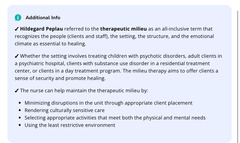
C. An emphasis of this therapy is the setting, the structure, and the emotional climate being important to the client's healing.
Choice C is correct. The cornerstone of milieu therapy is to provide an all-inclusive (staff and clients) structured environment that fosters routine, safety, and acceptance. This environment enables healing and promotes positive outcomes.
The nurse is preparing a staff development conference on milieu therapy.
Which of the following information should the nurse include?
A. This type of environment is established in inpatient treatment facilities, emphasizing physical well-beling
B. This therapy primarily focuses on helping clients develop emotional connections with individuals in the community.
C. An emphasis of this therapy is the setting, the structure, and the emotional climate being important to the client's healing.
D. The approach to milieu therapy is unstructured and allows clients to self-regulate what they feel should be allowed.
A. This approach helps support self-esteem.
B. This is an effective intervention in a group setting.
E. Reminiscing is a way to express personal identity
The nurse is teaching a group of students about using reminiscence therapy. Which statements should the nurse include in the teaching? Select all that apply.
A. This approach helps support self-esteem.
B. This is an effective intervention in a group setting.
C. This intervention focuses on looking forward.
D. Establishing future goals is important part of this intervention.
E. Reminiscing is a way to express personal identity

All of the above expect B.
The nurse is teaching a group of students about the concept of a crisis. It would be appropriate for the nurse to state that a crisis Select all that apply.
A. can be triggered by an external event, such as a natural disaster.
B. maintains homeostasis or equilibrium.
C. is a disturbance caused by a stressful event or threat.
D. causes normal coping mechanisms to fail.
E. may exacerbate concurrent medical and psychiatric disorders.
