Ch 4: Cell Injury, Aging, and Death
 Call Kai
 Learn
Learn Practice Test
 Spaced Repetition
 Match
Match Flashcards
 Knowt Play
1/119

There's no tags or description
Looks like no tags are added yet.
Name | Mastery | Learn | Test | Matching | Spaced | Call with Kai | Chat |
|---|
No analytics yet
Send a link to your students to track their progress
120 Terms
What does healing depend on?
Where the injury takes place and how serious the injury is
What three kinds of cells help repair damaged tissue?
Fibroblasts, endothelial cells, and myofibroblasts
What do fibroblasts do?
Produce collagen and connective tissue
What does the collagen and connective tissue produced by fibroblasts do?
It helps provide strength and structure to the healing tissue
What do endothelial cells do?
Help form new blood vessels
Why are new blood vessels important for healing?
They bring oxygen and nutrients to the damaged tissue, which supports tissue repair
What do myofibroblasts do?
Contract and pull damaged tissue together
Where do myofibroblasts develop?
On the edge of a wound
How do myofibroblasts help close a wound?
When myofibroblasts contract, they pull the damaged tissue together, which helps close the wound
What is an exudate?
A fluid that leaks out of blood vessels and into the affected tissue during inflammation or injury
What can inflammatory exudate transport to the affected area?
leukocytes (WBCs), antibodies, and nutrients
How can exudate help with harmful substances?
The fluid can dilute harmful substances in the affected area
What does serous exudate look like?
Thin, Clear, and watery
Serous exudate has little ________ in it:
Protein
Which exudate is commonly seen during mild inflammation?
Serous exudate
The contents of a blister are an example of a _________ exudate:
Serous
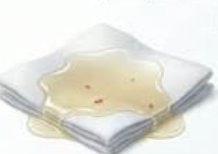
Name this exudate:
Serous
What does serosanguineous exudate look like?
Serous exudate mixed with a little bit of blood

Name this exudate:
Serosanguineous
What does fibrinous exudate look like?
Sticky
Fibrinous exudate is __________ because it has more ________ than serous exudate:
Sticky; protein

Name this exudate:
Fibrinous
What kind of exudate is commonly found from bigger injuries?
Fibrinous exudate
What needs to happen to fibrinous exudate for the wound to heal?
The fibrinous exudate must be cleaned or removed
What does purulent exudate look like?
thick, yellowish/brownish pus
What is purulent exudate made of?
Neutrophils, protein, and tissue debris
Which exudate indicates a severe bacterial infection?
Purulent exudate
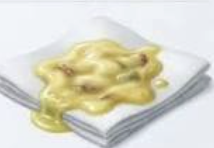
Name this exudate:
Purulent
What does hemorrhagic exudate look like?
Exudate with a large amount of blood
Which exudate occurs due to a severe leak or breakdown of blood vessels?
Hemorrhagic

Name this exudate:
Hemorrhagic
IgG antibody = ___________
General/Most common antibody
IgM antibody = ___________
First antibody made during a new infection
IgA antibody = ___________
Areas with secretions, found mainly in mucus, saliva, tears & breast milk
IgD antibody = ___________
B-cell development, found on B cells and helps with their activation
IgE antibody = ___________
Involved in allergic reactions and also helps defend against parasites/worms
Cells can swell, collect substances, shrink, get bigger, or increase in number when the body ______ or is under ______:
Changes; stress
What is hydropic swelling?
When a cell fills with too much water and swells up
Why does hydropic swelling happen?
When a cell gets injured and cannot properly control the amount of water inside it, too much water may enter and cause the cell to swell
What are intracellular accumulations?
When substances build up inside the cell that should not be there in large amounts
Fat building up inside of a cell is an example of ___________________:
Intracellular accumulation
What happens when too much fat builds up inside a cell?
An intracellular accumulation occurs and can injure the cell
What is atrophy?
When a cell shrinks and does not function as well
What two things can cause cell atrophy?
Disuse or ischemia
f you stop using your leg because it is in a cast, the muscles are not being used, so the muscle cells _________, which is called ________:
Shrink; atrophy
When a cell does not get enough _______ and ________, it can cause the cell to shrink, which is called __________:
Blood and oxygen; atrophy
Less work & not enough blood/oxygen = cells get _______
Smaller
What is hypertrophy?
An increase in cell mass
What happens to cells during hypertrophy?
They become larger
You lift weights which means your muscles have to work harder, this helps the muscle cells grow _______, which is called _________:
Larger; hypertrophy
If the heart has to work harder for a long time, its muscle cells can become ________, which is called ___________:
Larger; hypertrophy
More work/ heavy workload = cells get ________
Bigger
What is hyperplasia?
An increase in the number of cells
What happens during hyperplasia?
The body makes additional cells
How does hyperplasia happen?
Cells divide and make more cells
When your skin gets injured, your body needs ________ to repair the area, so cells divide and make more cells, which is called _______:
More cells; Hyperplasia
What is metaplasia?
A change in which one mature, differentiated cell type is replaced by another cell type
Why does metaplasia occur?
When the new cell type is better able to tolerate a chronic irritation or stressor
Is metaplasia reversible?
Yes
Long-term smoking can irritate the bronchial airways and cause the normal cells to change into a different type of cell that can better tolerate the irritation. This is called ________:
Metaplasia
What can happen to cells if the irritation causing metaplasia stops?
The cells may change back to their original cell type
What is dysplasia?
An abnormal and disorganized growth of cells
How can cells look during dysplasia?
The cells may vary in size, shape, and arrangement
Can mild dysplasia go away?
Yes
What can happen if severe dysplasia is untreated?
It can potentially progress toward cancer
Cervical _________ occurs when cells on the cervix begin to grow abnormally, causing the tissue to become disorganized:
Dysplasia
What is irreversible cell injury?
Irreversible cell injury is when a cell is damaged so severely that it cannot recover and will eventually die
What are the two types of irreversible cell injury?
Necrosis and apoptosis
What is necrosis?
Uncontrolled cell death
During necrosis, a cell gets damaged and dies ___________ usually die to a severe injury:
Unexpectedly
A blood vessel supplying the heart becomes blocked, therefore heart cells don’t receive enough _________. Eventually, the cell ______.
Oxygen; dies
What is apoptosis?
planned, programmed, controlled cell death
What happens during apoptosis?
The cell receives signals telling it that it should die in an organized way
During apoptosis, the cell breaks _______ down:
Itself
Why is apoptosis important?
It is a normal process that helps remove old, damaged, or unnecessary cells
Is necrosis controlled or uncontrolled?
Uncontrolled
Is apoptosis controlled or uncontrolled?
Controlled
What is ischemia?
not enough blood flow to a tissue
What is hypoxia?
not enough oxygen reaching the cells
Why do cells need oxygen?
to make ATP
What is a cells main source of energy?
ATP
Without enough oxygen, cells cannot make enough _______, which causes cell injury:
ATP
A blood vessel becomes blocked > _______ cannot reach the cells > the cells do not get enough _________ > cell injury:
Blood; oxygen
What is reperfusion?
When blood flow returns to an area after being blocked
Reperfusion injury occurs when resorting ____________ to an area after a blockage actually causes additional cell damage:
Blood flow
Infections like _______ and _______ can damage cells/ cause cell injury:
bacterial; viral
How do bacteria usually damage cells?
From outside
How can viruses damage cells?
From within by entering the cell and using the cell's machinery to reproduce inside the cell
Cells need the right amount of _________ to function properly. Cell injury can happen from not having enough, or having too much.
nutrients
What is immunologic injury?
when the immune system, which is supposed to protect the body, causes damage to the body's own cells
What is chemical injury?
When certain chemicals directly injure or kill cells
How can physical and mechanical forces cause cell injury?
Cells can be damaged by physical forces or trauma
What are examples of physical and mechanical injuries?
Cold, cuts, crushing, blows, electricity, and radiation
As we age, cells gradually become less able to _______, _________, and ____________:
Grow, repair themselves, and recover from damage
As we get older, cells become less able to ___________ (proliferate):
Reproduce
Throughout our life, cells have been exposed to ____________ that cause damage over time like sunlight and polluion:
Environmental factors
What is somatic death?
The death of the entire person or organism
Somatic death means the whole ______ has died:
Body
What is rigor mortis?
When the muscles become stiff after death
After death, the muscles can no longer properly produce/use ________ needed for normal muscle relaxation, so they become stiff and rigid.
Energy