biomedhanics so far
 Call Kai
 Learn
Learn Practice Test
 Spaced Repetition
 Match
Match Flashcards
 Knowt Play
1/74

There's no tags or description
Looks like no tags are added yet.
Name | Mastery | Learn | Test | Matching | Spaced | Call with Kai | Chat |
|---|
No analytics yet
Send a link to your students to track their progress
75 Terms
how does height of COM affect stability?
Lower centre of mass, greater stability
how does base of support affect stability?
the wider the base, the greater the stability
what is the line of gravity and how does it effect stability?
an imaginary line which extends down from the centre of mass to the floor
keeping line of gravity within the base of support helps maintain stability
what is stability able to withstand?
external forces
what are 4 factors that affect stability?
mass of the body
height of centre of mass
base of support
line of gravity
how does mass affect stability?
the greater the mass, the greater the inertia, so the more stable it is
explain how high jumpers use COM and stability to their advantage?
Curved run-up creates angular momentum for rotation.
At take-off, arms drive upwards to raise the centre of mass (CoM) and increase vertical lift.
The athlete rotates so their back faces the bar and arches into the Fosbury flop shape.
This curved body position moves the CoM to below the body, so the CoM can pass at or below the bar while the body clears it.
This makes the jump more efficient and increases the chance of clearing a greater height.
what is stability?
the ability of a body to resist motion and remain at rest
what is the centre of mass?
the point at which a body is balanced in all directions
what does centre of mass rely on?
the distribution of the body mass
can be manipulated to improve performance
what is a sporting example of a footballer using COM for performance?
footballer will raise hands above head when jumping for header to raise COM to enable them to jump higher and remain in air for longer
example of how starting on blocks to running race using COM and stability to advantage
Crouch position (“on your marks”)
Large base of support
Low COM
Line of gravity within base of support
Stable position → helps balance/control
Set position
Hips raised → COM higher
Base of support effectively smaller
Line of gravity near/outside front of base
Unstable position → allows quick acceleration
Drive/run phase
Line of gravity outside base of support
COM pushed forwards
Very unstable → maximises forward acceleration out of blocks
what are the 3 most common ways of analysing performance?
limb kinematics
force plates
wind tunnels
what is limb kinematics?
Method of analysing movement of body segments when performing a task
Usually takes place in lab
High speed cameras and computer software capture the movement of an athlete who is wearing motion capture material
what are force plates?
Work by measuring the amount of force that is applied to the ground when an action is performed on them
Can be used to study: balance, walking gait, jumping, movement etc.
Different types of force plates (in floor, on bar etc.)
what are wind tunnels?
Sports that are effected by wind tunnels are affected by air resistance so can use wind tunnels to try minimise impact by studying how air moves over object
Uses sensors and airflow vision (e.g. smoke or lasers) to analyse aerodynamic efficacy
what are some pros of using limb kinematics to analyse performance?
Improves performance analysis
Good for technique analysis
Non-invasive and safe
Good for injury prevention (can identify dangerous technique etc)
what are some cons of using limb kinematics to analyse performance?
Has to be done in a lab
Specialist equipment required
Doesn’t show forces
what are some pros of using force plates to analyse performance?
Accurate measure of force
Good for assessing power
Helps identify injury risk
Good at assessing force imbalances
Can asses best techniques to produce most force
what are some cons of using force plates to analyse performance?
Very expensive
Requires technical expertise
Limited to specific movements (e.g. jumps and landings not sprinting, changing direction etc.)
lab style
what are some pros of using wind tunnels to analyse performance?
Good for analysing aerodynamics
Can improve technique to improve aerodynamic and so enhance performance
Allows for equipment to be tested so the best can be used (e.g. helmets, bike frames etc.)
what are some cons of using wind tunnels to analyse performance?
Very expensive
Requires specialist staff
Time consuming set up
Unrealistic - not on a track etc.
what are some sports that may use limb kinematics to analyse performance?
Running
Gymnastics
Football
100m sprinter might use limb kinematics to check their "knee lift" height. If the data shows their knee isn't reaching the optimal angle, they can adjust their technique to gain more power in each stride
what are some sports that may use force plates to analyse performance?
Basketball
A netball player can use a force plate to see if they are pushing off equally with both legs during a jump. If the data shows the left leg is weaker, the coach can create a specific gym program to balance them out.
what are some sports that may use wind tunnels to analyse performance?
Cycling - A cyclist might test different "tuck" positions to see which one creates the least resistance.
Luge
Engineers use tunnels to design "slippery" helmets, skin-tight suits, and bike frames that slice through the air more easily.
what does force create?
motion
what are the 5 effects of force?
Create motion
Accelerate a body
Decelerate a body
Change direction of a body
Change shape of a body
what are some sporting examples to show a force that can:
decclerate an object
create motion
change the shape of a body
change the direction of a body
accelerate a body
|
|
|
|
|
what is a net force?
the sum of all forces acting on the body
what are the 2 types of forces?
internal
external
what are internal forces?
Produced by things inside of you
Produced by muscular contractions acting on the skeleton
e.g. rectus femoris to extend the knee in the 100m sprint
what are external forces?
Produced by things outside the body
e.g. weight, reaction, friction, air resistance
what is friction?
the force that opposes the motion of two surfaces in contact
what is friction measured in?
Newtons
what are some factors that affect friction?
Roughness of the surfaces in contact
Temperature if the surfaces in contact
Size of normal reaction
what type of force is air resistance?
a horizontal force
what is air resistance?
the force that opposes the motion of a body travelling through the air
what is air resistance measured in?
Newtons
what factors is air resistance effected by? (4)
the velocity of the body
shape of the body
frontal cross-sectional area
smoothness of the surface
what is an example of how sports performers adapt themselves and their equipment to reduce air resistance?
the luge performer lies as flat as possible to reduces frontal cross section and wears smooth clothing to reduce air resistance
In sports like sailing or paragliding the larger the cross-sectional area the better
what is a free body diagram?
A free body diagram is a simple drawing used in biomechanics to show:
An object or body
All the forces acting on it
The direction and sometimes the size of those forces
They help analyse movement in sport

which way does friction go normally when you are running or walking?
forwards
what is the force that pushes you off the floor and up?
reaction
what is the centre of mass?
the point at which a body is balanced in all directions
what does centre of mass rely on?
the distribution of the body mass and can be manipulated to improve performance
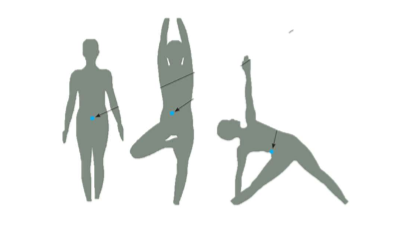
what is an example of how a performer may manipulate their centre of mass to enhance performance?
a footballer will raise their hands above their head when jumping for a header to raise the centre of mass to enable them to jump higher and remain in the air for longer
what is stability?
the ability of a body to resist motion and remain at rest
ability to withstand forces
what are some factors that effect stability? (4)
Mass of the body - the greater the mass of the inertia
Height of the centre of mass - the lower the centre of mass the greater the stability
Base of support - the wider the base of support the greater the stability
Line of gravity - is an imaginary line which extends down from the centre of mass to the floor, keeping the line of the gravity within the base of support to maintain stability

why does the mass of the body affect stability?
the greater the mass, the greater the inertia
why does the height of the centre of mass affect stability?
the lower the centre of mass the greater the stability
why does the base support affect stability?
the wider the base of support the greater the stability
why does the line of gravity affect stability?
Line of gravity is an imaginary line which extends down from the centre of mass to the floor, keeping the line of the gravity within the base of support to maintain stability
what is the general name of Newtons first law?
Law of inertia
what is the general name of Newtons second law?
Law of acceleration
what is the general name for Newtons third law?
Law of reaction
what is Newtons first law?
A body continues in a state of rest or uniform velocity unless acted upon by an external or unbalanced force
what is inertia?
the resistance an object has to change its state of motion.
The larger the object the greater the mass if the object the greater the inertia
what are some sporting examples where Newtons first law applies?
A golf ball will remain stationary on a tee with gravity acting upon it, until the golf applies an external force to it
A tennis ball will remain stationary in your hand unless someone throws it up applying an external force
A penalty in football where the ball will remain stationary unless someone applies an external force (e.g. kicking it)
what is Newtons second law?
A body's rate of change of momentum is proportional to the size of force applied and acts in the same direction as that force
how can Newtons second law be explained?
The quantity of motion is known as momentum and is related to acceleration.
This means that the acceleration is proportional to the size of force applied
what are some sporting examples where Newtons second law applies?
The harder to golfer hits the ball and the larger the mass of the club, the further the ball will travel
The harder the footballer strikes and the larger the mass of the player, the further the ball will travel
what is Newtons 3rd law?
For every action force applied to an object, there is an equal and opposite reactions
The action force is applied as the muscles cause the skeletal system to apply force to the ground or surface involved, the surface will then apply the same force back onto the skeleton to create movement in the opposite direction
what are some sporting examples where Newtons 3rd law applies?
The swimmer pushes against the wall in a tumble-turn and the wall applies the force back to the swimmer who moves in the opposite of the action force
When a tennis player hits a ball back the ball hits the racket and moves the ball in the opposite direction
within Newtons laws there are 4 key concepts which can be calculated to get the quantities of force and movement achieved. what are these 4 things?
Velocity
Momentum
Acceleration
Force
what is velocity?
the rate of change of displacement
what is momentum?
the quantity of motion possessed by a moving body
what is momentum measured in?
Kilograms metres per second (kgm/s)
what is the equation for momentum?
momentum = mass x velocity
what is acceleration?
the rate of change in velocity
what is the equation for acceleration?
Acceleration = (final velocity - initial velocity) / time taken
what is acceleration measured in?
Measured in metres per second per second (metres per second squared) (m/s/s)(m/s^2)
what is velocity measured in?
metres per second
what is force?
a push or pull that alters the state of motion of an object
what is the equation for force?
force = mass x acceleration
what is force measured in?
Newtons