9-4 Action Potentials
 Call Kai
 Learn
 Practice Test
 Spaced Repetition
 Match
 Flashcards
 Knowt Play
1/33

There's no tags or description
Looks like no tags are added yet.
34 Terms
1865 Julius Bernstein
when and who discovered the action potential recorded from frog nerves and called it the “negative variation”? this was before neuron staining and before Na/K pump identified (first action potential recorded in squid)
yes
are all cells polarized?
polarized
what does it mean to have a positive or negative charge?
negative
neuron membranes have a relatively what charge at rest?
when ions pass through the cell
when do charges change?
action potential
what is it called when neurons can alter polarization for a brief period of time?
stimulus, depolarization, action potential, repolarization, refractory period, resting state
process of action potential
refractory period
what happens at the end of an action potential to get back to baseline?
sodium
what does depolarization involve?
potassium
what does repolarization involve?
40
at what mV do the voltage gates close?
stimulus (something happens)
depolarization of cell membrane (voltage gets closer to 0mV)
if -55mV threshold is reached, voltage gated sodium channels open and an action potential will happen
In the rising (depolarization phase), Na+ floods into the cell through voltage gated Na+ channels
at +40mV, the voltage gated Na+ channels close
voltage gated K+ channels open, and K+ flows out of the cell (repolarization)
Because K+ ion channels are sluggish, the neuron is briefly hyperpolarized (refractory period)
to return back to resting potential, neuron uses sodium/potassium pumps (3 Na+ out/K+ in)
steps of action potential
myelinated, larger
action potentials move faster when axons are ___ and ____
saltatory conduction
what does myelin help with?
Na+ channels
myelinated axons don’t have _____ between nodes of ranvier
at exposed nodes of ranvier
where are Na+ channels located on axon?

unmyelinated axon
what axon takes a lot longer to reach axon terminal?
the action potential cannot travel continuously along axon, it jumps from one node to the next, which increases signal speed and consrves energy.
how does myeline help with saltatory conduction?
from axon hillock to axon to axon terminal
how does action potential travel?
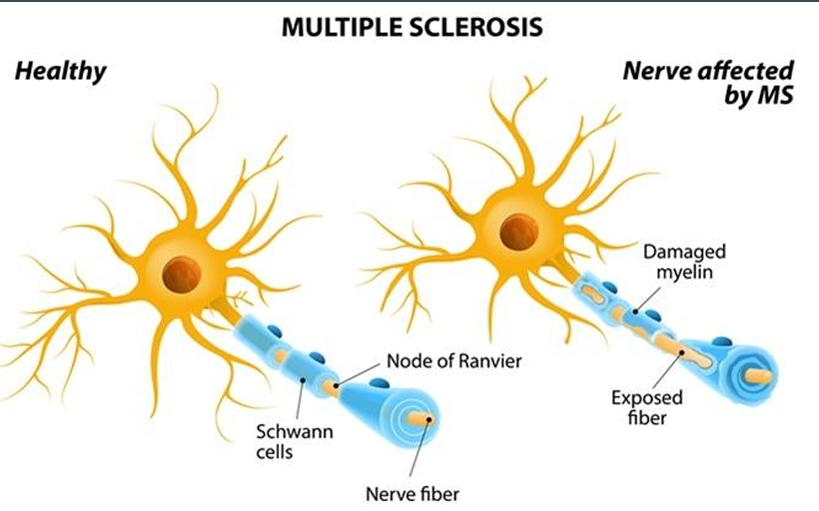
multiple sclerosis
disorder where immune system attacks and damages myelin sheath, and without myelination, electrical signals slow down, scramble or stop completely leading to trouble walking, balance issues, muscle weakness. damaged issues develop scar like tissues called sclerosis, over time the nerve fibers can be injured or destroyed.

influx of Na+ ions
cell membrane depolarizes
voltage gated Ca2+ channels activate
Ca2+ flows into terminal
intracellular Ca2+ activates process that leads to neurotransmitter release
neurotransmitter molecules float in synaptic cleft (some bind to ligand channels, some bind to other receptors)
ligand channels allow ions to flow in/out of post synaptic cell (will change membrane potential of post synaptic
what happens at axon terminal?
synaptic cleft
microscopic space between two neurons
action potential reaches axon terminal, neurotransmitter is released from vesicles, neurotransmitter molecules diffuse into synaptic cleft
what happens during synaptic transmission?
key
in synaptic transmission, neurotransmitters become the ___ to open ligand gated ion channels which allow ions to flow into the post synaptic neuron
excitatory, inhibitory
synaptic transmission can be ____ or _____
excitatory synaptic transmission
action potentials from neuron A cause more action potentials in neuron B
inhibitory synaptic transmission
action potentials from neuron A suppress action potentials in neuron B
the neurotransmitter
what tells the transmission to be excitatory or inhibitory?
acetylcholine
neurotransmitter with excitatory actions that helps the brain encode new info, form memories, and maintain working memory (helps with attention, arousal, and filtering background noise)
donepezil, botox
drugs that affect acetylcholine (used to treat alzheimer’s disease - more excitation) and (release of Ach from presynaptic motor neurons (less excitation)
more
more excitation = ____ possibilities for memories or new information
GABA
neurotransmitter with inhibitory actions
reduces nerve cell hyperactivity (controls fear, stress, anxiety)
what does GABA do?
valium (anxiety - increases inhibition), klonopin (treats seizures, panic disorder, anxiety - increases inhibition)
drugs that act on GABA receptors