PHYSICS ELECTRICAL CHARGE TRANSFER
 Call Kai
 Learn
 Practice Test
 Spaced Repetition
 Match
 Flashcards
 Knowt Play
1/29

There's no tags or description
Looks like no tags are added yet.
30 Terms
Quantised
when charge only exists in dicreate specific amounts
current
rate of flow of electrical charge (amps)
kirchoff first law
total current entering junction same as total current leaving junction (current must be same everywhere in series circuit)
what else can transfer charge
ions - in molten or liquid solutions
series circuit
current same, pd added, resistance added
parallel circuit
current added, pd same, resistance decrease and number of branch increase
PD
energy transfer per unit of charge
ohm law
electrical current flowing through a conductor is directly proportional to the voltage applied across it and inversely proportional to its resistance
metallic bonding
sea of delocalise electrons
thermionic emmission
filament wire need high melting point to “boil off” electrons. If big enough pd in anode, the electrons will shoot across through anode at constant speed ganing kinetic energy
drift velocity
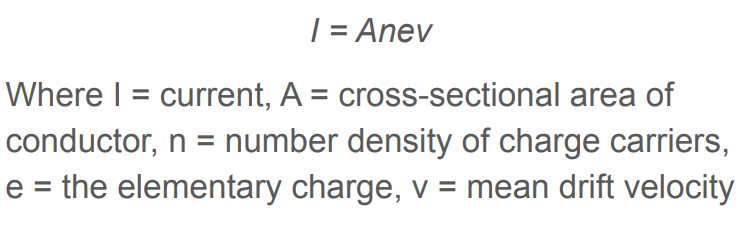
speed of electrons travelling through conductor ((average velocity of charge carriers due to applied electric field) - average because they often moving randomly in all directions)
electromotive force
energy transfer from chemical to electrical charge
in electricity what does ‘e’ represent? what are the units?
‘e’ - elementary charge (coulombs)
example of charge carriers
electrons - in metal, ions - in aqueous solutions (electrolytes)
which way current flow
positive to negative - it is in opposite direction to movement of electrons in circuit
what equation uses drift velocity to calculate current?
I = Anev