Case 11: Martin Barratt - CKD + ADPKD
 Call Kai
 Learn
 Practice Test
 Spaced Repetition
 Match
 Flashcards
 Knowt Play
1/30

There's no tags or description
Looks like no tags are added yet.
31 Terms
Chronic Kidney Disease (CKD): Description
Abnormal kidney structure/function persisting for > 3 months
Acute on CKD
Acute worsening renal function in patients with preexisting CKD
High risk for renal failure
CKD: Epidemiology
Risk factors…
Older age
NSAID/nephrotoxic drug use
Overweight/obese
Comorbidities:
Previous AKI
HTN
Proteinuria
Diabetes
CVD
CKD: Etiology
Diabetes mellitus
HTN
Glomerulonephritis
Polycystic kidney disease
Analgesic misuse
CKD: Pathogenesis
Nephron loss and damage from:
Glomerulonephritis: Inflammation
Diabetic and Hypertensive Nephropathy: Hypertrophy → Decreased RBF and ischemia
Older Age: Natural aging or surgery
Decreased renal function = Low GFR
Low urine production = Volume overload + Decreased waste and phosphate excretion
Decreased maintenance of acid-base and electrolyte balance = Metabolic acidosis and electrolyte imbalances
Reduced endocrine activity
Decreased calcitriol production + Decreased phosphate excretion = Low serum Ca2+ = Increased PTH
Decreased erythropoietin = Decreased erythropoiesis = Low RBC
CKD: Clinical Presentation
Asymptomatic until later stages
Na+/water retention
HTN
HF
Edema
Uremia
Constitutional
Fatigue
Weakness
GI
Nausea
Vomiting
Appetite loss
Derm
Puritus
Serositis (serous inflammation)
Uremic pericarditis
Neurological
Seizures
Coma
Hematologic
Anemia
Increased infections
CKD: Investigations
Blood test
Urinalysis
Imaging
CKD: Blood Test
Assess eGFR
< 60 mL/min/1.72m²
High creatinine
High cystatin C (enzyme inhibiting cysteine proteinases)
High BUN
High bleeding time
CKD: Urinalysis
Proteinuria
Urine ACR > 3 mg/mmol
Waxy casts
CKD: Imaging
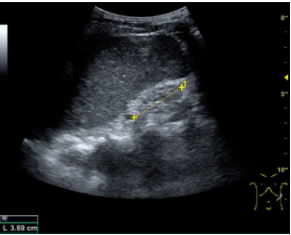
Ultrasound
Decreased kidney length
Decreased parenchymal and cortical thickness
Increased cortical echogenicity (whiteness)
Cysts
CKD: Treatment/Management
Diet changes
Pharmacotherapy
RRT
CKD Management: Diet
Low Na+, K+, phosphate
Manage hyperkalemia and renal metabolic bone disease (high PTH)
Vit D supplements
CKD Management: Pharmacotherapy
Avoid nephrotoxic drugs (NSAISs, metformin if eGFR < 45)
RAAS inhibitors (ACE inhibitors, ARBs)
Manage HTN
Decrease proteinuria
Statins
Decrease lipids = Decrease CVD risk
CKD: Complications
Anemia
Low erythropoietin synthesis = Decrease RBC production = Anemia
Treatment: Erythropoietin-stimulating agents + iron replacement therapy
Mineral and bone disorders
Decreased renal phosphate excretion = Increased blood phosphate = Ca2+ phosphate precipitation in tissues = Hypocalcemia
Decreased renal hydroxylation of vit D = Low intestinal Ca2+ absorption = Hypocalcemia
Treatment: Normalize phosphate, Ca2+, and PTH
RRT: Conservative Care
Delayed CKD progression + minimize complications without RRT
Includes…
Pain management
Treat complications
Diet changes
Indications:
Older patients with high comorbidities and low functional status
Low survival with dialysis
Autosomal Dominant Inheritance
Inheritance pattern requiring 1 allele from nonsex chromosome for phenotypic expression
Variable expression
Autosomal Dominant Inheritance: Pedigree
1 Heterozygous Parent: 50% chance of inheriting trait
2 Heterozygous Parent: 75% chance of inheriting trait
1 Homozygous Parent: 100% chance of inheriting trait
Autosomal Dominance Inheritance: Penetrance
Proportion of individuals with genotype manifesting specific phenotype
Complete: Phenotype expressed in all carriers of gene
Incomplete: Phenotype expression not observed in all individuals
Autosomal Dominant Inheritance: Expression
Extent phenotype manifesting in individuals carrying specific genotype
Variable: Different phenotype (sign, symptoms, severity) with genotype
Autosomal Dominant Polycystic Kidney Disease (ADPKD): Description
Hereditary disease causing multiple cysts in kidney = Enlarge/distort kidney = CKD
ADPKD: Epidemiology
Most common cause of inherited CKD
ADPKD: Etiology
Gene mutation in…
PKD1: Early onset, more severe
PKD2: Later onset
ADPKD: Pathogenesis
PKD1/2 mutation = Dysfunction in membrane proteins (polycystin-1/2) = Cystogenesis (cyst expansion)
Compress normal nephrons = Decrease function
Initially: Normal renal function from functioning nephrons compensating with hyperfiltration
Stable eGFR
Over Time: Renal impairment from compensation failure
HTN from:
Renal ischemia
Increased renin and aldosterone
Endothelial dysfunction
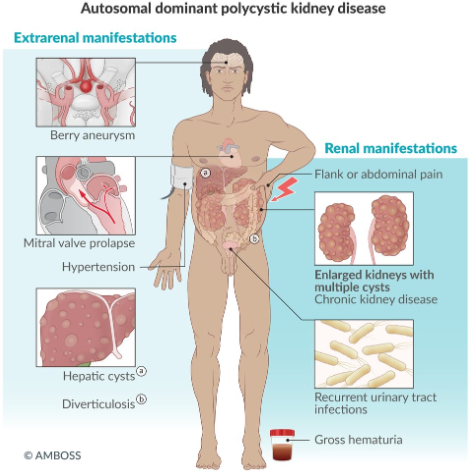
ADPKD: Clinical Presentation
Hematuria
Flank/abdominal pain
Recurrent UTIs
Large/palpable kidneys
HTN
Mitral valve prolapse
Hepatic cysts
Intracranial aneurysm
ADPKD: Investigations
Imaging
Genetic testing
ADPKD: Imaging
Ultrasound
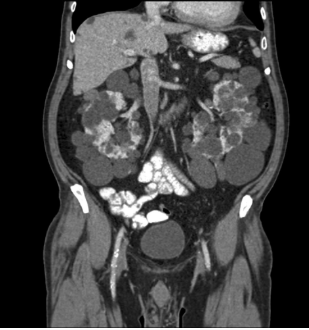
Abdominal MRI or CT
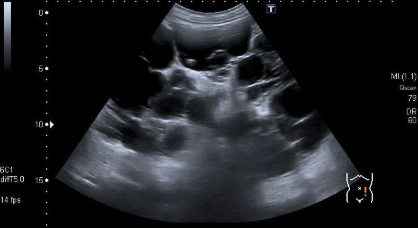
ADPKD Imaging: Ultrasound
≥ 2-3 renal cysts
Bilateral
Varying sizes
Bilateral renal enlargement
Hepatic, pancreatic, splenic cysts
ADPKD Imaging: Abdominal MRI or CT
If ultrasound unclear
ADPKD: Genetic Testing
Not routine
Confirm etiology
ADPKD: Treatment/Management
ACE inhibitors or ARBs
Treat HTN and proteinuria
Slow GFR decline
Avoid nephrotoxic substances
*Tolvaptan: Vasopressin 2 receptor antagonist
Increase water excretion
Slow cyst progression and GFR decline
Kidney transplant
ADPKD: Complications
Renal
Hematuria
Nephrolithiasis
Renal failure
Coronary artery aneurysm
Fractures
Erectile dysfunction
Low NO bioavailability = Vasoconstriction = Low O2 delivery to penile tissues