Genetics - Chapter 8 - Variation in Chromosome Number and Structure
 Call Kai
 Learn
 Practice Test
 Spaced Repetition
 Match
 Flashcards
 Knowt Play
1/31

There's no tags or description
Looks like no tags are added yet.
Name | Mastery | Learn | Test | Matching | Spaced | Call with Kai | Chat |
|---|
No analytics yet
Send a link to your students to track their progress
32 Terms
Euploidy
The condition of having an integral number of sets of chromosomes
Most organisms are diploid (two sets), with variation from haploid, monoploid (one set) to octoploid (eight sets) in plants and animals
Aneuploidy
The condition of not having an integral number of sets of chromosomes (ex. 2n + 1)
Aneuploidy occurs when a chromosome but not a complete set is lost (monosomy, nullisomy) or gained (trisomy, etc
Termination for variation in chromosome numbers

Euploidy
Complete sets of chomosomes are present
the number of chromosomes in a set is called the haploid number and is represented by an x
The number of chromosomes in a gamete is presented by n; this value may be the same or different as x
In diploids, x = n
In polyploids, x =/= n
The numbers of sets can vary from one set (haploid) to two sets (diploid) to more than two sets (polyploid)
Haploids
Organisms with one set of chromosomes
ex. plants alternate between haploid (gametophyte) and diploid phases (sporophyte)
There is mitotic cell division in haploid cells
Microbes (yeasts) like C. glabrata
In primative plants, the haploid phase may be free living
Polyploidy
Occurs when more than two sets of chromosomes are present
ex. triploid, three sets
Bananas, seedless, watermelons, commercial oysters
12-15% of spontaneous abortions in humans due to triploidy, ¾ of these have 2 paternal sets of chromosomes
Triploids
Have three sets of chromosomes
Can arise in multiple ways
Fertilization of an abnormal diploid gamete with a haploid gamete
Fertilization of an egg by two haploid sperm
Crossing a diploid with a tetraploid
Diploids produce haploid gametes (n) and tetraploids produce diploid gametes (2n); fertilization would generate a triploid
THEY ARE STERILE
An odd number of homologous chromosomes cannot synapse properly during meiosis
They will not segregate properly and the developing gametes will not have an integral number of sets of chromosomes
Pairing possibilities and separation in anaphase I of meiosis
If meiosis I can move to anaphase, there would be massively uneven chromosome segregation (each univalent can migrate to either pole, randomly) All gametes have multiple n+1 aneuploidies

Autopolyploidy
2 sets of identical chromosomes from the same species can synapse during meiosis, chromosomes are homologous
Auto = self = same species
Allopolyploidy
2 sets of similar, but not identical chromosomes from different but related species, hybrids formed by interspecies mating cannot synapse during meiosis, chromosomes are homeologous
Allo = other = different species
Differences between autopolyploidy and allopolyploidy

Differences between autopolyploidy and allopolyploidy
Genome doubling (WGD) is a rare mistake
A catastrophic event due to whole genome non-disjuncture; disruption to the microtubule network that separates chromosomes at anaphase
This may be more common in plants than in animals

Tetraploids
Can have a regular meiosis
Because there is an even number of chromosomes, each one can pair with a homologue
However, in autotetraploids – because there are 4 identical chromosomes – there can be unusual chromosome pairings during synapsis
Can generate two bivalents as well as a trivalent + univalent.
Because of the missegregation of chromosomes, autotetraploids have reduced fertility
In allotetraploids (amphidiploids), there is only one way to generate homologous pairs between identical members.
Identical chromosomes are “homologous” whereas similar ones are termed “homeologous”
Amphidiploids are more fertile than autotetraploids
Pairing possibilities and separation in anahase I of meiosis

How do we get tetraploids?
An allotetraploid arises from hybridization of two closely-related diploid species.
Hybridization is the cross between two species. Generally the hybrid is sterile
If the sterile hybrid undergoes a natural chromosomal doubling, a fertile amphidiploid is produced
Amphidiploid plants can be produced by somatic cell hybridization.
ex: triticale wheat is a hybrid of wheat and rye that combines favorable characteristics from both crops

Other polyploids
Other polyploids, (penta-, hexa-, etc.) are generated by the same mechanisms discussed above for triploids and tetraploids and would have the same issues with fertility.
Formation of polyploids is a major force in plant speciation
There are animal polyploids (e.g. amphibians, fish (e.g., salmon), reptiles, flatworms, brine shrimp, leeches)
Endopolyploidy
The condition in which only certain cells or tissues in an otherwise diploid organism are polyploid
In these cells, replication and segregation of chromosomes occur without nuclear division
Ex.
cells of the human liver can be 4n (tetaploid), 8n (octoploid) or more
the polytene chromosomes found in the salivary glands of some insects have >2000 copies aligned side-by-side in register
Aneuploidy
The condition of having more or fewer chromosomes than in an integral number of chromosome sets
The loss of one chromosome to produce a 2n – 1 complement is called monosomy.
The loss of two members of an homologous pair of chromosomes to produce a 2n – 2 complement is called nullisomy.
The gain of one chromosome to produce a 2n + 1 complement is called trisomy.
Aneuploidy can occur in…
Meiosis, leading to genetic disorders upon fertilization. All organs in the body are affected; problems in developmental pathways.
Mitosis, leading to cancer. Cellular overgrowth.

Mistakes in meiosis
Nondisjunction is a cell division error in which homologous chromosomes or the sister chromatids fail to separate and migrate to opposite poles.
Nondisjunction can occur during meiosis I or II.
Failure to crossover or crossovers too close to (or too far away from) the centromere
Loss of sister chromatid cohesion
Defects in spindle assembly/disassembly
This leads to gametes with abnormal numbers of chromosomes and can lead to abnormal offspring after fertilization.
Human monosomy
Monosomy for any of the autosomes is not tolerated in humans and other animals
Monosomic gametes themselves may be very functionally impaired
Monosomy for the X chromosome occurs in humans
Turner syndrom, X0
This is the only human monosomy that survives
Trisomy
Trisomy (2n + 1 chromosomes)
Trisomy for the sex chromosomes has a less dramatic phenotype than trisomies for autosomes, which are often lethal.
XXX, XXY (Kleinfelter syndrome), XYY
Trisomy for the autosomes leads to
Down syndrome (trisomy 21), Patau syndrome (trisomy 13), Edward syndrome (trisomy 18)
In trisomy, three copies of one chromosome are present, so pairing configurations in meiosis are usually irregular.
At any particular region along the chromosome length, only two of the three homologs may synapse, though different regions of the trio may be paired
Down syndrome
Nondisjunction of the maternal chromosome 21 during meiosis.
Nondisjunction shows an increased incidence with increasing maternal age.
Most trisomies are due to material meiotic errors; maternal age affects some of these errors.
The first meiotic division begins in the fetal ovary but isn’t completed until ovulation(!); a pregnant woman can affect her grandchildren’s phenotypes
Aneuploidies in Cancer
Aneuploidy is consistently observed in virtually all cancers. Some examples:
trisomy 12 in chronic lymphocytic leukemia (CLL)
trisomy 8 in acute myeloid leukemia (AML).
Alteration of normal mitotic checkpoints are also important tumorigenic events, and these may directly lead to aneuploidy.
Loss of p53 creates genomic instability that most often results in the aneuploidy genotype.
Genetic syndromes that predispose an individual for chromosome breakage are associated with increased risk for various types of cancer.
Aneuploidy contributes to carcinogenesis by disrupting the asymmetric division of adult stem cells.
Structural abnormalities
Four classes
Deletions (deficiencies)
Duplications
Inversions
Translocations
Two basic mechanisms
Breakage and reunion
Two DNA breaks - incorrect resealing
Recombination between non-homologous sites
Cross-overs between repeated DNA at different sites

Deletions
Loss of genetic information
Sometimes is called a partial monosomy (if large)
Deletions occur after repair of chromosomal damage or by unequal crossing over
Consequences
Generally deleterious or lethal
Ex. cri-du-chat syndrome
Creates “null” alleles
Recessive lethals if affect essential genes
Deletions may by “haplo-insufficient”
If ½ normal gene dose not enough for normal phenotype
Acts like a dominant mutation
Phenotype is dependent on size
Small deletions may have no phenotype
Some may by deleterious (depends on genes)
Large deletions → major gene imbalance
Lethal in metazoans (partial monosomy)
When homologous chromosomes pair wild-type DNA loops out
Reduces map distance - no crossovers possible in deleted DNA
Can be used to determine location and size
Also visible in polytene chromosomes in mitosis
Uses
Useful for mapping
Uncovers recessive alleles
Effectively homozygous loss of function
Ex. Drosophila
Different known deletions crossed to various mutations
Extents mapped on polytene
Different deletions express different recessive traits “prune” and “facet”

Deletion Summary
Definition: Loss of genetic information
Sometimes is called a partial monosomy (if large)
Deletions occur after repair of chromosomal damage or by unequal crossing over.
Consequences:
Generally deleterious or lethal
Examples: cri-du-chat syndrome; deletion of the end of chromosome 5
Identified by genetic behavior & microscopically
May behave as dominant alleles (haploinsufficiency)
Lack of reversion
The inability to convert a mutant phenotype back to the normal
See the recessive phenotype
the recessive allele is on one chromosome and a deletion on the other chromosome; in principle, same situation as X-linked recessive alleles being expressed in males, except here it is on an autosome.
Detection of deletion (or deficiency) loops through cytogenetic analysis of meiotic chromosomes (Fig.8-15c)
Useful for mapping; mapping distance is smaller
Duplications
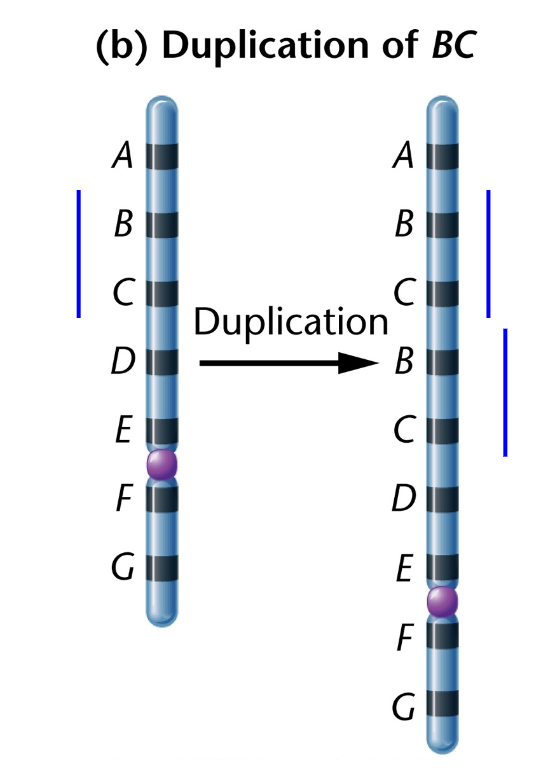
Description: Duplicated genetic material.
Duplications arise as the result of unequal crossing over during meiosis or through a replication error (re-replication) during S-phase (this tends to be smaller in scale).
Consequences of gene duplications
May be deleterious, neutral or advantageous
Can’t predict; depends on the extent of the duplication
Copy number variants may play crucial roles in human traits and disease
Provides increased gene dosage relative to other genes (e.g., duplications led to the increase in rRNA genes)
A second copy of gene is free to undergo modification to acquire new functions (e.g., rhodopsin genes, globin gene amplification; steroid hormone receptor gene amplification).
Detected as loops during synapsis in meiosis
Inversions
Definition: Flipping a segment of a chromosome
Consequences
A change in the order of genes
No loss of genetic information
Gene order is different along the chromosome
However, if the break point is within a gene or changes expression of a gene (e.g., an oncogene), then there are consequences
Generally speaking, no effect on viability but decreased fertility
But inversion loops are formed during the pairing of homologous chromosomes during meiosis
Recombination results in inviable offspring
Inversions “suppress recombination” (e.g., evolution of Y from X)
Detection
A change in the order of genes (change in linkage)
Inversion loops
Reduction in isolating recombinants; partial sterility

Two kinds of inversions
Paracentric: para - outside of (not including) the centromere, recombinant chromosomes: dicentric (2 chomosomes) and acentric fragment (no centromere)
Pericentric: peri - including the centromere, both recombinants inviable
Recombination during meiosis
If there are no crossovers within the inverted sequences, then the meiotic products will be viable (all cross-overs are outside of the inverted region).
Half will be normal and half will carry the inversion
However, if there are crossovers in the inverted region, then not all of the meiotic products will be viable.
For pericentric inversions, half will be viable (normal plus the inversion carrier), and half will be nonviable (contain duplicated and deleted genetic material).
For paracentric inversions, half will be viable (normal and the inversion carrier), and half will be nonviable (dicentric or acentric with duplicated and deleted genetic material).
Inversions
During Meiosis 1 segregation
Bridges break
Acentric lost
Recombinant chromosomes → large deletions, inviable
Only parentals obtained
Maps like deletion
Note: Can recover DCOs
Inversions “suppress” recombination

Translocations
Definition: Fusion of two different chromosomes
These can be reciprocal or nonreciprocal
Consequences
A change in the order of genes
No loss of genetic information
Genes are on different chromosomes (linked to different centromeres)
However, if the break point is within a gene or changes expression of a gene (e.g., an oncogene), then there are consequences
Consequences can vary; generally, no effect on viability but decreased fertility.
Recognized by
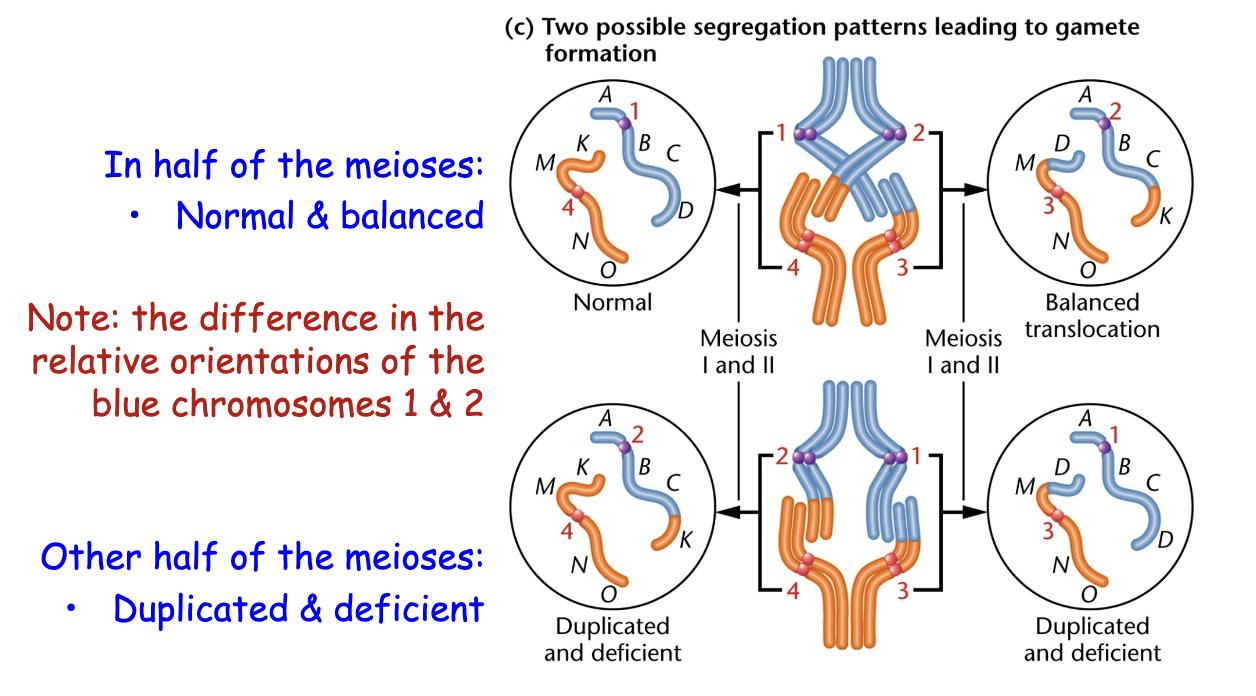
Pairs of synapsed chromosomes during meiosis (cytological)
Unusual synapsis between that includes different homolog pairs
Genes show linkage to the genes and the centromere from another different chromosome
Semi-sterility (half of the meiotic products are non viable)