Sensation and Perception Exam 3
 Call Kai
 Learn
 Practice Test
 Spaced Repetition
 Match
 Flashcards
 Knowt Play
1/59

There's no tags or description
Looks like no tags are added yet.
60 Terms
Attention
devoting some of your perceptual resources to a subset of the world. And that means not devoting them to other subsets of the world.
Overt orientation
Moving attention while moving your eyes
Covert orientation
Moving your mind’s attention while not moving your eyes
Mike Posner experiment
Fixate on the center
A square will appear to the left or right, and you have to click a button to signal where that square is
There will be a hint right before the square appears about its location, with an arrow
The participants were faster to get a target when the arrow was correctly pointing to where the square appeared
Some trials with neutral cues
The first indication that we could move our attention without moving our eyes
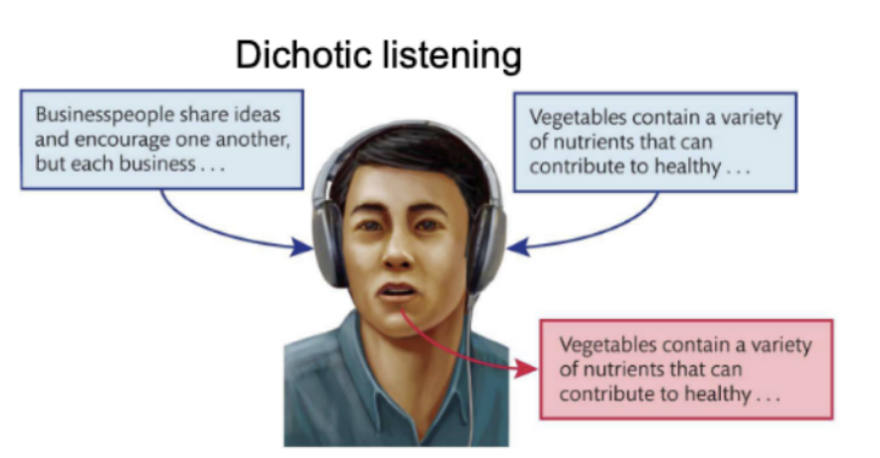
Dichotic listening
(Examples where attention may be necessary to see or hear some things)
You have an attentional filter where you filter out desired information from other, unnecessary information
Only the desired information passes on to the higher-level processing and into the memory
This is why participants, when they had headphones and received noise from both ears, could not tell what information was going through the other side of the ear
Cocktail party phenomenon
Examples where attention may be necessary to see or hear some things
the brain's ability to focus your auditory attention on a single voice or conversation while filtering out background noise in a crowded, loud environment.
If someone says your name, your attention immediately shifts.
We do evaluate the meaning of our unattended channel, and then we change what we pay attention to if it is highly salient (like your name)
Inattentional blindness
Examples where attention may be necessary to see or hear some things
Inattentional blindness is a psychological phenomenon where you fail to notice a fully visible, unexpected object or event because your attention is intensely focused on something else.
Cross experiment
Examples where attention may be necessary to see or hear some things
The stimulus is presented briefly and then masked with a jumbled pattern, where the stimulus is a large cross and they have to determine which line is longer in the cross. The middle of the image changes to a shape (critical stimulus) but since they are not paying attention to it they cannot see it.
Task is a difficult discrimination: Which is longer: The horizontal or the vertical segment?
Key finding: many participants do not see the shape here even though they were looking directly at it.
Attentional blink
Examples where attention may be necessary to see or hear some things
The attentional blink is a cognitive phenomenon where a person temporarily fails to notice a second target stimulus if it appears shortly after a first target stimulus.
Attention is important for you to be able to see something
Experiment
Task 1: Name the green letter. (target)
Task 2: Is there a red ‘X’? (probe)
One group of subjects: do both tasks.
The other group of subjects: just do Task 2.
Task 2 is easy but not if you also have to do Task 1
Participants who were required to identify the target and detect probe were significantly worse at identifying if there was a Red x compared to those who just did task 2
As the number of letters between the target and the probe increases, there is more time to shift attention to the other task, so performance increases
Change blindness
Examples where attention may be necessary to see or hear some things
Suggest that we are not good at noticing some very major changes in the world
Limited Attentional Resources: The human brain cannot process every detail of the visual field at once. Instead, it focuses on the general meaning or gist of a scene
Changes are easily missed if they happen simultaneously with a visual distraction—such as a blink, a camera cut, a flickering screen, or a mudsplash. Without a local motion signal or "retinal transient" drawing attention to the exact spot, the brain assumes the scene is continuous
Flicker paradigm
Researchers flash an original image and a modified image back and forth, separated by a tiny gray screen or blank gap. Even large changes (like a missing building or a shifting color) can take a long time to spot.
Moran and Desimone 1985
(Attention can modulate activity in the visual system)
Moran and Desimone 1985
Recorded individual neurons in area V4 in monkeys
They first found the location of the receptive field of that neuron when the monkey was fixating somewhere
They put an effective stimulus (where the cell responded well) and an ineffective stimulus (where the cell did not respond well)
In some trials the animals were paying attention to the effective stimulus. In other blocks they were awarded for paying attention to the effective stimulus. Others payed attention tot he ineffective stimulus. And they were rewarded for these too.
When the animal was interested in the effective stimulus, it showed a strong response. When the animal was interested in the ineffective stimulus, there was reduced activity in that neuron, even though the visual stimulus (the effective stimulus) was unchanged. This tells us attention that modulates neural activity
So this cell only records the effective stimulus only when the animal pays attention to that stimulus
Chiu and Yantis
(Attention can modulate activity in the visual system)
In this study, participants were instructed to monitor the letters on the left and the digits on the right. Sometimes they were paying attention to the left letters, and sometimes they were supposed to monitor the digits. When people were paying attention to the right of fixation, there was activity in the left hemisphere. When people were paying attention to the left of fixation, there was activity in the right hemisphere. Even though the stimulus was the same, there was more processing in either hemisphere of the brain, depending on where they paid attention.
D Heeger
(Attention can modulate activity in the visual system)
Participants were asked to move their attention to the left or the right, and the idea is that the main thing that changed brain activity was where participants looked and payed attention to
O’Craven et al
(Attention can modulate activity in the visual system)
Participants were asked to look at the center of the image and attend to the moving white or black dots. 20-second period paying atention ot the moving periods or stationary periods
When people were attending to the moving white dots, there was higher activity in the MT than when they were attending to the stationary black dots
Cells are attuned to a specific direction of motion when you pay attention to it
Cells are less active if you are not paying attention to those stimulus
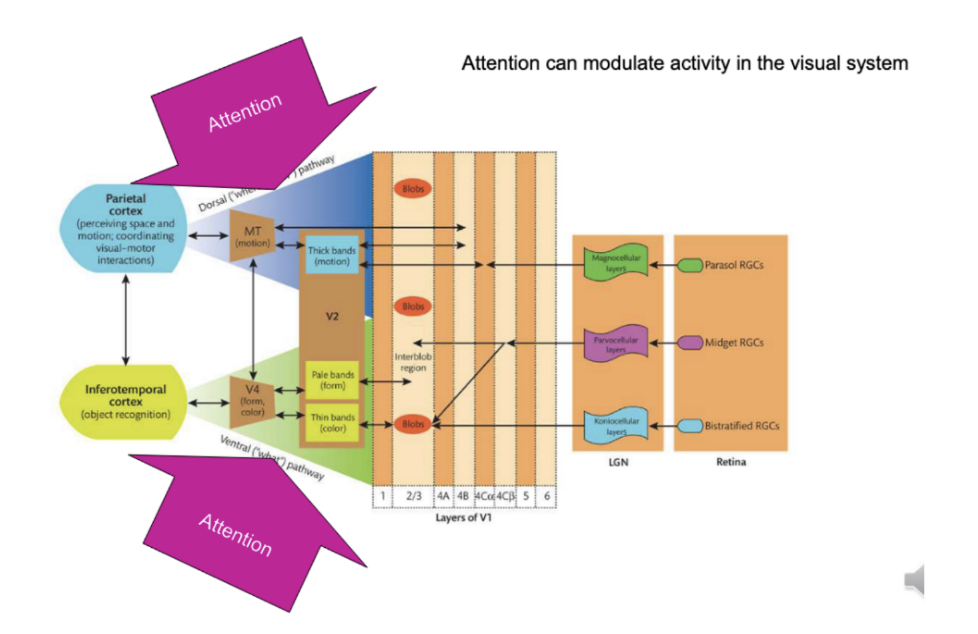
How attention modulates activity in the visual system
Based on this diagram, attention modulates visual activity by sending top-down signals directly into the two main higher-level visual pathways rather than changing how your eyes take in raw light:
Acts in the opposite direction of visual input: Normal visual information flows from right to left (from the Retina \(\rightarrow \) LGN \(\rightarrow \) V1 \(\rightarrow \) V2). The large purple Attention arrows point back toward the middle of the system, showing that higher brain regions actively influence processing once signals reach the cortex.
Targets the Dorsal ("where") pathway: The top attention arrow points toward MT and the Parietal cortex, modulating how your brain processes motion, spatial location, and movement coordination.
Targets the Ventral ("what") pathway: The bottom attention arrow points toward V4 and the Inferotemporal cortex, modulating how your brain processes color, shape (form), and object recognition.
Attention may help to solve the binding problem
Binding problem
Distinct pathways or brain areas for different attributes of a stimulus produce a problem
We know a football has color, shape, and motion, but that information arrives in different parts of the brain, so how do we correctly perceive and bind these attributes together?
Solution: Feature Integration Theory
Solution: Feature Integration Theory (Treisman)
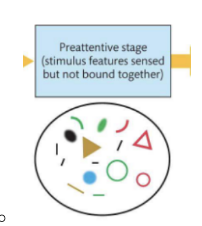
Example stimulus:
1) preattentive stage: where primitives (basic things) automatically and effortlessly pop-out
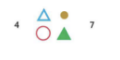
Primitives are sensed but not bound together in the first stage of attention
2) focused attention stage: where the primitives are combined which requires effort and attention
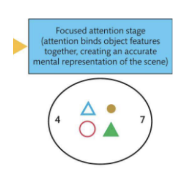
This theory solves the binding problem because it says attending to things allows us to combine and bind things.
Visual Search Experiments
The participant looks for a specific target
Presses one key if the target is present, another if absent
Reaction time is measured
Singleton
Only important thing or only target
Feature Search
Popout
Really easy to find, target differs from everything else but that one feature
Perceptual popout
Easy to find the target – regardless of the number of distractors
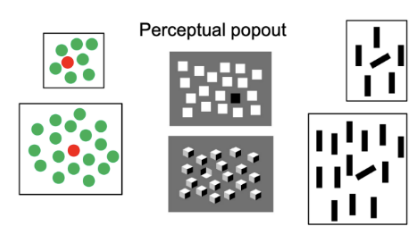
Automatically noticeable and recognizable
This is support for Feature Integration Theory because you do not need the focused attention to find the target if it is different from other targets based on incredibly basic features
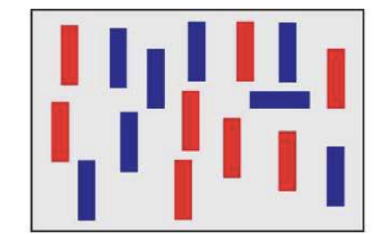
Conjunction search
Target is defined by a conjunction of two features
Not the only blue thing and not the only horizontal thing
Takes slower

This requires binding and we need focused attention
Perceptual popout
Reaction time does not increase with the number of items in display

Why when the target is absent in the conjunction search the slope is much steeper (much more objects to look through)
Expect the target to be there when it is not
When the target is not there, you have to check all of them to be sure it is not there so you have to do more searches
Feature stage = preattentive stage. Conjunction search = focused attention stage.
Binding failure
Illusory conjunctions (Treisman and Schmidt)
reported results when there is a failure of conjunction
They get the letters right and the colors right, but they cannot put them together.
You saw an X, and you saw Blue, but these are not the actual conjunctions
Consistent with feature integration theory, because if you do not have enough time to bind, then you only have enough time for the preattentive stage
Card trick
Pick a card and then the next screen all the cards are different
We picked a card but we did not have enough time to process everything or all the other cards
We just have the basic primitives but not everything else
Illusory conjunctions occur because the primitives exits in un-bound form prior to the operation of the focused attention stage.
Focused attention is used to select a single object (and bind together all of its properties)
Biased Competition Theory
Desimone and Duncan 1995
Helps to explain how attention might select different attributes
They plotted the response of a V4 neuron. When a stimulus is presented that is effective in that receptive field, it is high. The researchers also found that when an ineffective stimulus was presented in the cell’s receptive field the response was not high.
What if they are both presented?
The two stimuli compete and the response of the cell is sort of in between
In the second example when the creature pays attention to the effective simulus (and the both presented stimulus is unchanged), or when the creature pays attention to the ineffective simulus (and the both presented stimulus is unchanged), it almost mimicked the response when both were not there (its like almost the other stimulus disappears). Like only the attended stimulus is the only thing there. Attention biases the competition between these two stimuli here
Attentional capture and selection
What are the features of attention that will automatically catch your attention
Jonides and Yantis
Researchers revealed letters by removing some of the segments
Target letter = C. when the target letter appears in a previously unoccupied are of the screen, detection of target is faster then when it is just in the space of the placeholder. New objects must then be important just like animate motion.
New objects attract attention
When a new object appears people look at that first no matter how many distractors there are.
People do not move their eyes, just their attention around
Value-driven attention
Value also captures attention. In an experiment, people are trained to believe that one color is more valuable than another. In a second experiment unrelated to the first, they are more distracted by the valuable color, even if it has nothing to do with the experiment.
They would earn money in the first experiment if they found the valuable color
People learned the value association in a very short time
Attention is “object based”
The things that people perceive to be present in a scene play an important role in what is attended
People are told to fixate in the center of a display that has two rectangles on it. What they are looking for its a light to appear at one of the end of the rectangle. They get a false cue right before the target appears.
How long does it take them to find that target as a function of the relationship between the target and the false cue?
Result: target is detected more quickly in the cued object than in the other object
If your attention is drawn to one part of the object, your attention expands that to the entire object. That object benefits.

Brain areas involved in attnetional control
Frontal eye field (FEF)
Posterior parietal cortex (PPC)
On the dorsal pathway (Where/how)
Evidence for involvement of PPC
Strokes or other damage to right PPC produce unilateral visual neglect on the left side of space
Patients can see salient stimuli in the impaired field, but often do not report them especially when there are competing stimuli on the right. So the problem is one of attention not vision. “Blindsight”.

More evidence for involvement of PPC
Recordings from PPC neurons in monkeys reveal increased activity in response to a shift of attention even without an eye of hand movement
Monkey sees an object appear in its receptive field. Monkey is supposed to (1) fixate on the object, (2) move its eyes back and forth, (3) reach with its hand, (4) monkey had to leave its attention to the object and wait for the object to dim
1. Monkey waits for fixation point (looking at the center) to dim.
2. Monkey makes eye movement to stimulus
3. Monkey makes hand movement to stimulus
4. Monkey waits for stimulus to dim
If you are planning to make an eye movement or hand movement or anything like that, you have to maintain your attention in the receptive field.
Attention was sufficient to fire the neuron even without an eye or hand movement (monkey 4)
Sound energy
Traveling wave of air pressure changes
You hear a hand clap because there is a change in the atmospheric pressure at your ears

This is called an impulse
Continuous sounds
The hinds of the tuning fork vibrate, when they vibrate they compress as they get closer together and compress the air molecule
When they expand (rarefaction) they reduce the pressure of the air molecules between the tuning fork the pressure changes
This is a continuous sound since it happens repeatedly
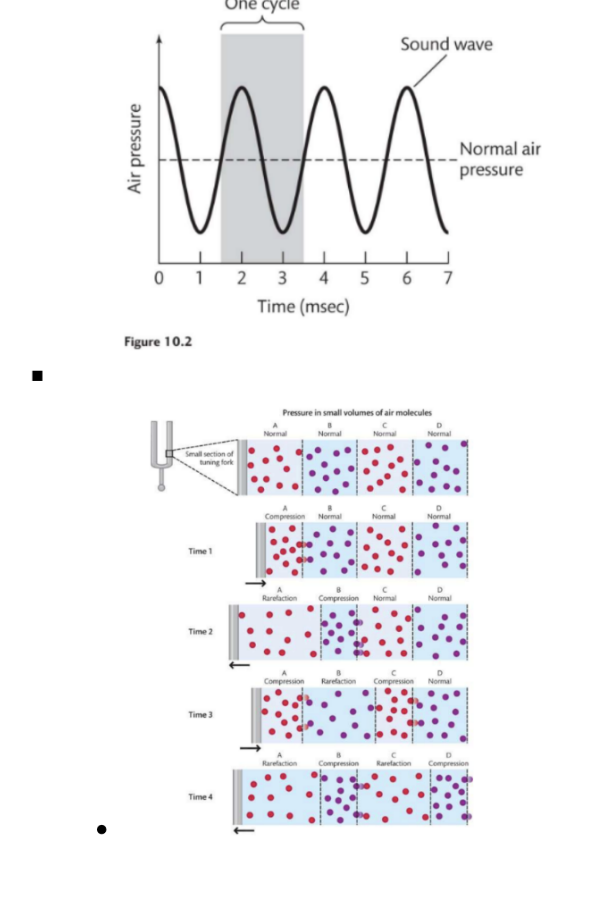
The disturbance of higher than normal and lower than normal air pressure

expands outwards and disturbs all of the air around it. This air pressure is graphed on a sine wave.
Pure tones are in
sine waves (only pure tones)
Wavelength is between the two peaks or two naught points
Frequency or Hz is # of cycles per second
Human range is 20-20000 Hz
Changing the frequency can also make some sound louder than others
Amplitude is the height of the wave
How much is the air pressure changing
Increasing the amplitude makes it sound louder
Whales and dolphins have the largest range of noise of all species
Producing sounds
How does the speaker produce sound?
The webpage produces a voltage as a sine wave function of time
But then it is passed through an amplifier to make the amplitude of that voltage change
The speaker then has a paper cone connected to an electromagnet. The electromagnet moves the paper cone in the amplitude

Pure tones vs more complex stimuli
A 300 Hz tone and a 500 Hz tone together
The individual tones are very smooth but when they are combined there is an addition of the waves
Sometimes the waves can be syncrhonized (in-phase) or (out-of phase)

When the waves are in-phase they both increase wave pressure so the noise is added together
When the wave are out-of-phase, those waves will cancel each other out
The principle of noise-cancelling headphones is
where waves fron the outside surroundings are canceled out by an opposing anti-wave to the wave outside

General motors uses this technology in their cars. Their engine was running at a more fuel-efficient engine but it was too loud, so they generated a sound wave that has the same frequency as the engine noise but with an inverted phase
People have tried noise-cancelling mechanisms for apartments
The entire apartment emitted opposing waves
How can a noise-cancelling software break down each wave and block it out?
Any complex wave-form can be broken down into the components of all of the sine waves within that wave
This results in a Fourier spectrum. Each of the frequency components can be put into the graph and each bar represents one wave. The height of that bar represents the amplitude.
Fundamental frequency and harmonics
Sounds that are produced by physical means or musical instruments will have energy at a range of frequencies and not just a pure tone
The entire string moves as a whole, producing energy at a fundamental frequency. The string is also vibrating in each half, moving in opposite directions.
The result of this other movement is sound energy that has exactly twice the frequency of the fundamental frequency
For each third of the fundamental, the opposite movement produces a frequency exactly three times the fundamental frequency
These are called overtones (exact multiples of the fundamental frequency)
One note played on a clarinet of 880Hz
Exact multiples of 880Hz
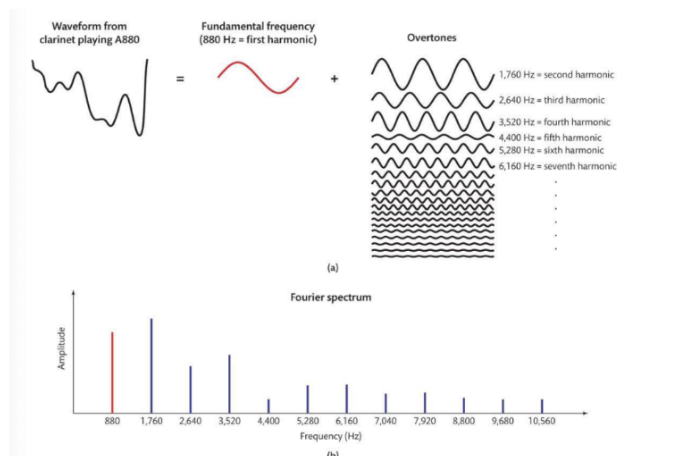
Some harmonics can have amplitudes greater than the first harmonic
The same note played on different instruments
Some components will be similar, but they may have different amplitudes (relative strengths of different harmonics)
This is part of what makes one instrument sound different than another
How do you specify the amplitude of a sound?
Amplitude is specified in terms of pressures. But the range of pressures we can experience is enormous
To make the numbers manageable
The pressure is described in terms of a ratio relative to a reference pressure
pressure/p_1.
p_1= 20 micropascals (threshold for hearing a 1000Hz tone by a sample of normal-hearing adults)
Formula for amplitude
20 log (P/p_1)
This is computed in dB (decibels) or Sound Pressure Level (SPL)
Common SPLs
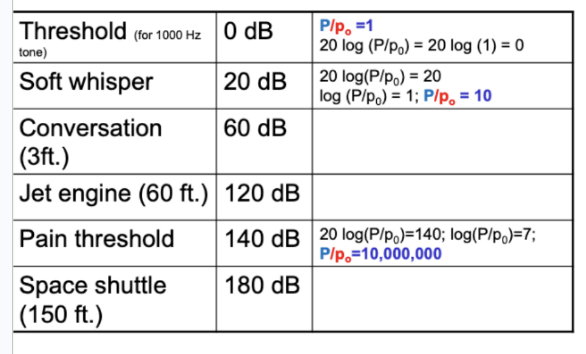
When there is 0 db what is the pressure
The pressure ratio is 1 when there is 0 dB.
How to add SPLs
Each saw would be 20 log P/P_1=80 dB. Find the pressure.
log(P/P_1) = 4
P/P_1= 10,000
Two saws
20 log (10K+10K)
20 (log2+log10K)
20 (0.3+0.4)
=86dB
80 db + 80 db = 86 dB. This tells us that doubling the sound pressure will increase the SPL by 6 dB
Logarithm review
log1=0, log10=1, log100=2, log1000=3, log0.1=-1
Psychological dimensions of sound
Frequency is perceived as pitch
High frequency = high pitch
Amplitude is perceived as loudness
High amplitude = loud tone
Waveform (pure or complex for tone) is perceived as timbre
Simple waveform = pure tone
Complex waveform = complex sound
Timbre (pronounced TAM-burr) is the unique quality or "color" of a sound that allows you to tell the difference between two voices or instruments, even when they are playing the exact same note at the same loudness.
For example, if a piano and a guitar play the exact same musical note at the same volume, you can still easily tell which is which because of their different timbres.
Loudness depends on amplitude and frequency
Hear tones of several frequencies decreasing in steps by 10 dB. We will hear a 125 Hz tone that is a high amplitude. And then they slowly decrease the tone’s amplitude until it is inaudible. It will move to a slightly higher frequency and repeat again.
All steps are physically the same amplitude but we are more sensitive to some frequencies than other (depending on the Hz)
For some frequencies we can only hear up to 30 or so dB. For the higher frequencies we can hear up to 40 dB.

Our sensitivity to sound depends on
frequency…
Audibility curve
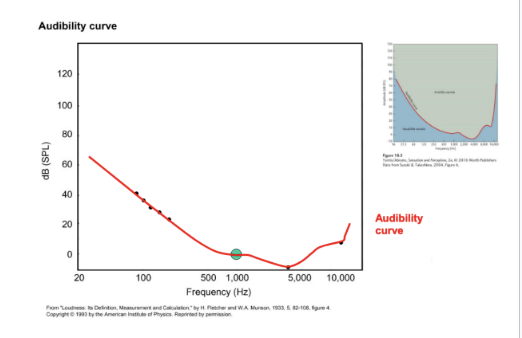
An audibility curve is a graph that shows the quietest sound level a human can just barely hear across different sound frequencies
Vertical axes is sound pressure level of a sound in dB
Horizontal axis is frequency in Hz
Shows for a given frequency what the threshold of hearing is
1. You can measure someone’s absolute threshold (ex. 100 Hz tone at 40 dB)
2. Measure the absolute threshold for a higher frequency
As the frequency goes down the threshold goes down so people are more sensitive
As the frequency gets higher and higher the threshold is lower
At 1000 Hz the threshold is 0 because that is how P sub 0 is defined. 0 dB SPL (Sound Pressure Level) is defined as a root-mean-square pressure of \(20\ \mu\text{Pa}\) (micropascals), or \(2 \times 10^{-5}\ \text{N/m}^2\), in air
3. More sensitive to slightly higher frequency
At extremely high sound frequencies like 5000 Hz because we are below the standard
We are most sensitive to 1000-6000 Hz perhaps due to alert and daner cues, consonants, and speech harmonics.

How loud is a 60 dB on AC
As you go above the audibility curve it means the noise will be loud. As you stay below the curve, the loudness decreases
Loudness scales and units
Lines above the audibility curve
Any two points on any curve will have the same loudness (on the audibility curve they sound just barely loud but the same level of loud)
1 phon = perceived loudness of 1kHz tone at 1dB
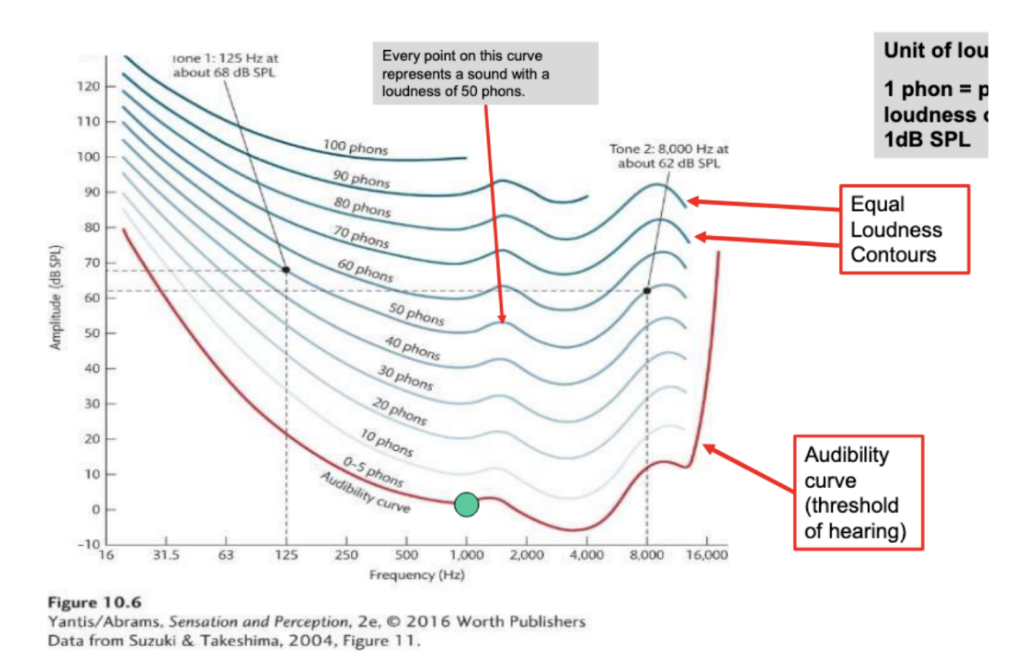
What do loudness buttons do on stereo amplifiers?
Compensate for a deficit on the audibility curve
The equal loudness contours get flatter “more straight” as you increase in loudness. But when the amplitude is low, then the lines are very curved. This is the issue. If the music is turned up really loud, the loudness button does not do anything since it is not compensating for anything. If the volume is low, the loudness button boosts the bass to hear the lower frequencies amplified.
A loudness button on a stereo amplifier boosts the bass and treble frequencies when you are listening to music at a low volume.
Human ears do not hear low (bass) and high (treble) sounds as well when the music is quiet.
Without this button, quiet music can sound thin, flat, or lacking in punch.
How does the stuff we hear in our ear convert pressure changes in the air into impulses in neurons?
The pressure changes in the air around your head results in pressure changes in the auditory canal
Outer ear
Pinna and auditory canal
Middle ear
Tympanic membrane at the end of auditory canal
Pressure changes cause the tympanic membrane to rumble
Bones after the tympanic membrane
Ossicles
Malleus
Incus
Stapes
As the tympanic membrane moves, it pushes on the malleus, then the incus, then the stapes.
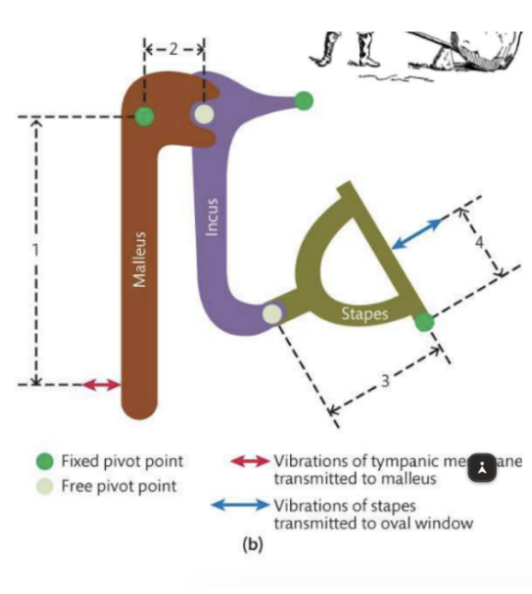
Ossicle vibrations etc
Eventually these vibrations get transmitted into fluid in the inner air. But first, the ear has to amplify the vibrations it receives.
These bones are arranged in such a way so they take advantage of the lever principle (shown above)
• Air vs. Water: The inner ear (cochlea) is filled with fluid. Moving sound waves from air into fluid creates natural resistance (impedance mismatch).
• Energy Loss: Without help, roughly 99.9% of sound energy would bounce away. The middle ear boosts the force to push through the fluid
• The Pivot: The bones pivot as a connected chain.
• Long Arm vs. Short Arm: The malleus attached to the eardrum has a longer lever arm, while the stapes attached to the inner ear's oval window has a shorter lever arm.
• Trade-off in Motion: Just like a physical lever, the side with the shorter arm moves a shorter distance, but it multiplies and concentrates the force.
• Mechanical Advantage: The lever action adds roughly 35% to 1.3-fold mechanical advantage, multiplying the push on the oval window.
The purpose of the middle ear is to amplify these noises
Second way the middle ear amplifies the tympanic membrane
The surface area of the tympanic membrane is much greater than the surface area of the stapes touching the cochlea. All the area from the tympanic membrane is concentrated on the stapes. The size difference amplifies the forces.
Inner ear
Eustachian tube
Allows us to equalize the air pressure of the inner ear to the air pressure of the environment
If the middle ear is sealed when the eustachian tube is blocked it means there is more pressure in the middle ear and that makes it (1) harder to hear as there is pressure inside and (2) it hurts
People try and chew to let the air pressure out

Inner ear technically begins in the oval window
Consists of a cochlea (coiled structure)
The far end of the cochlea is called the apex. The end near the cochlear window is called an apex.
There are three chambers in the cochlea. The oval window is in the upper chamber of the cochlea. The tympanic canal is the bottom canal.
Organ of Corti
The membrane under the organ of corti is most important (the basilar membrane)
There are cells that are called hair cells (outer hair cells) and inner hair cells and the top of the cells have stereocilia. When these stereocilia get stimulated or bent, they produce an action potential. Their axons leave the cochlea and head into the brain through the auditory nerve. Type I nerve fibers are the majority of information and they come from the inner hair cells.
Type 2 nerve fibers come from the outer hair cells ang this is only 5% of information.
Movements of the basilar and tectorial membranes can result in shearing forces on stereocilia
Fluid in the endolymph also provide resistance which causes shearing on tee stereocilia
The disturbance in the cochlear fluid causes the organ of corti to move which causes action potentials
The vestibular canal and tympanic canal both have an abundance of fluid which causes this movement
Reissner’s membrane releases pressure
We can distinguish between many different sounds. How is it that the signals in the auditory nerve fibers provide information about different types of sounds?
1. Pressure waves in air cause vibration of tympanic membrane
2. Vibration of tympanic membrane causes vibration of ossicles
3. Vibration of stapes against oval window causes pressure wave in perilymph (uncoiled cochlea on the basilar membrane)
At thicker, narrower, stiffer base of basilar membrane (near stapes), high-frequency pressure waves cause greatest displacement.
In middle portion of basilar membrane, midfrequency pressure waves cause greatest displacement
At thinner, wider, more flexible apex of basilar membrane, low-frequency pressure waves cause greatest displacement
4. Pressure wave in perilymph causes traveling wave in basilar membrane
hair cells all along the basilar membrane.
Other hair cells can fire at different rates depending on where they are on the basilar membrane and what the frequency is, because of this unique vibration on the membrane.
Envelope of travelling waves (displacement envelope)
You can trace the bounds of how the wave moves and how high it goes. There are distinct envelopes for each frequency
Peak displacement for a high frequency is near the middle of the apex, while peak displacement for a low frequency is at the apex.
Helps characterize where the location of maximum displacement of each hair cell is and those will be the locations that will be firing at the highest rate which may help the brain know where is which