General Science - Life Science - The Lymphatic System
 Call Kai
 Learn
 Practice Test
 Spaced Repetition
 Match
 Flashcards
 Knowt Play
1/48

There's no tags or description
Looks like no tags are added yet.
49 Terms
What is the primary function of the lymphatic system regarding body fluids?
Filtering impurities out of the fluid that surrounds body tissues
The lymphatic system's core function is __________ impurities out of the fluid surrounding body tissues.
filtering
Which structural elements constitute the overall composition of the lymphatic system?
A network of organs, ducts, and tissues
Being structured as a network of organs, ducts, and tissues is characteristic of which bodily system?
The lymphatic system
Which of these is a primary lymphatic organ?
Thymus
Which of these is NOT a primary lymphatic organ?
Lymph nodes
Which of these correctly lists examples of primary lymphatic organs?
Thymus and bone marrow
What cellular elements are produced by primary lymphatic organs?
Lymphocytes
What is the functional relationship between primary lymphatic organs and cellular production?
They produce lymphocytes
How does the thymus develop and function from childhood into adulthood?
It is critical for T-cell development in children and begins to shrink as they progress toward adulthood
What is the relationship between the thymus and human life stages?
It plays a critical developmental role during childhood but shrinks toward adulthood
Which of these is classified as a secondary lymphatic organ?
Spleen
Which of these is NOT classified as a secondary lymphatic organ?
Thymus
Which of these is a secondary lymphatic organ?
Tonsils
Which of these is NOT a secondary lymphatic organ?
Bone marrow
Which of these is included among secondary lymphatic organs?
Lymph nodes
Which of these is NOT a secondary lymphatic organ?
Thymus
Which of these correctly lists examples of secondary lymphatic organs?
Spleen, appendix, tonsils, adenoids, lymph nodes, and Peyer’s patches
How do human tonsils develop in size from childhood to adulthood?
They reach full size at approximately age 7, then gradually shrink until adulthood
What is the relationship between age milestones and tonsil size?
Full size is reached around age 7; gradual shrinking occurs toward adulthood
What was the historical surgical practice regarding children's tonsils and adenoids?
They were routinely removed surgically in most children
In the past, tonsils and adenoids were routinely removed __________ in most children.
surgically
What current medical guideline governs the surgical removal of children's tonsils?
Tonsils are not removed unless a child experiences repeated infections known as tonsillitis
What is the relationship between tonsillitis infections and tonsil removal today?
Repeated infections prompt removal; absence of repeated infections prevents removal
What primary function is performed by primary lymphatic organs?
Producing immune cells
What is the functional relationship characteristic of primary lymphatic organs regarding immune cells?
They produce immune cells
How do secondary lymphatic organs function in relation to immune cells and infections?
They serve as sites where immune cells go to fight infections
Secondary lymphatic organs serve as sites where immune cells go to fight __________.
infections
Which of these is a primary clustering location for lymph nodes?
The pelvic area
Which of these is NOT a primary clustering location for lymph nodes?
The renal cortex
Which of these is a primary clustering location for lymph nodes?
The armpits
Which of these correctly lists examples of primary clustering locations for lymph nodes?
The pelvic area, the neck, and the armpits
What primary role do lymph nodes play within the body?
They act as the lymphatic system’s way of fighting infection
Lymph nodes are the lymphatic system’s way of fighting __________.
infection
How are individual lymph nodes connected to one another throughout the body?
By lymphatic vessels
What is the structural relationship between lymph nodes and their interconnecting pathways?
Lymph nodes are connected to one another by lymphatic vessels
What specific cellular action do white blood cells perform in the nodes and other secondary organs?
They surround and destroy debris to prevent it from reentering the bloodstream
White blood cells in the nodes and other secondary organs surround and destroy __________ to prevent reentry into the bloodstream.
debris

What should the label be in position A?
Tonsil

What should the label be in position B?
Cervical lymph nodes

What should the label be in position C?
Subclavian vein

What should the label be in position D?
Thymus gland

What should the label be in position E?
Red bone marrow
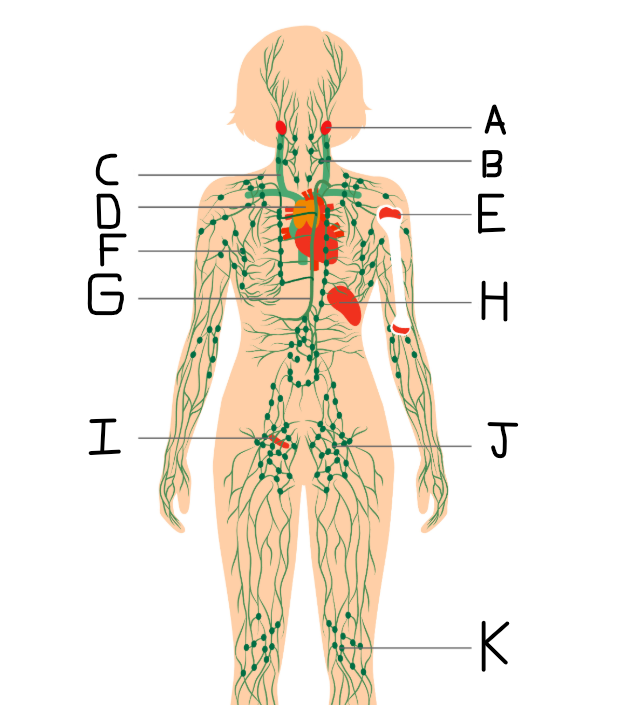
What should the label be in position F?
Axillary lymph nodes
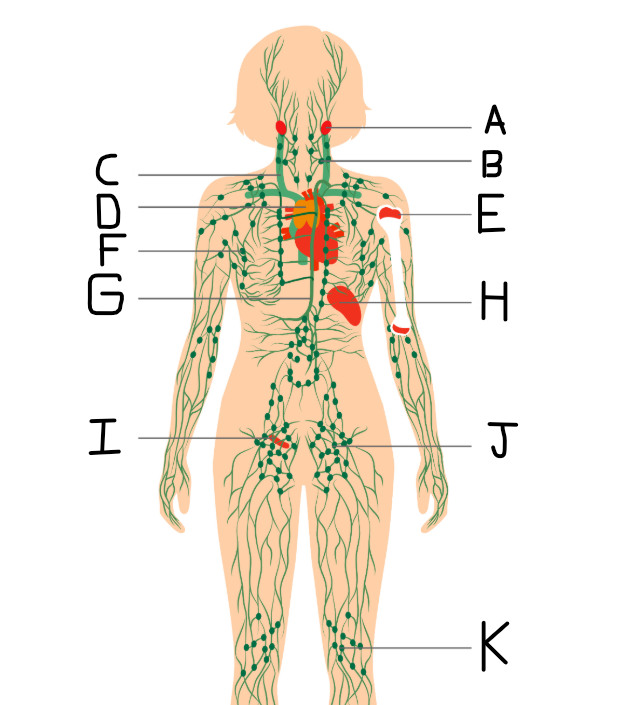
What should the label be in position G?
Thoracic duct

What should the label be in position H?
Spleen

What should the label be in position I?
Appendix

What should the label be in position J?
Inguinal lymph nodes

What should the label be in position K?
Popliteal lymph nodes