General Science - Life Science - The Plant Kingdom
 Call Kai
 Learn
 Practice Test
 Spaced Repetition
 Match
 Flashcards
 Knowt Play
1/93

There's no tags or description
Looks like no tags are added yet.
Name | Mastery | Learn | Test | Matching | Spaced | Call with Kai | Chat |
|---|
No analytics yet
Send a link to your students to track their progress
94 Terms
The two principal phyla that comprise the plant kingdom are the Bryophyta and the ____________.
Tracheophyta
Which major taxonomic classification represents one of the two principal plant phyla defined in botanical study?
Bryophyta
How do Bryophytes and Tracheophytes fundamentally differ in their structural organization regarding transport?
Bryophytes lack a vascular system, whereas tracheophytes possess a vascular system.
What is the relationship between the vascular system and the classification of the two principal plant phyla?
The presence or absence of a vascular system is the defining distinction between these two phyla.
Bryophytes are classified as non-vascular plants because they do not have a vascular system for transporting water, food, and ____________.
minerals
Which of the following statements is NOT true regarding the transport characteristics of Bryophytes?
They feature an advanced system of xylem and phloem tissue that rapidly pumps water to high elevations.
Which of the following organisms are specifically categorized as bryophytes?
Mosses and liverworts
Which of the following plants is NOT an example of a bryophyte?
Moss
Because they lack a vertical transport system, bryophytes generally grow to a height of only a few ____________.
inches
Why do bryophytes generally remain restricted to a height of only a few inches?
Because they lack a vascular system to transport water and nutrients vertically.
Tracheophytes differ from bryophytes because their vascular tissue actively moves water and nutrients to the ____________ of the plant.
height
What internal physiological feature allows tracheophytes to maintain fluid transport throughout their structure?
A vascular system that moves water and nutrients.
Which group of plants is explicitly classified under tracheophytes?
Ferns, conifers, and all flowering plants
Which of the following plant types is NOT categorized as a tracheophyte?
Liverworts
Because their internal transport tissue circulates water and nutrients upward, tracheophytes are able to grow much ____________.
taller
Why are tracheophytes capable of achieving significantly greater heights than bryophytes?
Because their vascular tissue moves water and nutrients to the height of the plant.
In terms of internal transport organization, bryophytes are officially classified as ____________ plants.
nonvascular
Which anatomical structures do bryophytes completely lack throughout their lifecycle?
True roots, stems, leaves, and woody tissue
How do the internal structure and tissue composition of bryophytes compare to tracheophytes?
Bryophytes lack true roots, stems, leaves, and woody tissue, whereas tracheophytes possess specialized vascular organs.
Because they lack woody tissue and internal transport tubes, bryophytes generally grow only a few ____________ in height.
inches
Why are bryophytes generally restricted to growing only a few inches tall?
Due to their lack of woody tissue and internal transport tubes, which prevents vertical fluid distribution.
Which of the following groups of organisms are classified as bryophytes?
Mosses, many-celled algae, and liverworts
Which of the following organisms is NOT classified as a bryophyte?
Conifers
Tracheophytes are officially classified as ____________ plants.
vascular
How do the internal structures of tracheophytes and bryophytes fundamentally differ?
Tracheophytes possess true roots, stems, and leaves along with a vascular system, whereas bryophytes lack true roots, stems, and leaves.
To organize their broad evolutionary diversity, tracheophytes are subdivided into exactly ____________ principal classes.
three
How is the phylum Tracheophyta hierarchically organized beneath the phylum level?
It is divided into three principal classes.
Members of Class Filicineae, such as ferns, are unique because they do not produce flowers or ____________.
seeds
Which characteristic is NOT true of plants belonging to Class Filicineae (ferns)?
They produce flowers and seeds to propagate.
What developmental phase occurs naturally within the life cycle of ferns (Class Filicineae)?
Spore-producing generations
How do ferns manage reproduction despite lacking flowers and seeds?
Spore-producing generations occur in their life cycles, allowing reproduction through spores.
Due to their specific physiological needs, ferns (Class Filicineae) typically require moist and ____________ areas to thrive.
shady
Why do ferns typically inhabit damp, dark environments?
Because they require moist, shady areas to support their life cycle requirements.
What defines members of Class Angiospermae in terms of their reproduction and seed structure?
They are flowering plants that produce seeds with protective coverings.
Which statement accurately characterizes the reproductive features of Angiosperms?
They produce flowers and generate seeds enclosed within protective coverings.
In angiosperms, the combination of the seed and its surrounding protective tissue is botanically referred to as the ____________.
fruit
What term is given to the integrated structure formed by an angiosperm seed and its protective tissue?
Fruit
To study their structural variations further, angiosperms are broadly subdivided into monocots and ____________.
dicots
How are angiosperms classified into smaller subcategories within their class?
Angiosperms are subdivided into monocots and dicots.
Seeds of monocots are characterized by containing only one ____________, which functions as a food-bearing structure.
cotyledon
What structure in monocot seeds serves as the single food-bearing unit?
A single cotyledon
Monocots typically feature long, narrow leaves that display ____________ veining.
parallel
How do the leaf and vein structures of monocots contrast with those of dicots?
Monocots have long, narrow leaves with parallel veining, whereas dicots have broad leaves with branched veining.
In monocots, the flowering parts are typically arranged in threes or multiples of ____________.
three
Which floral symmetry or numerical arrangement is characteristic of monocot flowers?
Parts arranged in threes or multiples of three
Which of the following groups consists entirely of plants classified as monocots?
Banana, corn, and wheat
Which of the following plants is NOT classified as a monocot?
Maple tree
Which of the following plants is NOT a monocot according to botanical classification?
Apple tree
Which of the following is an exception that is NOT a monocot?
Maple
Unlike monocots, seeds of dicots contain exactly ____________ cotyledons.
two
What distinguishes the seed structure of a dicot?
Seeds contain two cotyledons
Dicots are typically characterized by having broad leaves that feature ____________ veining.
branched
How do dicot leaves differ structurally from monocot leaves?
Dicots have broad leaves with branched veining, whereas monocots have long, narrow leaves with parallel veining.
In dicot flowers, the floral parts are typically arranged in fours or fives or multiples of four or ____________.
five
Which numerical floral arrangement is typical of dicot plants?
Parts arranged in fours, fives, or their multiples
Which of the following plant selections represents examples of dicots?
Apple and maple
Which of the following is NOT an example of a dicot?
Wheat
Which of the following plants is an exception and NOT a dicot?
Corn
Members of Class Gymnospermae are unique because they produce seeds without any protective ____________.
coverings
What is the defining seed feature of gymnosperms compared to angiosperms?
They produce seeds without protective coverings
Which of the following sets correctly lists examples of conifers that produce seed cones?
Cedar, fir, pine, and spruce
Which of the following plants is NOT a conifer or gymnosperm?
Wheat
Which of the following organisms is an exception and NOT a conifer?
Apple
Which of the following plants does NOT belong to the conifer group of evergreens?
Corn
Which of the following is NOT classified as a seed-cone-producing evergreen conifer?
Banana
What is the relationship between angiosperms, gymnosperms, and their seeds?
The defining difference between angiosperms and gymnosperms is whether their seeds have protective coverings.
The defining difference between angiosperms and gymnosperms is whether their seeds have protective ____________.
coverings
Which group of plants features seeds enclosed within a protective tissue?
Angiosperms
Angiosperm seeds are uniquely enclosed within a protective ____________.
tissue
What is the botanical term for the combination of an angiosperm seed and its surrounding protective tissue?
Fruit
Which of the following statements accurately describes the composition of a fruit in angiosperms?
It consists of the seed together with its protective tissue.
Which of the following plants is an example of an angiosperm?
Apple
Which of the following plants is NOT classified as an angiosperm?
Spruce
Which of the following plants represents an angiosperm with enclosed seeds?
Grasses
Which of the following selections correctly lists examples of angiosperms?
Apples, maples, and grasses
Gymnosperm seeds are described as ____________ because they have no protective coverings.
naked
What is the primary characteristic of gymnosperm seeds regarding their outer structure?
They have no protective coverings and are considered naked.
Which of the following plants is NOT a conifer containing unprotected seeds?
Grass
Which of the following is a familiar conifer whose seed cones contain unprotected seeds?
Fir
Which of the following is NOT a gymnosperm conifer with naked seeds?
Maple
Which of the following plants belongs to the conifer group of gymnosperms that produce seed cones?
Spruce
Which of the following selections correctly lists examples of conifers that are the most familiar group of gymnosperms?
Cedar, fir, pine, and spruce

Which component of the Gymnosperm is represented by position A?
Micropyle
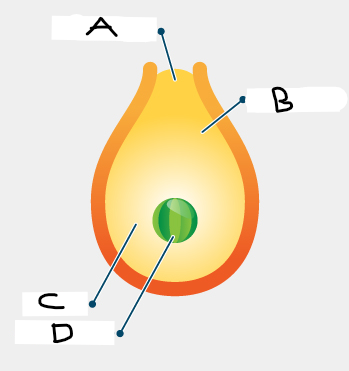
Which component of the Gymnosperm is represented by position B?
Integument
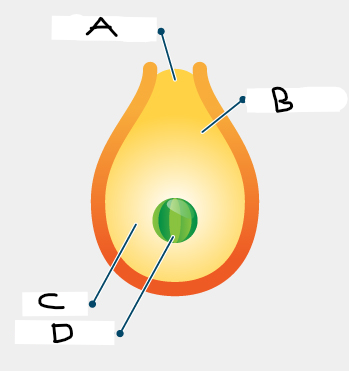
Which component of the Gymnosperm is represented by position C?
Nucleus

Which component of the Gymnosperm is represented by position D?
Megasporocyte

Which component of the Angiosperm is represented by position A?
Stamen

Which component of the Angiosperm is represented by position B?
Style
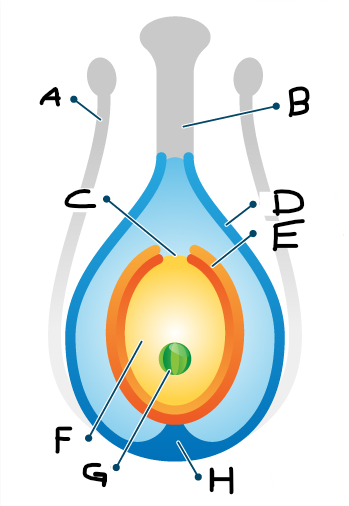
Which component of the Angiosperm is represented by position C?
Micropyle

Which component of the Angiosperm is represented by position D?
Ovary Wall

Which component of the Angiosperm is represented by position E?
Integuments

Which component of the Angiosperm is represented by position F?
Nucleus

Which component of the Angiosperm is represented by position G?
Megasporocyte
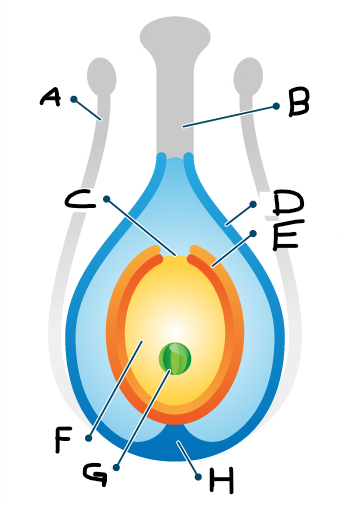
Which component of the Angiosperm is represented by position H?
Funiculus