ANTH 201 Artworks
 Call Kai
 Learn
 Practice Test
 Spaced Repetition
 Match
 Flashcards
 Knowt Play
1/82

There's no tags or description
Looks like no tags are added yet.
83 Terms

Man in a Red Turban, Jan van Eyck
northern renaissance, 1433
small scale, impressive detail thanks to use of oil paint
includes signature and exact date

Giovanni Arnolfini and His Wife, Jan van Eyck
Northern Renaissance, 1434, oil on wood
symbols (dress, broom, figurine, dog)
sacred over profane (resembles annunciation)
mirror (depictions of Christ, reveals rest of room)
signed above mirror

Ghent Altarpiece, Jan van Eyck
Northern Renaissance, 1432, oil on wood
infinite detail, enormous scale (12 major panels)
started by brother who then died, finished by Eyck
Holy interior
oldest surviving nudes in European art not idealized
angels fail to sing in harmony; represents disorder
Jesus/God combo, Mary left, John Baptist right
sacrificial lamb on altar
ordinary exterior - Mary in regular room, praying patrons

Saint Luke Drawing the Virgin, Roiger van der Weyden
northern renaissance, 1440, oil over tempera on wood
spiritual topics in ordinary rooms
self-referential artist
realistic depiction of Mary & Luke
baby is elongated & appears much older (Christ’s wisdom)

Portrait of a Lady, Roiger van der Weyden
Northern Renaissance, 1460, oil on wood
tightly clasped hands, bound waist, & averted gaze symbolize woman's restraint
weird proportions, odd posture (new format, uncertainty)
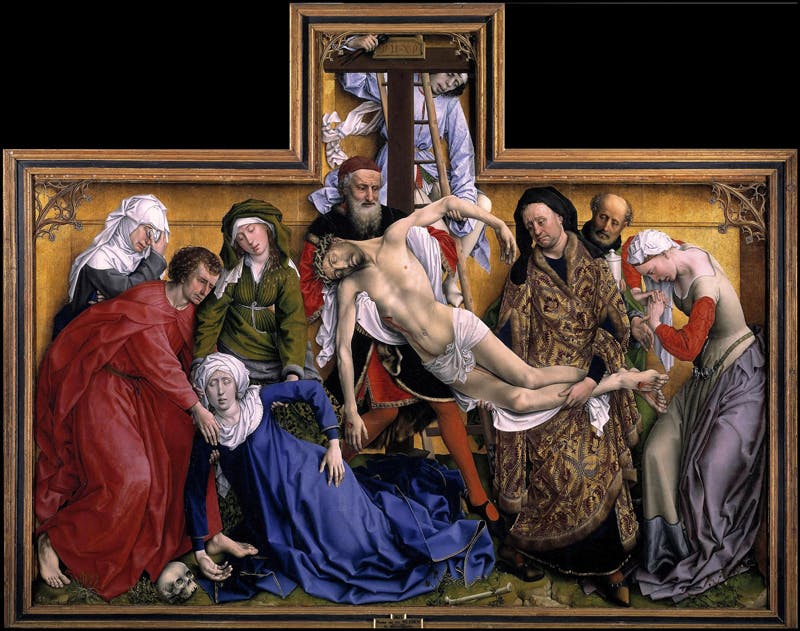
Deposition, Roiger van der Weyden
northern renaissance,
huge altarpiece; central panel of triptych (other panels lost)
skull is Adam since Christ was crucified at Adam's burial
also shows how humans are sinful & everything goes back to Adam & Eve (original sin)
very realistic, extreme anguish; invokes compassion

Duomo, Florence Cathedral, Filippo Brunelleschi
Italian Renaissance, 1436
tall & lightweight
octagonal base, shell structure

Gates of Paradise, Lorenzo Ghiberti
Italian Renaissance,1452, gilded bronze (lost wax method)
doors to Florence Cathedral Baptistry
name given by Michelangelo

Saint Mark, Donatello
Italian Renaissance, 1413, marble statue
idealized, posed, clothes w/ movement
characteristic of late gothic period (elongated, stylized, stiff, intense drapery)
placed in niche of church in Florence, patroned by church’s guild

David, Donatello
Italian Renaissance, 1440, bronze
lost wax technique (hollow, lightweight)
earliest nude in Florence, departure from use of nudity as reminder of sin
small (5’2”) & effeminate; emphasized David’s youth

Holy Trinity, Masaccio
Italian Renaissance, 1428, fresco
one-point-perspective, extends chapel, use of classical architecture
God holding Jesus on cross, Mary left, John Evangelist right
painted for church chapel, private patrons depicted praying outside
skeleton atop coffin, memento mori inscription

Tribute Money, Masaccio
Italian Renaissance, 1425, fresco
story: Peter gets money from fish’s mouth bc Jesus says so (belief above all)
continuous narrative, not chronological; christ commanding Peter in the middle (most important)

Expulsion of Adam and Eve from Eden, Masaccio
Italian Renaissance, 1427, fresco
NOT IDEAL; very unappealing, Adam & Eve look ugly
blue area around Adam - part of fresco painted on a different day

Annunciation, Fra Angelico
Italian Renaissance, 1443, fresco
large mural in Monks’ quarters
elegant, idealized, more old-fashioned & stylized
bc Monks are in a more private & conservative space

West facade of Santa Maria Novella church, Leon Battista Alberti
Italian Renaissance, 1470
reflects a want to return to classical antiquity (pediment, columns, repetition of ornaments, symmetry)
doesn’t copy antiquity & instead emulates it

Presumed self-portrait medallion (of Leon Battista Alberti)
Italian Renaissance, c.1435; commissioned by Alberti
profile view (thought to be most accurate view of someone in antiquity)
includes little eye with wings
Alberti believed that of the senses, sight was most noble

Primavera, Sandro Botticelli
Italian Renaissance, 1482
tempera on wood (Italy didn’t have oil paint yet), massive scale (10’4”)
sense of translucency with clothing (both flowing & form-fitting), very difficult w/ tempera & requires immense skill; light figures on dark bg
allegory - series of motifs woven together to show a theme (love)
doesn’t copy antiquity, but creates an original image in the spirit of antiquity; idealized forms
Mercury (far left) reaches up
3 Graces (left) signify uninterrupted cycle of love (give, receive, return); always shown dancing and holding each other
Venus at center, celebration of spring (aka life), which is brought by love
round belly, pagan version of Mary
Cupid above Venus blindly shoots arrows at everyone
idea that love is universal (Venus & Cupid akin to Mary & Jesus)
right: wind god Zephyrs tries to kidnap (rape) nymph Chloris, who escapes by turning into Flora (goddess of spring & flowers)
represents transformation from non-living to springtime & life

Birth of Venus, Sandro Botticelli
Italian Renaissance, 1484-6, found in suburban villa in Florence
prime example of Renaissance (how antiquity was revived)\
Idealized forms
Venus resembles Venus Pudica (roman statue of Venus embarrassed abt her beauty & nudity) and is shown arriving to Cyprus on her shell
shows revival of the classical, marble —> flesh (via paint)
left: Zephyrs holds Chloris & the both of them spit flowers
represents pollination; the wind blows seeds to create flowers
revolutionary bc it doesn’t depict biblical scenes

Young Man Holding a Medal of Cosimo de’ Medici, Sandro Botticelli
Italian Renaissance, 1474-5
Cosimo was the first Medici to pay people to go to monasteries & collect ancient texts, created an academy to translate them (study of non-christian material during an intensely christian era)
medal is a relief (3D element) made of plaster added on top of the tempera painting; painted with gilded gesso
medal is profile view, preserves the dead for the living
early example of Italian portraiture, which only got to Florence in 1460s (northern renaissance was doing them earlier)
renaissance developed differently across Europe

Madonna of the Rocks, Leonardo da Vinci
High Italian Renaissance, 1483-90, oil paint
idealized forms; sense of relief (3-dimensionality) in painting (depth); sfumato
extra deteriorated bc of 19th century conservation: originally on a wood panel that was mostly scraped off, rest of painting was glued onto canvas
commissioned by monastery but was never given to them
baby John the Baptist under Mary’s arm, baby Jesus is blessing him, an angel behind Jesus points
figures are intentionally hard to distinguish
setting is a bunch of mysterious rocks & water, relates to medieval accounts of Mary giving (water) to the world; novel take on old iconography
maybe foreshadows Jesus’ death & the cave
pyramid composition

The Last Supper, Leonardo da Vinci, oil & tempera on plaster
High Italian Renaissance, 1495-8
strives for perfect balance in composition; composition feels contained, nothing is exaggerated
da Vinci tried putting oil paint on plaster that was still wet, causing it to peel before it was even done being painted
painted in church dining room; monks eat together, reliving the last supper; last supper paintings are always in the dining room bc it reminds monks of Judas’ betrayal
background frames figures, linear perspective converges at Christ’s head, 3 windows symbolize holy trinity (father, son, holy spirit), atmospheric perspective

Mona Lisa, Leonardo da Vinci
High Italian Renaissance, 1503-4, oil on wood
Woman & background resemble Madonna on the Rocks; idealized
dressed very simply in dull colors and no jewelry
da Vinci believed face was more important; what carries the artwork

The Fetus and Lining of the Uterus, Leonardo da Vinci
Italian Renaissance, 1511-3, anatomical drawings
detailed, includes blood vessels, tries to illustrate evolution of the womb (like a growing flower)
da Vinci for in contact w/ doctors and would dissect unclaimed corpses for study
notes written backwards w/ the help of mirror so that knowledge isn’t stolen

Vitruvian Man, Leonardi da Vinci
Italian Renaissance, 1485-90
based on Vitruvius’ writings on the perfect body; it must touch, when laid out, both a circle and a square; da Vinci solved the puzzle
exemplifies how da Vinci read classic literature & was very inventive
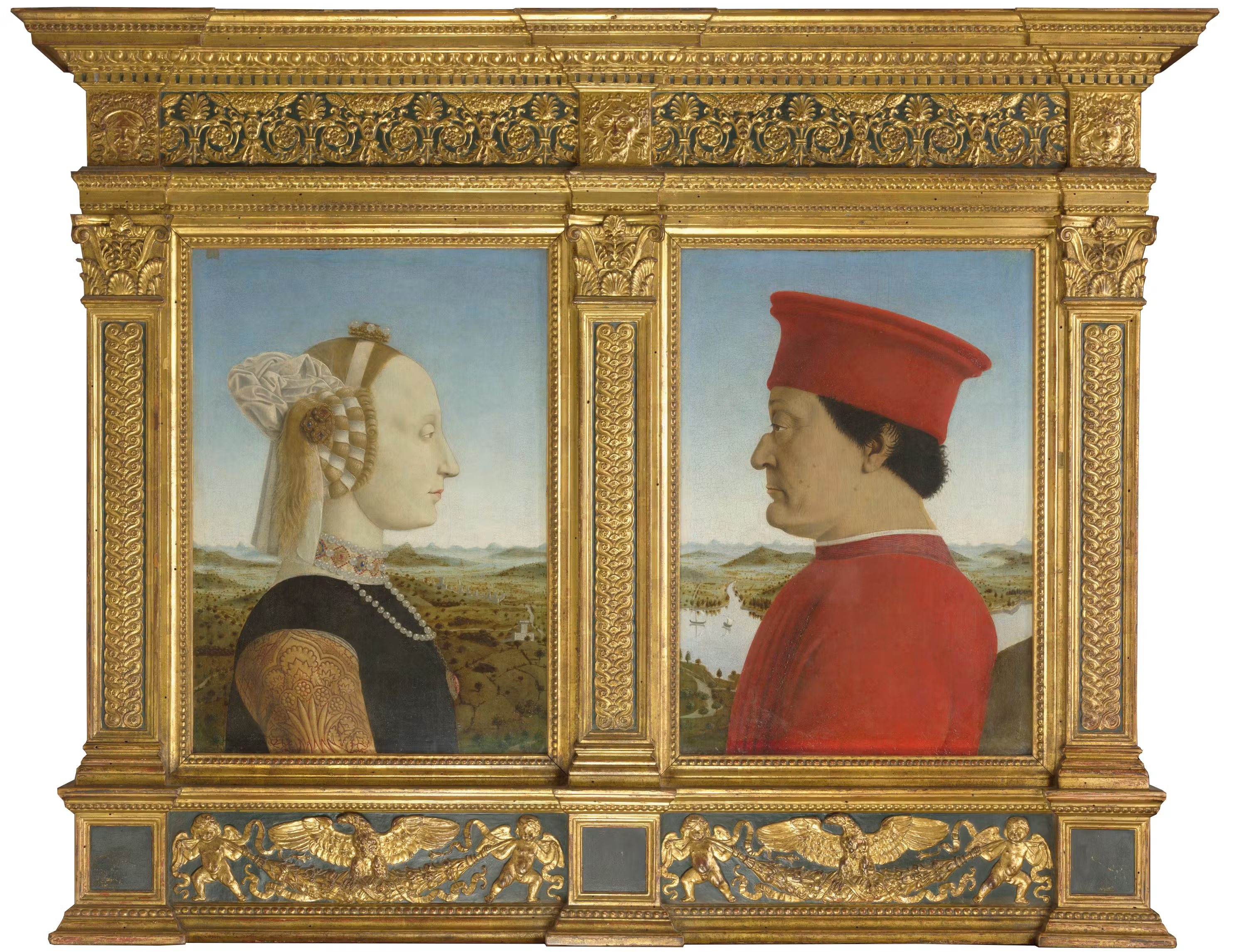
Battista Sfarza and Federico da Montefeltro, Piero della Francesca
Italian Renaissance, tempera on wood
first double portrait in Italy, shown in profile (truest representation)
idea that proper women don’t face the painting (like Portrait of a Lady by van der Weyden)

Madonna in the Meadow, Raphael
High Italian Renaissance, 1505-6, oil on board
contained composition, bright color palette, triangular composition
idealized Mary w/ baby Jesus and John the Baptist; John hands cross over to Jesus
poppy flowers in background represent Christ’s (future) bloodshed
signed name & date on the collar of Mary’s dress (like saying he made Mary)

Philosophy (School of Athens), Raphael
High Italian Renaissance, 1509-1511, fresco
Pope Julius II was a massive art patron, spent crazy money on Raphael & Michelangelo to paint Pope’s quarters & Sistine Chapel (“most pagan pope”)
full of ancient philosophers; Plato & his student Aristotle argue at center
Plato points to sky bc he believes life is sub-version of God/what’s above (idealism) while Aristotle extends hand toward Earth (empiricism)
Diogenes lays in middle of the stairs, very eccentric & counterculture; believed humans should live fully with nature
Heraclitus leaning on block of stone; thought humanity was miserable; thought to be representation of Michelangelo, who was very melancholic & disliked by Raphael
Raphael painted himself in between Ptolemy (geographer) and Zoroaster (astronomer); painter of the world & the bridge between earth & heavens
bald man is his uncle Bramante
structure is not archaeologically accurate, but strongly uses greek & roman imagery
the large number of philosophers shows new age of thought/debate & value of multiple perspectives (debate is healthy for truth)

Marriage of the Virgin, Raphael
High Italian Renaissance, 1504
scene isn’t actually from the Bible, comes from Golden Legend (medieval compilation of religious stories)
none of Mary’s suitor’s rods grew a flower except Joseph
linear perspective
revival of antiquity; temple in background looks old & resembles his uncle Bramante’s church design

Baldassarre Castiglione, Raphael
High Italian Renaissance, 1514
portrait of one of Raphael’s friends that was the author of “The Book of the Courtier” which became a Renaissance bestseller; resulting in the portrait became very popular
taught renaissance people how to act/dress/think/behave (ex. men must be calm and dress nicely w/o being flashy)
exemplified what Baldassarre described as the perfect man
spezzatura / artful artlessness - made the painting look easy

Pietà, Michelangelo
High Italian Renaissance, 1498-1500
intense drapery, idealized forms (neoplatonism), insanely good anatomy, triangular/pyramidal structure
Michelangelo snuck back and carved his name onto the band that goes along Mary’s chest so that everyone would know who made it and where
“Michelangelo Buonarroti, the Florentine, made this”
idealistic > realistic depiction of Mary

David, Michelangelo
High Italian Renaissance, 1501-1504
nude body w/o shame
largest sculpture carved in marble since antiquity
inherited another artist’s block of marble
represents ideas of high renaissance (anatomical knowledge, idealism)
head is slightly big because Michelangelo knew it would be on a pedestal, took into account observer’s point of view
sculpture engages the surrounding space; gazes off into the distance, feels bigger than the material space it occupies

Moses, Michelangelo
High Italian Renaissance, 1513-15
made for tomb of Pope Julius II
Pope has authority over church, Moses holds authority (10 Commandments)
engages space, looks into distance
depicted with horns bc of a mistranslation of medieval text (run rays emerging from his head mistranslated as horns)

Sistine Chapel (as a whole), Michelangelo
High Italian Renaissance ceiling (1508-1512) & late Italian Renaissance/Mannerist altar wall (1536-1541); frescos
really did NOT want to paint it, lowk forced to by Pope
scenes based on Genesis (origin of the world)
very bright colors (made to be visible in just candlelight)
incredible anatomical knowledge & idealism
masculine women
lower walls painted before Michelangelo & depict Jesus’ life
INCLUDES: Creation of Adam, Fall of Man, Libyan Sibyl, Last Judgement

Creation of Adam, Sistine Chapel, Michelangelo
High Italian Renaissance, 1508-1512, ceiling fresco
shows moment God infused Adam with humanity

Fall of Man, Sistine Chapel, Michelangelo
High Italian Renaissance, 1508-1512, ceiling fresco
temptation & expulsion of Adam and Eve, they immediately age and get ugly
lowk continuous narrative: snake w/ female form around tree turns into angel that throws them out of heaven
resembles Masaccio’s expulsion of Adam & Eve, which Michelangelo studied

Libyan Sibyl, Sistine Chapel, Michelangelo
High Italian Renaissance, 1508-1512, ceiling fresco
sibyls = female pagan prophets
platonic idealization; very muscular, man-like woman bc of how women came from men (and later grew more feminine features, per Michelangelo)
sibyls & prophets appear all over ceiling’s sides; connect genesis to Exodus (new testament)

Last Judgement, Sistine Chapel, Michelangelo
Late Italian Renaissance —> mannerism, 1536-1541, altar wall fresco
last judgement doesn’t typically appear on altar wall, emphasizes pope’s power of judgement
good souls brought up, sinful ones condemned & dragged to hell by demons
Christ at center resembles Apollo (like how Venus was made into the pagan version of Mary by Botticelli)
criticized by church official for having too many naked figures, so Michelangelo painted the official in hell surrounded by snakes
nudes were covered up in the later fig leaf movement
shows transition into new era: Mannerism
bodies are contorted & many are non-idealized

Tempietto, Bramante
Italian Renaissance, 1502-1509
small church/temple; extremely round; very classical
foundation of design for St. Peter’s cathedral
inspiration for temple in Raphael’s Marriage of the Virgin

Money-Changer and His Wife, Quentin Matsys
Northern Renaissance, 1514, oil on wood panel
man counts coins, woman reads bible; woman looks over at money in interest but still turns bible page
morality: money is being prioritized over religion; dilemma
circular mirror shows reflection of man in red turban by window
reminds viewers to reflect

Isenheim Altarpiece, Matthias Grünewald
Northern Renaissance, 1512-15 (same as Sistine Chapel ceiling frescos)
at St. Anthony’s hospital; meant to be seen by people who were dying of diseases that caused disfigurement
interior: wood carving, gilded; old fashioned, strong medieval influence
St. Anthony at center
exterior: oil paint; horrifically gory depiction of crucifixion; intense detail
John the Evangelist holding Mary, dead Jesus on the cross, John the Baptist next to lamb of god
left panel: St. Sebastian, pierced by arrows (associated with protection from illness, suffered bodily damage/disfigurement)
right panel: St. Anthony
lower panel: Lamentation (Jesus & Mary)

Self-Portrait, Albrecht Dürer
Northern Renaissance, 1500, oil on wood panel
Italian influence, feels more real & idealized (how he wants to be remembered)
depicted himself like Jesus; hand posed as Christ’s blessing
idea in 1500 that it would be the second coming of Jesus, portrays himself as that second coming
signed w/ explanation that he is the painter & he painted it at 29

The Fall of Man (Adam and Eve) Albrecht Dürer
Northern Renaissance, 1500, black and white print engraving
Eve resembles Venus Pudica & Adam is very muscular (Italian influence; incorporation of antiquity)
tons of animals, symbols of 4 humors
elk (black bile; melancholy, unhappiness)
ox (phlegm; indifference)
rabbit (sanguine; optimism, happiness)
cat (yellow bile; ill temper)
parrot signifies paradise (comes from warm, exotic climate)
goat on the edge of the cliff represents sexuality
Adam traps mouse’s tail with his foot, cat looks ready to pounce
they’ve yet to eat the apple, represents the evil that is about to be unleashed
sign hangs from tree (signature, specifies that a northerner made it)
Adam hold onto branch so that it’s more noticeable

Melencolia I, Albrecht Dürer
Northern Renaissance, 1514, black and white print engraving
represents creative block; condition of the melancholic genius (artist); sin of sloth
angel (unclear gender) sits unable to do anything
cupid sits down, sad
craft tools on floor; not being used
skinny stray dog lays down, asleep
scale hangs in perfect balance (no movement)
ladder blocked by large stone (stopped from being able to go up / move forward)
demon bat in distance holds up “melencolia” sign
use of art to convey philosophical messages

Great Piece of Turf, Albrecht Dürer
Northern Renaissance, 1503, watercolor
literally just a wet patch of grass & dirt
idea that God (his great design) can be seen in even the smallest & most humble/ordinary things
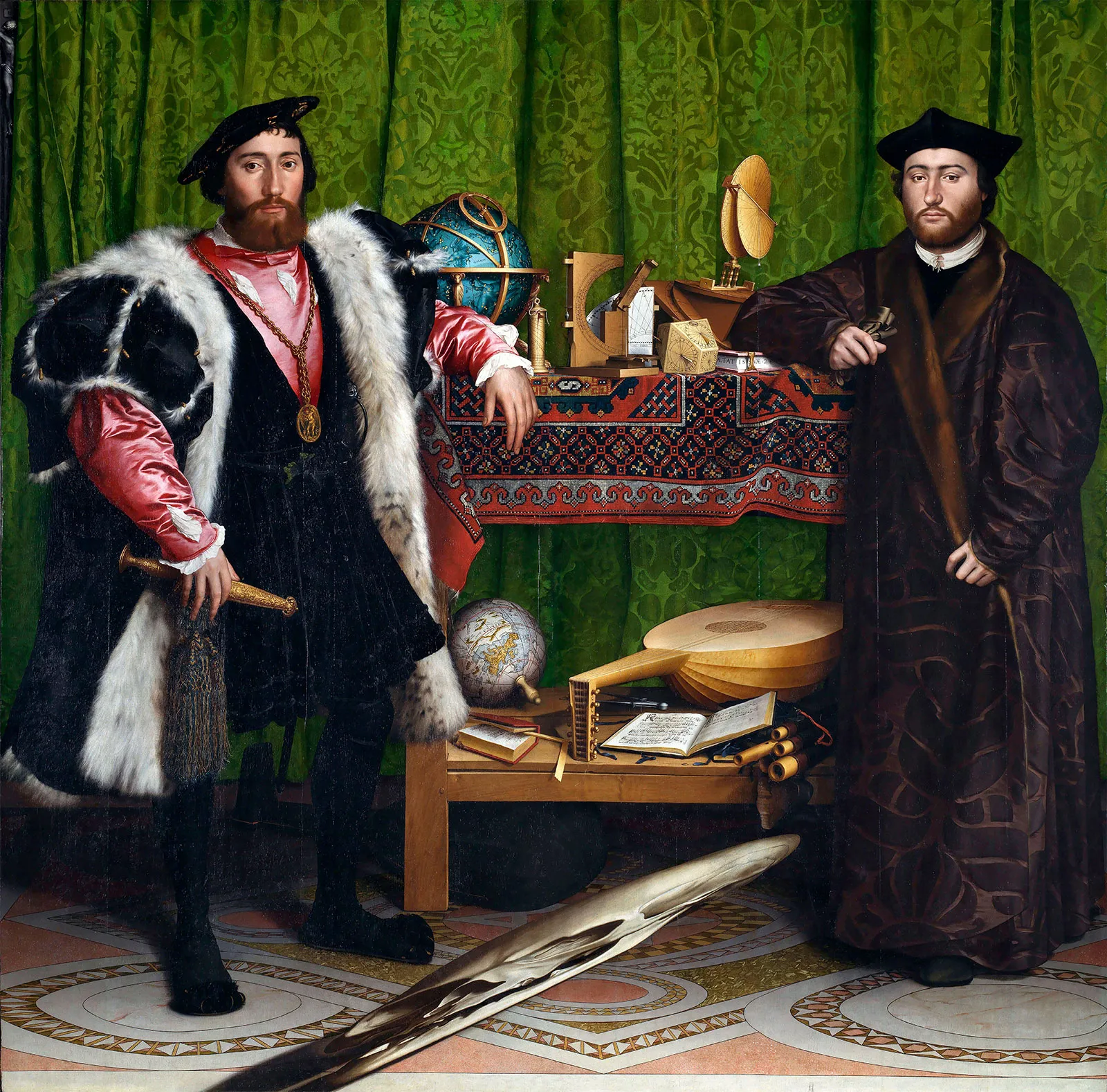
The French Ambassadors, Hans Holbein the Younger
Northern Renaissance, 1533, oil & tempera on wood
double portrait of 2 French ambassadors; monument of their friendship & shared time in England (when Henry 8th left Catholic Church)
represent secular (left) and religious (right) authority
top shelf: navigation tools on top of an oriental rug
bottom shelf: represents disarray in Europe due to issues w/ the church
fallen globe w/ an upside-down Europe
lute that normally represents harmony has a loose/missing string
math book open to page on division (not addition)
skull in center is only visible from side angle (memento mori)
some things are invisible until you take on the proper perspective
tiny hanging figure of Jesus on the cross pokes out on the edge of the bright green curtain
most people just focus on the “interesting” part and never see what’s actually important

Madonna and Child with Saints, Giovanni Bellini
Venetian Renaissance, 1505, oil on wood transferred to canvas
more subtle, naturalistic color palette compared to Michelangelo (same time); still rich, jewel-like colors
triangular composition
sensitivity to light & shadow; soft contours, otherworldly appearance
one-point-perspective; painted columns mimic actual columns of altar, 3D effect, viewer feels physically brought into space
large scale altarpiece in San Zaccaria (father of John the Baptist) church
surrounded by other paintings; Venice kept painting & repainting
Mary sits on throne holding baby Jesus, surrounded by other figures
symbol of God the father on top of chair
St. Peter wearing yellow, holding keys
St. Jerome wearing red, white beard
St. Catherine of Alexandra holds broken wheel (how she was martyred) & St. Lucy holds vessel w/ eyes - “brides of Christ”

Feast of the Gods, Giovanni Bellini & Titian
Venetian Renaissance, Bellini started in 1514 but died, finished by Titian in 1529
chaotic scene of gods from classical mythology
painted for palace of Duke of Ferrera (secular, in private residence, NOT for general public, reserved for patrons, reg people only get religious paintings)
gods represent Duke’s wealth & happiness
during a festival, a demigod tries to lift a nymph’s skirt but a donkey starts making noise, which alerts everyone of what the demigod is trying to do so they all start making fun of him
little child (Dionysus/Bacchus) fills cup w/ wine
gods hold Chinese vessels (shows trade & desire for exotic goods)

The Tempest, Giorgione da Castelfranco
Venetian Renaissance, 1509-1510
prime example of poesia
not a conventional story; poetic exploration of theme without (clearly) depicting an actual story from Bible or classical myth; meant to be unclear and have multiple interpretations
shows how liberal Venice was (for the time)
nude woman breastfeeds a child, surrounded by nature, looks toward viewer
man in soldier uniform looks longingly at woman, water flows as gap between them
background shows ruined buildings & an oncoming storm

Assumption of the Virgin, Titian
Venetian Renaissance, 1515-1518, HUGE scale (22×11’) altarpiece
Mary assumed into heaven following her death/sleep to be crowned queen of Heaven (not in Bible); apostles look up in disbelief
3 levels: apostles, Mary, & God; surrounded by angels
eyes drawn up to God
apostles point to Mary, Mary looks up to god
colors get brighter & warmer closer to God
many many many angels
Titian wanted to show his ability to create harmony with many figures & ability to depict both the material and non-material
clouds shift into angels’ faces
emphasis on light & shadow, no firm outlines (like sfumato) yet still feels real & flesh-like

Venus of Urbino, Titian
Venetian Renaissance, 1536-1538, oil on canvas
commissioned by Duke of Urbino, displayed in his bedroom
nude woman (“Venus”) lays provocatively on bed
maids reach in background reach into chest & hold her dress; unclear if Venus has just been undressed or is about to be dressed
symbolism: Venus holds flowers (virginity), dog lays on bed (loyalty)
exemplifies how Venetian Renaissance came up with new types of subject matter & didn’t follow strict storytelling

The Last Supper, Tintoretto
Venetian Renaissance, 1594, oil on canvas, huge scale
large-scale canvas, not fresco, bc humidity in Venice is so high that frescos can’t hold up
side/diagonal view of the table; shows full scene (what’s on the other side of the table)
depicts non-material along material; spirits/ghosts/angels form the atmosphere
dark with concentrated areas of light (ceiling light flame & Jesus’ halo)
mannerism - bodies twist & turn; more value placed on manner of painting than the actual content itself/the story being told

Christ in the House of the Levi, Paolo Veronese
Venetian Renaissance, 1573, oil on canvas
originally meant to be The Last Supper; Veronese was called into trial for religious heresy bc he painted so many extra people (incl German soldiers)
sentenced to fix the painting but instead just changed the name so that it was about a different dinner Jesus attended
depicted w/ contemporary Venice buildings & clothes

Entombment of Christ / Deposition From the Cross, Jacopo da Pontormo
Mannerism (Italy), 1525-28
In church chapel for Capponi family
images in chapels often deal with death since that’s where the patron family is buried; this depicts when Jesus is taken off of the cross and put in his tomb
yet neither the cross nor the tomb are visible
figures blend into each other, unusual proportions, weird poses
figures seem to float in an undefined space
vibrantly-colored clothes that aren’t primary (pink, green, light blue) - typical of mannerism; light colors despite the dark, morbid theme
feels disconnected from the religious significance (Pontormo not concerned if ppl will be actually moved by it)
faces of figures all look nearly identical
small self portrait peeks out in the background

Self-Portrait in a Convex Mirror, Parmigianino
Mannerism (Italy), 1524, small scale, oil on wood
mimics actual mirror: size, slightly curved wood mimics how mirrors were convex, round, large frame
proportions are twisted in “mirror”; interesting perspective
idealized; how artist wants to be remembered
dressed in nice clothes (silk & fur)
hand at the forefront, with a gold ring - not just craftsmanship, but elegance & intellect
like Dürer’s self-portrait
demonstrate’s artist’s ability to play with forms; “look how clever I am”

Garden of Earthly Delights, Hieronymus Bosch
Mannerism (Northern Europe), 1505-1510, large wooden panel
shaped like altarpiece set so bizarre that it feels insulting to Christianity
accepted & kept w/ Spanish kings (biggest catholics in Europe) bc it was treated as a satire on the stupidity of humanity
teaches how to be good christians via bad examples (what not to do/how not to be)
CLOSED: black & white representation of Earth; very weird but fit w/ contemporary knowledge (both flat & round)
LEFT: Garden of Eden
owl hidden in fountain of life (odd pink sculpture); knows what’s actually going on but no one pays any attention to it
CENTER: humans on earth
everyone is getting crazy freaky in ALL types of ways (humans w/ animals, same-sex, different races)
shows how world (humanity) is wrong & upside down
berries are the delights; everyone is trying to eat berries
only source of smth sweet/sugary at the time
singular nude man holds onto owl (the only one who understands)
RIGHT: hell (the only possible afterlife; no heaven)
everyone is punished by different musical instruments
satan eats people and poops them out
pig nun harasses man w/ indulgences
we are all egg man (fragile, meant for/stuck in hell)
message: current church is corrupt (ties into Protestant Reformation); all humans do is be gluttonous & frivolous (eat & play music)

Venus, Cupid, Folly, and Time, Bronzino
Mannerism (Italy), circa 1546
like a puzzle; very odd scene, still unknown what the story is
name is just the one given by art historians
meant for a sophisticated audience that wanted something new & diff from high renaissance; NOT for regular people
patrons like to feel intelligent & superior
allegory, veiled meanings; visual puzzle w/ complicated narrative (a LOT going on)
main figures are smooth & refined, they look like porcelain dolls (artificial & decorative)
Venus (holding golden apple) & winged Cupid (her son) kiss incestuously
non-winged cupid holds flowers that he throws at Venus
idea of 2 cupids: good & bad love
woman behind flower cupid is weirdly posed and her bottom half morphs into weird monster amalgamation creature
Father Time (old man) holds up bright blue drapes w/ help from unknown figure; various interpretations abt relationship w/ time & truth
time removes veils, revealing truth
deception; something is not as it seems
Envy - man hideous with envy screams behind the drapery
allegory - meaning is diff than what’s directly shown

Landscape with the Fall of Icarus, Pieter Bruegel the Elder
Mannerism (Northern Europe), 1558
highly philosophical; only intellectuals can decipher the meaning
Icarus is drowning but no one notices/looks at him
not at the center, instead hidden in the water; viewer must search for him & be attentive to understand what’s actually going on
most of the world won’t care or even notice what happens to you, even if your world feels like its ending
highly detailed landscape - introduces idea of Northern landscape depiction

Netherlandish Proverbs, Pieter Bruegel the Elder
Mannerism (Northern Europe), 1559
series of moralizing images meant to teach people how to be (via bad example), based on many many many proverbs
some shear sheep, some shear pigs; throwing pearls to the pigs; closing the well after the calf has drowned; pissing at the moon
shows world/humanity’s chaos & backward-ness

St. Peter’s, Bernini (& many others but he finished it)
Italian Baroque, completed in 1660
HUGE scale, piazza is even bigger than the church (brings everyone in)
piazza lined with saints to affirm catholic doctrine
interior meant to inspire awe and make you feel like it’s the best (and therefore most powerful)
interior contains Baldacchino

Baldacchino, Bernini
Italian Baroque, within St. Peter’s
placed precisely over where St. Peter is thought to have been buried
bronze & gilded; highly decorated
spiral columns meant to emulate oldest temple (Solomon)
show continuity & constance of church and that it is evolving
can look directly through to see St. Peter’s chair at the altar

David, Bernini
Italian Baroque, 1623
in-motion; depicts moment where David is about to throw the stone
more difficult to portray than static pose, wanted to show he was better than Michelangelo
life-size, make’s Michelangelo’s seem like the new Goliath
thought to be a self-portrait
commissioned by Cardinal, sits in same room that it was created in
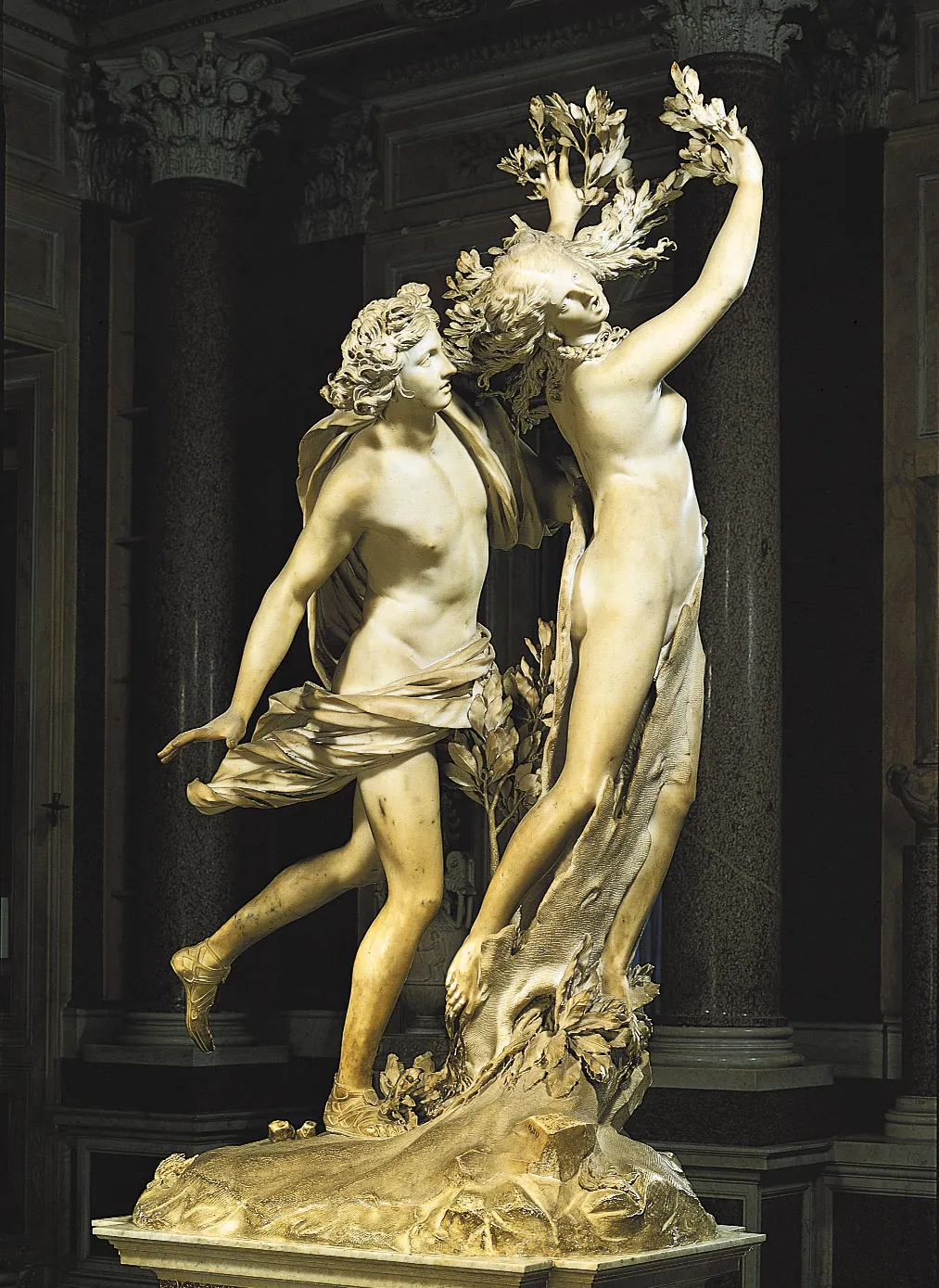
Apollo and Daphne, Bernini
Italian Baroque, 1623-4
two figures in motion, 8’ marble sculpture
same room as David statue, part of Cardinal’s collection
immense detail that can be seen from all angles, marble is very thin in certain areas; delicate
STORY: Apollo was taunting Eros, who got back at him by shooting him with a gold arrow, causing Apollo to fall in love with the nymph Daphne; she was hit by a lead arrow (hate) and prayed for help to escape him, gods turned her into a Laurel tree
poets given Laurel bc art is compensation for failure in love
statue depicts exact moment of Daphne’s transformation as Apollo grabs onto her

Ecstasy of Saint Teresa, Bernini
Italian Baroque, 1647-52, large marble statue in a chapel
looks extremely real, very expressive
extremely elaborately decorated; highly impressive
STORY: depicts one of St. Teresa’s spiritual visions where an angel pierced her heart with an arrow, causing her to die but also showing/giving her the path to Heaven
Teresa was a real woman that had “visions”, was brought up to sainthood after her death; part of counter-reformation efforts
sculpture depicts crucial moment right before her heart is pierced; tension
real light comes in through window above & combines with artificial golden rays; blurring of line between reality and art; transformative

San Carlo alle Quattro Fontaine, Borromini
Italian Baroque, 1646
highly dramatic; classical elements but with movement
FACADE: concave, flowing shapes, undulating shapes
interior: oval, not symmetrical

Glorification of St. Ignatius, Fra Andrea Pozzo
Italian Baroque (counter-reformation), 1691-4, ceiling fresco
depicts St. Ignatius being brought up to heaven
unclear distinction between wall and ceiling; illusion of room extending upwards into heaven
includes known continents at the time (America, Asia, Europe, Africa)
jesuits travelled everywhere to convert people; shows widespread reach & universal-ness of church

Calling of Saint Matthew, Caravaggio
Italian Baroque, 1597-1601, oil painting
tenebrism (high contrast, dramatic illumination), chiaroscuro
painted for church chapel (private commission)
critical moment: Jesus and St. Peter (dressed humbly & barefoot) have just walked into room, interrupting group of men (dressed in fancy contemporary Italian clothing) that are counting money
among the men is Matthew, a tax collector that would become one of the four gospel writers; hasn't quite realized what’s going on, points to himself in confusion
Jesus points at Matthew that intentionally mimics gesture in Adam & Eve in Sistine chapel (audience in Rome would understand reference; challenges Michelangelo)
contemporary clothing made it more relatable to the audience, makes them think about being in that situation/what they would do
light comes in through window above/behind Jesus & Peter, “enlightening” Matthew
window on visible wall is blocked (Matthew isn’t quite aware yet), frame on window resembles cross

Conversion of Saint Paul, Caravaggio
Italian Baroque, 1601, oil painting
scene comes book of apostles, NOT bible; treated as fact
critical moment: Paul had been persecuting Christians and now, on his travels, was temporarily blinded by a vision of Jesus that caused him to fall of his horse and he is now about to be trampled (maybe)
Paul is instead saved by the grace of God and is converted (transformation scene)
viewer feels involved in scene, invokes concern and empathy
highly realistic & naturalist; chiaroscuro adds drama

Judith Slaying Holofernes, Artemisia Gentileschi
Italian Baroque, 1614-20, oil painting
STORY: from Old Testament, Judith goes into Holofernes’ tent (enemy general) to “seduce” him; gets him drunk and kills him (heroic woman, symbol of female virtue)
symbolizes Gentileschi’s revenge against her rapist
very graphic & dramatic, chiaroscuro; more intense to show women’s ability to push extremes (like how Bernini went further than Michelangelo to show he was better/more skilled)

Martyrdom of Saint Philip, José de Ribera
Spanish Baroque, 1639, oil painting
baroque bc themes of crucial moment, seeking faith, & transformation
spanish bc of emphasis on martyrdom (influence of Reconquista & fighting/sacrificing for faith)
critical moment: St. Peter is about to be crucified by Romans for his Christian beliefs (being pulled up onto the cross)
agonized & emaciated yet seems accepting of fate; looks up to heavens
connection to St. Teresa where moment of martyrdom=moment of salvation that brings you closer to God/heaven bc like Jesus, you have sacrificed yourself for your faith

Saint Serapion, Francisco de Zurbarán
Spanish Baroque, 1628, oil painting
Serapion died 3 centuries earlier by Muslims (merging of past & present; connects to contemporary struggle for faith)
idea that sacrifice/martyrdom=salvation
pose resembles Jesus/crucifixion
stark contrast between dark background and light drapery/clothes

Water Carrier of Seville, Diego Velázquez
Spanish Baroque, 1619 (early work), oil painting
realistic, naturalistic, use of chiaroscuro
appears to be a scene of ordinary daily life—humble man in tattered clothes brings jug of water to boy
water is crucial in hot Seville —> humble man offers something precious (like idea that you shouldn’t judge a book by it’s cover; sophistication in even the most humble of things)

King Philip IV of Spain, Diego Velázquez
Spanish Baroque, 1644, oil painting
portrait of King Phillip IV of Spain, who Velázquez was on friendly terms with
royal attire, aristocratic, feels regal yet still shows sense of humanity (king has taken off his hat and holds it casually)
exemplifies how he always want to show humanity in his subjects, even/especially if those subjects are the royal court

Surrender of Breda, Diego Velázquez
Spanish Baroque, 1634-5, oil painting
unusual depiction of military success because it emphasizes humanity
Dutch on left (chaotic formation), Spanish on right (orderly) in foreground; background depicts battle scene (burning fields & ruined buildings)
STORY: Spanish won against Dutch for control of Breda; Spanish threaten to pillage the town if they aren’t given the city; Dutch mayor gives keys to the city to Spanish general
humility: general has gotten off of his horse (pictured backwards in front of the Spanish soldiers) and has taken off his hat to meet the Dutch mayor at his level; almost embraces him as he accepts the key
spanish aren’t just victorious, but humane as well
viewer involvement- various people in the crowd look at viewer
some people have their backs turned, creates more real & 3D effect
figure peeks out from behind horse on far right, self-insert of Velázquez

Las Meninas, Diego Velázquez
Spanish Baroque, 1656, HUGE oil painting (10’×9’)
very atypical royal portrait, highly conceptual; depicts scene at painting studio
more so a painting about painting than an actual portrait
interpretation: painting about how everything passes through a space, including the viewer who will move on to look at something else
self-portrait of himself painting a large canvas that’s the same size as Las Meninas
paradoxical - painting the painting that we are seeing
more servants than royals pictured; shown on equal level
King and queen portrait in background, puts viewer in same position as them
influenced by Arnolfini Portrait, which was under Spanish possession at the time
could be a mirror, reflecting what is being painted on the large canvas
humanizes the environment, breaking conventions of royal portraiture
unique piece; only royal portrait like it; nothing looks similar neither before or after it
man in the background stands in doorway; shows how there’s more going on; both entry & exit

Elevation of the Cross, Peter Paul Rubens
Northern Baroque (Flemish), 1610, massive scale oil painting, 3 panels
baroque elements: strong diagonal movement, dramatized portrayal, massive scale, in the middle of a moment
unusual depiction of crucification: portrays moment Christ is being lifted on the cross
many muscular men struggle to raise Jesus on the cross; symbolizes weight of sins
Jesus’ arms are raised in an almost triumphant-looking manner (show his heroism & catholic focus on self-sacrifice)
Left: various women cry; child tries to grasp mother’s breast; Mary (blue) appears calm next to John the Evangelist (stoicism)
Right: two other men are about to crucified as well
influence from Michelangelo (muscle), Caravaggio (light/shadow, realism), & Titian (color)

Consequences of War, Peter Paul Rubens
Northern Baroque (Flemish), 1638-9, massive scale oil on canvas painting
anti-war painting; created during 30 Years’ War
war causes suffering to art & innocent people
painted for Duke Medici, Rubens wrote a letter that was sent alongside the painting explaining the allegory in the painting
wanted to make sure others understood his symbolism/message
Venus grabs at Mars, but he continues powering forward with his bloody sword toward group of women & children
beauty/peace try but fail to hold back war
Old woman with torch (a fury) leads Ares forward/toward war
woman in black represents Europe, stands in front of a temple w/ a symbol of Janus above some open doors
open doors to Janus’ (god of boundaries) temple represents war
little cupids try to help their mother; emphasize drama & sadness

Garden of Love, Peter Paul Rubens
Northern Baroque (Flemish), 1630-2
painted for himself; hung in Ruben’s house
at a point where he was so rich/famous that he could just paint for himself/pleasure
personalized allegory
idealized image of Rubens bringing his new wife Helena to the Garden of Love (poetic construct; around since Middle Ages)
doesn’t use regular symbols; demonstrates artist as intellectual
overlap of sacred & profane
fountain of Venus squeezes water out of her own breasts
Rubens saw Venus as the mother of everyone (bc love creates children)

Archers of Saint Hadrian, France Hals
Northern Baroque (Netherlands), 1633
group portrait of civic guards, complicated scene
each person pictured paid to be included
sense of clarity; everyone’s face is visible
painted during 30 Years’ War; Holland was no longer fighting w/ Spain but soldiers that fought previously liked to demonstrate their heroism by continuing to dress up
figures seem to be reacting to viewers; invite viewer in/makes one feel like they’re there in the room (very baroque)

Night Watch, Rembrandt
Northern Baroque (Netherlands), 1642
captain talks to lieutenant, surrounded by other people
unlike Hals, figures are less defined
little girl in yellow has a chicken tied onto her waist
inside joke; painting depicts General Cocq (cocq—>chicken)
little eye, presumably Rembrandt, peeks out behind figures (self-insertion)

Anatomy Lesson of Dr. Nicolaes Tulp, Rembrandt
Northern Baroque (Netherlands), 1632
depicts Dr. Tulp giving an anatomy lesson to a group of men, using a corpse
Anatomy Theater - as medicine began to rlly develop during 1600s, doctors would hold classes that anyone (even women) could attend to learn about anatomy
commissioned by Dr. Tulp (famous dr), who wanted an image of himself and his students
innovative portraiture: combines group portrait with an event
invites viewer into painting, space for viewer to join group
anatomy lesson is started on arm, not chest
left arm is considered sinister, corpse used was likely criminal; can extrapolate some meaning about bad things can still lead to goodness/knowledge

Self-Portrait (1658), Rembrandt
Northern Baroque (Netherlands), 1658
one of many, often painted himself; dressed in various fancy costumes
not idealized; depicted himself realistically w/ his age
sits on a throne w/ fancy clothes
ironic bc he was bankrupt at that time

Self-Portrait (1659-60), Rembrandt
Northern Baroque (Netherlands), 1659-60
realistic depiction of himself/his age; doesn’t beautify himself
shows himself as a painter; dressed simply in studio clothes, holds brushes & palette
2 large circles on wall behind him
empty maps of the two hemispheres? —> is so busy he doesn’t have time to finish map/what he’s started; consideration of morality?

Christ with the Sick around Him (Hundred-Guilder Print), Rembrandt
Northern Baroque (Netherlands), 1649, etching/engraving
strong contrast between dark and light
sold for a hundred guilder, which was a massive amount to money for a print (typically that much was only paid for actual paintings)
allowed w/ Protestants despite being imagery from the Bible bc the scene is presented as historical/informational instead of in a way that idealizes/iconizes figures