Alkene Reaction Mechanisms
 Call Kai
 Learn
 Practice Test
 Spaced Repetition
 Match
 Flashcards
 Knowt Play
1/19

There's no tags or description
Looks like no tags are added yet.
20 Terms
-SP2 hybridized
-Empty P orbital= highly reactive
3 > 2 > 1 > methyl
-carbons are supportive
Carbocation Stability
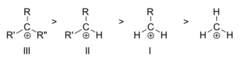
-spreading out charge by the overlap of an empty p orbital with an adjacent sigma bond
-Inx of e- in a sigma bond (C-H or C-C) with an adjacent empty P or pi orbital to give an extended molecular orbital that increases stability
hyperconjugation

-electron pair donor
-negative charge
-Attacker
Nucleophile

-Love electrons
-Gets attacked
-Positive Charge
Electrophile

-H2, Metal
-Break Pi bond
-Add H and H
-Syn (same side)
Hydrogenation

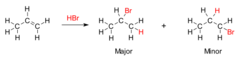
-HBr or HCl
-Break Pi bond
-Add H and X (Br, Cl)
-Mark
-Rearrangements
HX addition

-HBr or HCL, H2O2
-Break Pi bond
-Add H and X (Br, Cl)
-Anti-Mark
HX + hydrogen peroxide

when two substituents add to the same side of a double bond
syn addition

hydrogen will add to the least substituted carbon of the double bond
Markovnikov's Rule
- used to convert alkenes to alcohols
- electrophillic addition reaction
- Markov
- carbocation rearrangements are possible
- reagents: H20, H+, H2SO4 (aq)
Mechanism:
1) protonation of alkene pi bond to form carbocation
2) reaction with H2O to give alcohol product
Acid Catalyzed Hydration

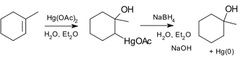
1) Hg(OAc)2, H2O
2) NaBH4
-break pi bond
-add H and OH
-Mark
1. HgOAc added
2. H2O attach carbocation
3. O of H2O attack O of H2O to make alcohol
4. NaBH4 replaces Hg(OAc)2 with H
Oxymercuration alkene to alcohol
1) Hg(OAc)2, MeOH or EtOH
2) NaBH4
-break pi bond
-add H and OR
-Mark
1. HgOAc added
2. MeOH attack carbocation
3. O of H2O attack O of MEOH to make MeO
4. NaBH4 replaces Hg(OAc)2 with H
Oxymercuration alkene to ether
1) BH3-THF
2) H2O2, NaOH
-break pi bond
-add H and OH
-anti mark
-syn
1. attack and break at the same time, BH2 and H added
2. H2O2, NaOH replaced BH2 with OH
Hydroboration

-Br2 or Cl2, CCl4
-addition of X2
-Break pi bond
-Add X & X
-Anti (different sides)
-2 halogens attached to 2 carbons participating in double bond
Dihalogenation (X2)

-Br2 or Cl2, H2O
-addition of X and OH
-Break pi bond
-Mark
-Anti (different sides)
Dihalogenation halohydrin formation

-OsO4
-Break pi bond
-Add 2 oh alcohols
-Syn
-2 alcohols attached to 2 carbons participating in double bond
Dihydroxylation

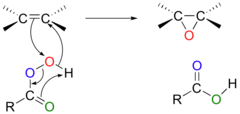
-mCPBA
-Break pi bond
1. Add oxygen that forms single bond (epoxide) with each carbon of double bond
2. mCPBA converted to carboxylic acid
Epoxidation of Alkenes
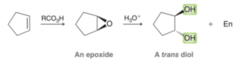
1) MCPBA
2) H3O+ or NaOH
1. Add oxygen that forms single bond (epoxide) with each carbon of double bond
2. mCPBA converted to carboxylic acid
3. Add H3O+ or NaOH to make 2 trans alcohols
Epoxidation anti-diol
1) O3
2) DMS
1. break sigma and pi bond (double bond)
2. form double bond with oxygen
3. form aldehyde + ketone
Ozone

KMnO4
1. break sigma and pi bond (double bond)
2. form 2 double bonds with oxygen
3. hydrogen gets oxidized to OH
3. form carboxylic acid + ketone
KMnO4
