Comprehensive Guide to Lean Six Sigma and Process Improvement in Pharmacy
 View linked note
 Call Kai
 Learn
Learn Practice Test
 Spaced Repetition
 Match
Match Flashcards
 Knowt Play
1/34

There's no tags or description
Looks like no tags are added yet.
Name | Mastery | Learn | Test | Matching | Spaced | Call with Kai | Chat |
|---|
No analytics yet
Send a link to your students to track their progress
35 Terms
What is the definition of Lean Six Sigma?
a diciplined, data-driven approach to process improvementthat combines the principles of Lean manufacturing and Six Sigma methodologies to enhance efficiency, reduce waste, and improve quality in organizational processes.
What is Lean?
Process primarily focused on efficiency, doing more with less, and reducing waste (Muda). It asks: “Are there steps in this process that do not need to exist?”
What is Six Sigma?
Process focused on precision and reducing variation to eliminate defects. It asks: “Why isn’t this process producing the same exact results every single time?”
The combination of Lean and Six Sigma allows for Continuous improvement (CI), what is CI?
Iterating on a process repeatedly until a flawless result is achieved every time.
Developer of Six Sigma and what company?
Bill Smith (Motorola)
Where did Lean originate?
Toyota
What is the phylosophy of Lean?
If a step does not add value for the costumer, it should be eliminated.
What does Kaizen mean?
Continuous improvement; It is a culture of making small, intentional changes every day rather than waiting for something to break before fixing it.
The Lean Six Sigma standard of excellence euqates to less than ____ defects per million opportunities (DPMO)
3.4
What is Dr. Walter A Shewhart responsible for?
Developed control charts to track process variation, and the Plan-Do-Check-Act (PDCA) cycle
PDCA?
Plan: Identify change or improvement
Do: implement change
Check: measure process or outcome
Act: Occurs when outcomes are not desired
Lean principle: Value
Defined by what the costumer (patient/player) is willing to pay for. It must improve safety, outcomes, or satisfaction..
Lean principle: Create value stream
Mapping every step to see that adds value and what causes waste
Lean principle: flow and pull
keeping work moving based on real costumer demand (Just-in-Time)
Lean principle: Empowerment
Ensuring the people doing the work are empowered to eliminate waste
Lean principle: perfection
constant striving for zero defects and zero waste
Roles in Lean Six Sigma project: executive management
senior organization executives who create vision for the project:
Define the strategic goals, metrics, and business targets
create and promote environment for Lean Six Sigma to be used
Roles in Lean Six Sigma project: Executive sponsor:
senior leaders who allocate resources, set strategic goals, and remove roadblocks
Roles in Lean Six Sigma project: Champions
upper-level managers who work with sponsor to align projects goals; responsible for deparmental communication
What is the DMAIC methodology?
step-by-step roadmap for running Six Sigma
DMAIC Step: Define
identify the problem, the costumer, and the project scope
DMAIC Step: Measure
establish a baseline and understand the process as it runs today using collection and process mapping
DMAIC Step: Analyze
Dig into data to find the real root cause (x’s) of the problem (y) using fishbone diagrams and the “5 whys”
DMAIC Step: Improve
Develop, pilot and implement a solution
DMAIC Step: Control
Lock in the win through monitoring and documentation to prevent the process from sliding back
Total Quality Management (TQM)
A broad phylosophy where quality is everyone’s responsibility (frontline to c-suite)
Business Process Re-engineering (BPR)
A radical, all-at-once redesign often triggered by new technology
Rummler-Branche
Uses a “Nine Boxes Model” to check performance at three levels (performer, Process, Organization) against three needs (Goals, Designs, Management).
Scrum
A fast-moving project management method with three phases: Pregame (planning), Game (working), and Postgame (QA/change management)
Costumer Experience Management (CEM)
An “outside-in” approach that starts with customer needs and works backwards
Jumpstart
A fast-paced session for solving a small, low-risk problem in a single day
The Eight Muda:
Overproduction: Compounding more meds than needed before they expire
Defects/rework: Mislabeling a prescription bottle
Inventory: Expensive meds sitting on shelves depreciating
Motion: Walking long distances to a printer or different floors
Transportation: shuttling meds between facilities unnecessarily
Waiting: Patients stuck in a drive-thru for prior-authorizations
Over-processing: Running five redundant checks when two suffice
Skills: using a PharmD for data entry tasks that a technician could perform
5S Methodology: workplace organization
Sort: Keep only what is needed; discard the rest
Straighten: Label a “home” for every item
Shine: Keep the area clean to prevent errors
Standardize: ensure everyone, not just the organization person, follows the rules.
Sustain: Maintain the habit over time even when not being watched
The Pareto Principle
“80/20 Rule” 20% percent of the cuases for errors lead to 80% of the problems
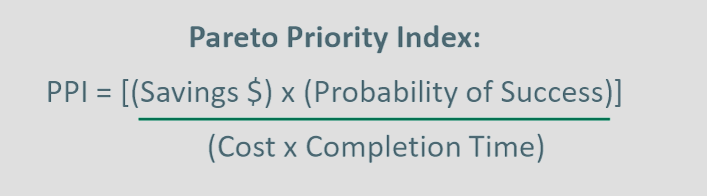
Pareto Priority Index
index used to prioritize a project based on estimated savings, likelihood of success, cost, and time required