Review Notes: Catabolism of Fatty Acids - Oxidation of Fatty Acids
 Call Kai
 Learn
 Practice Test
 Spaced Repetition
 Match
 Flashcards
 Knowt Play
1/23

There's no tags or description
Looks like no tags are added yet.
24 Terms
Purpose of the Oxidation of Fatty Acids
→ FA oxidation is the MOST important fuel for the liver
provides 80% of the energy needed by the liver & heart
preferred fuel of skeletal muscle (but muscle also mops up blood glucose via GLUT transporters)
Pathways of Fat (TAG) & Fatty Acid metabolism
FAT (TAG): synthesis & breakdown
storage of fatty acids as fat (TAG) via esterification
breakdown of fat to release fatty acids via lipolysis
Fatty acids: Synthesis & Breakdown
fatty acid synthesis (FAS)
Breakdown via B-oxidation (B-OX)
Breakdown of Fat (TAGs) in the Liver & Adipoctyes
→ Hormones trigger mobilization of stored TAGs in the adipocytes
glucagon (works here & in liver) + adrenaline/epinephrine
lipid droplets in adipocytes store TAGs + are surrounded by Perilipin
Perilipin = when NOT phosphorylated it from a barrier around lipid droplet → phosphorylation of this is CRITICAL for TAG breakdown (more than lipase)
see decreased expression in adipocytes during obesity, thus they release a large # of free FA into bloodstream
see increased expression in other cells, thus buildup of TAGs (bc perilipin is a barrier)
Adipose triglyceride lipase (ATGL) = main enzyme breaking down TAGs → free FA + glycerol
process of TAGs → free FA:
hormone (glucagon/adrenalin) binds to receptor → activates α-subunit
α-subunit activates Adenylyl cyclase → converts ATP to cAMP
4 cAMP activate PKA
PKA uses ATP to add P to hormone-sensitive lipase → ACTIVE when phosphorylated bc we need energy from fat
lipase uses ATGL to breakdown TAGs stored in lipid droplets by phosphorylating the perilipin barrier
TAGs are broken down into FA’s by ATGL using water, these free FA enter bloodstream & bind to albumin
glycerol released goes to liver


free FA from bloodstream → CO2 + energy:
FA transporter allows free FA bound to albumin in bloodstream to enter muscle cell
free FA goes thru B-oxdiation, CAC & respiratory chain (ETC) → generates ATP & CO2
How do free fatty acids travel in the bloodstream?
free FA CANT travel in the bloodstream as they have extremely low solubility in aq solutions → THUS, they’re bound to serum albumin that allows them to move thru blood

Is Fat (TAGs) or glycogen a more efficient store of energy?
note: glucose in glycogen has a lot more -OH groups, thus requires more oxidation
→ Fat is a MORE efficient store of energy than glycogen: 2 reasons
more energy is available from fatty acids as they’re more highly reduced (more H’s)
1g of fat contain 7x as much energy as 1g of glycogen
fat is anhydrous, thus contains little water as its highly hydroPHOBIC
bc they’re PHOBIC, FA can pack tightly together making their mass and volume more efficient
What is the effect of muscle contraction in skeletal muscle on fatty acid translation & glucose?
→ muscle contraction INCREASES translocation of fatty acids & GLUT4 transporters to PM in muscle
occurs when insulin (hormone) increases & exercise/muscle contraction result in an increased level of AMP that activates AMPK
effect on glucose levels:
insulin binds to receptor on PM signalling high blood glucose → signal cascades to endosomal compartment of muscle that causes GLUT4 vesicle to send GLUT4 to PM → INCREASES glucose entering the muscle cell
effect on fatty acid translocation:
increased muscle contractions increase AMP levels → AMP activates AMPK → AMPK causes release of CD36 (FA translocase) vesicles to be sent to PM → transporters on PM allow longer chain FA to enter muscle cell

What is a limitation is the use of fatty acids as fuel molecules?
fatty acids can ONLY be metabolized AEROBICALLY
thus we don’t store fat in muscle for energy, bc they cant be metabolized in hypoxic conditions where the muscle needs energy
note: RBC & the brain CANT oxidize FA (RBC don’t have mito to oxidize FA)
What are the 2 Major sites of fatty acid (FA) catabolism (breakdown)?
→ Liver : breaks down FA’s → A-CoA
uses A-CoA to generate ATP by it entering the CAC
uses A-CoA to make ketone bodies during gluconeogenic conditions (starvation & diabetes, Not when we’re using lactate to make glucose)
note: the liver is the only tissue that can make ketone bodies
→ Skeletal muscle : uses FA’s to generate ATP during AEROBIC catabolism
ex. in cardiac tissue
reminder: fatty acids can ONLY be metabolized AEROBICALLY
TAGs were broken down into free FA in adipose tissue
3 Steps in the Catabolism (breakdown) of Fatty acids (FA’s)
Activation of FA → Acyl-CoA
occurs in cytosol mainly
via fatty acyl-CoA synthetase
requires 2 ATP + 1 H2O
transport of the FA into mito matrix
short & medium chain FA: enter matrix as free FA → activated by synthetase → Acyl-CoA
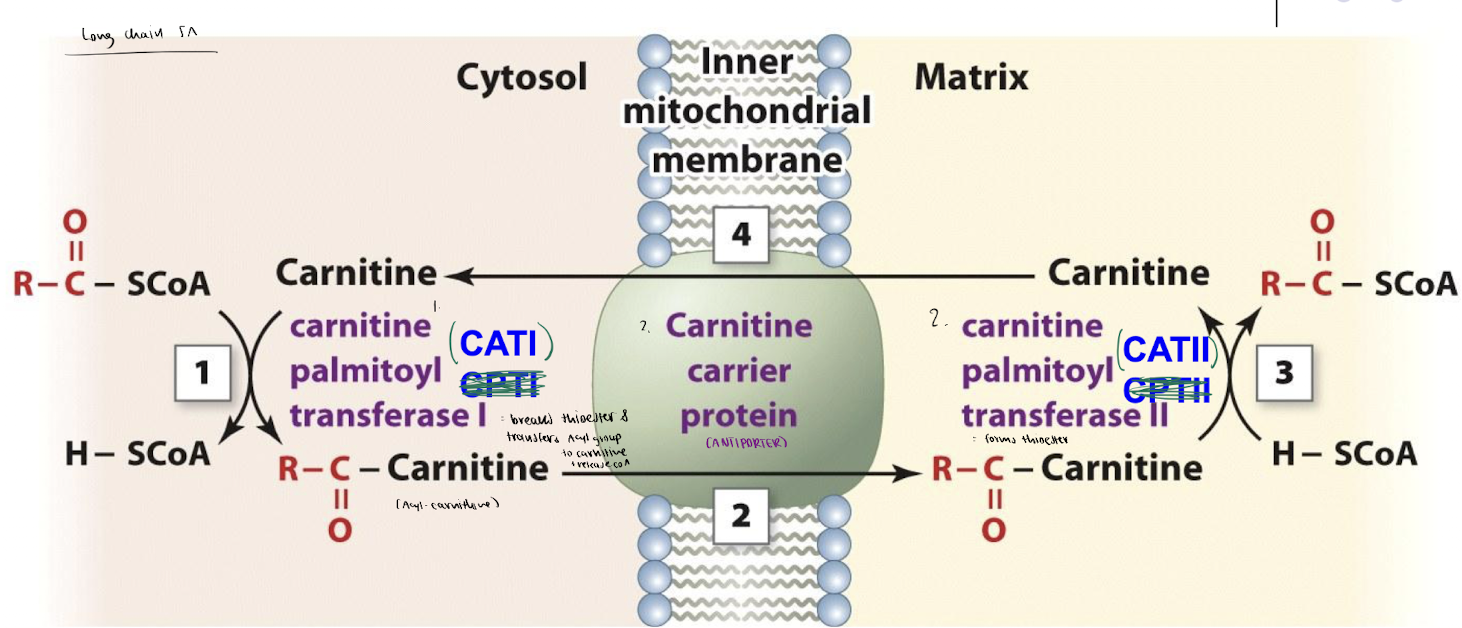
long chain FA: activated in the cytosol THUS attached to CoA & require transferases to enter matrix
must use CATI in the cytosol → carnitine carrier protein at IMM → use CATII in the matrix
reminder: CANT transport NADH, OAA, CoA or anything attached to it, or long chain FA across membrane
B-oxidation = pathway by which FAs → Acetyl-CoA
occurs in matrix
Catabolism (breakdown) of Fatty acids: 1. Activation of FA
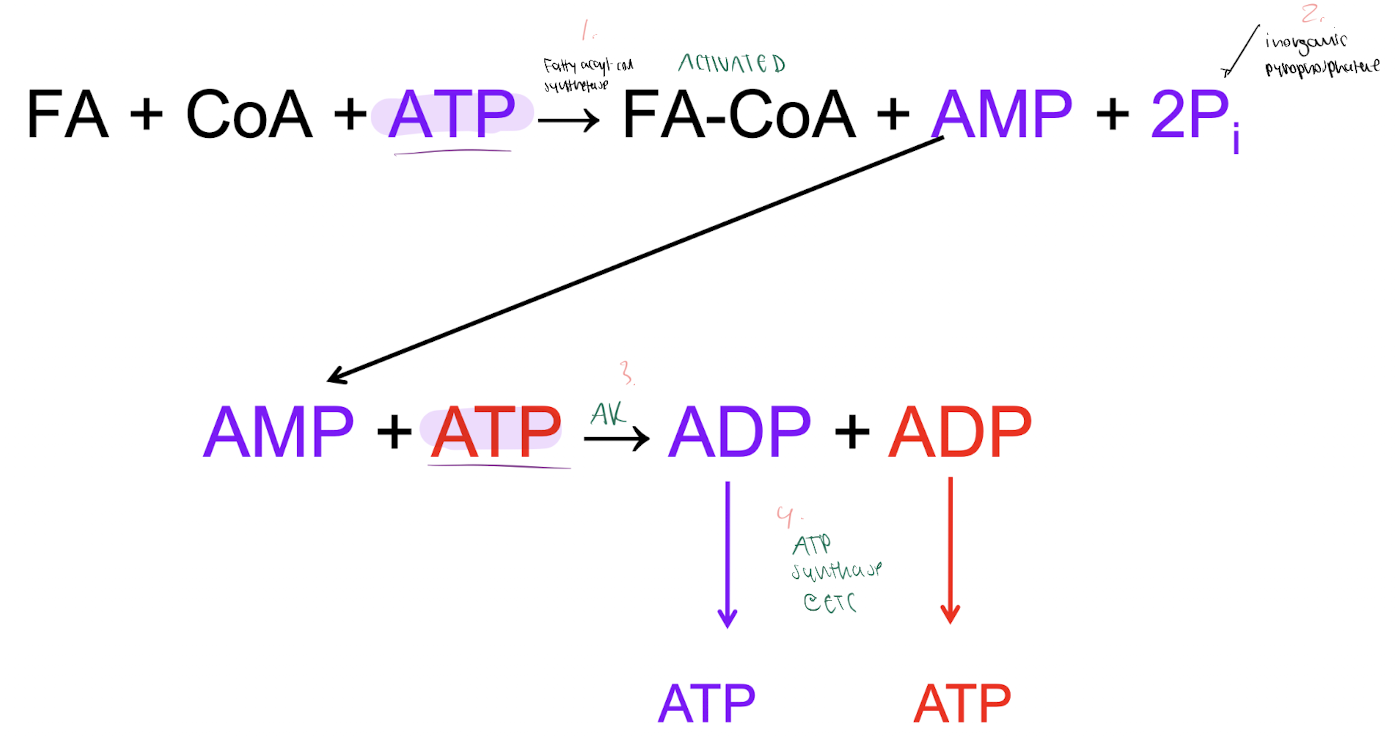
→ FA are activated by linking to CoA via fatty acyl-CoA synthetase
requires: 2 ATP (1 for synthetase & 1 for AK) + 1 H2O (for pyrophosphatase)
there are 3 isozymes of FA thiokinase (fatty acyl-CoA synthetase)
where activation of FA occurs:
short/ medium chain FA are activated in matrix (dont require transporters into matrix)
thiokinases are donut in matrix for this
long chain FA are activated in cytosol → require transporters to enter matrix bc its attached to -CoA
thiokinase is found on OMM facing cytosol for this
process:
FA + ATP (high energy) react → PPi & mixed anhydride
PPi + H2O -inorganic pyrophosphatase→ 2 Pi
mixed anhydride (higher energy) + H-SCoA → Acyl-CoA (high energy) + AMP

→ 4 enzymes are involved in FA activation:
fatty acyl-CoA synthetase (requires ATP)
inorganic pyrophosphatase (requires H2O)
AK (requires ATP)
ATP synthase @ ETC
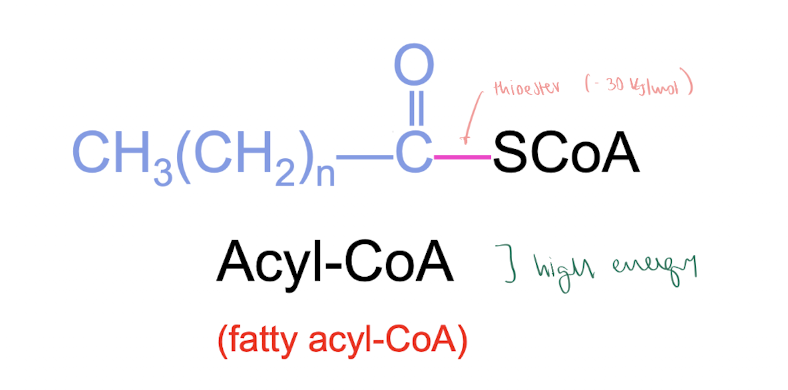
activated FA (Acyl-CoA) vs. Acetyl-CoA (A-CoA)

Why is Acyl-CoA (activated FA) an activated or high energy molecule?
Acyl-CoA (activated FA) is high-energy bc its options for resonance stabilization are limited
substrates are unstable, but products are stable → thus high energy
contains thioester

features that DONT make Acyl-CoA high-energy:
Can be catabolized to produce ATP, but so can glucose thus that doesn’t make it high-energy
contains phosphoanhydride bonds, but it doesn’t break them for energy so that doesn’t make either high-energy either
Catabolism (breakdown) of Fatty acids: 2. Transport of Fatty acids
short/medium chain FA: move into matrix as free FA → activated by acyl-CoA synthetase into Acyl-CoA in the matrix
bc its not attached to -CoA in cytosol
long chain FA: require transporters as its activated (attached to CoA) in the cytosol
activated by acyl-CoA synthetase in the cytosol: FA → acyl-CoA
CATI (transferase on OMM facing cytosol) breaks thioester & transfers acyl group to carnitine + releases CoA
Acyl-carnitine passess OMM thru a PORIN
Acyl0carnitine enters IMM thru carnitine carrier protein (translocase antiporter)
CATII (transferase on IMM facing matrix) forms thioester by reacting HSCoA + Acyl-carnitine→ Acyl-CoA in matrix

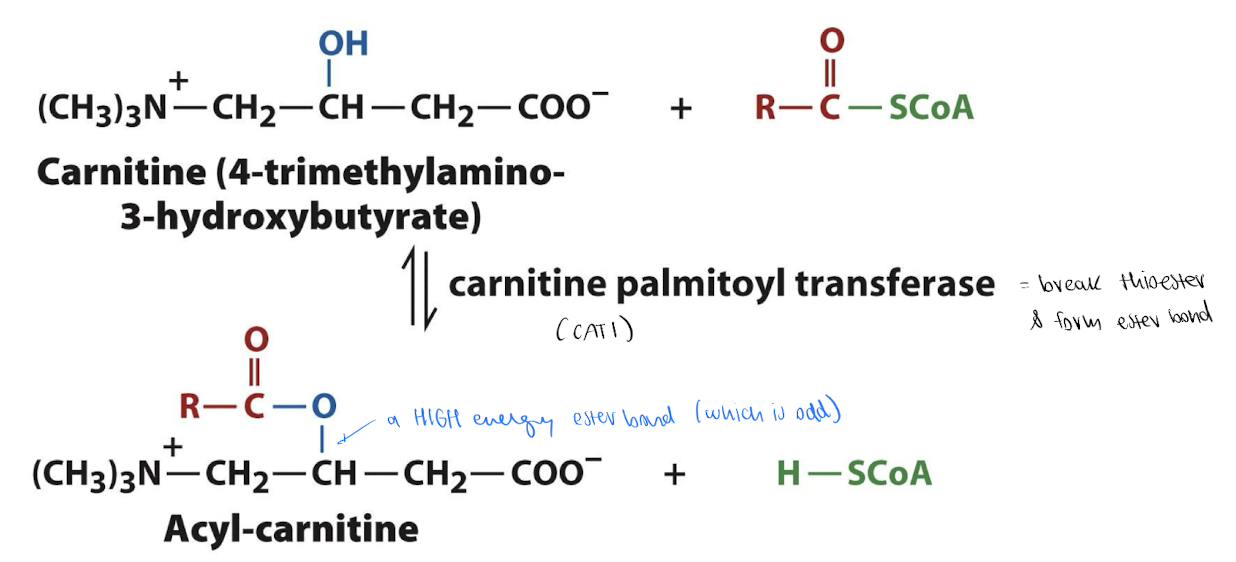
carnitine = zwitterionic alcohol
transesterification rxn occurs when carnitine + Acyl-CoA react in cytosol & CATI breaks thioester to form higher-energy ester bond linking Acyl group to carnitine + release H-SCoA
What is a likely effect of carnitine deficiency on fatty acid oxidation?
carnitine is used to transport long chain FA into the matrix for B-oxidation, thus w/o it you wouldn’t be able to oxidize long chain FA when you need energy
damages liver & cardiac tissue
treatment of carnitine deficiency:
DONT eat lipids w long chain FA, only short & medium chain that can be oxidizes since they can enter matrix
eat carnitine
Catabolism (breakdown) of Fatty acids: 3. B-Oxidation
B-Oxidation = process in which activated FA (Acyl-CoA) is broken down to Acetyl-CoA in the matrix
involves 4 repeated rxns (oxidation, hydration, oxidation, thiolysis)
every round of the 4 rxns generates 1 A-CoA & the last round generates 2 A-CoA
→ determining the # of A-CoA produced by B-oxidation of a FA:
every A-CoA contains 2c, thus divide FA total C/ 2 = # of A-CoA released
ex. C16 FA : 16/2 = 8 A-CoA released
→ determining the # of rounds of B-OX for EVEN # FA : (n ÷ 2) -1
get 1 A-CoA (2C) every round + 2 A-CoA in last round
ex. c20 FA: 20÷2 = 10 -1 = 9 rounds, thus get 10 A-CoA
ex. c16 FA: 16÷2 = 8 -1 = 7 rounds, thus get 8 A-CoA
ex. Palmitoyl-CoA (C16 activated FA) B-oxdiation in matrix
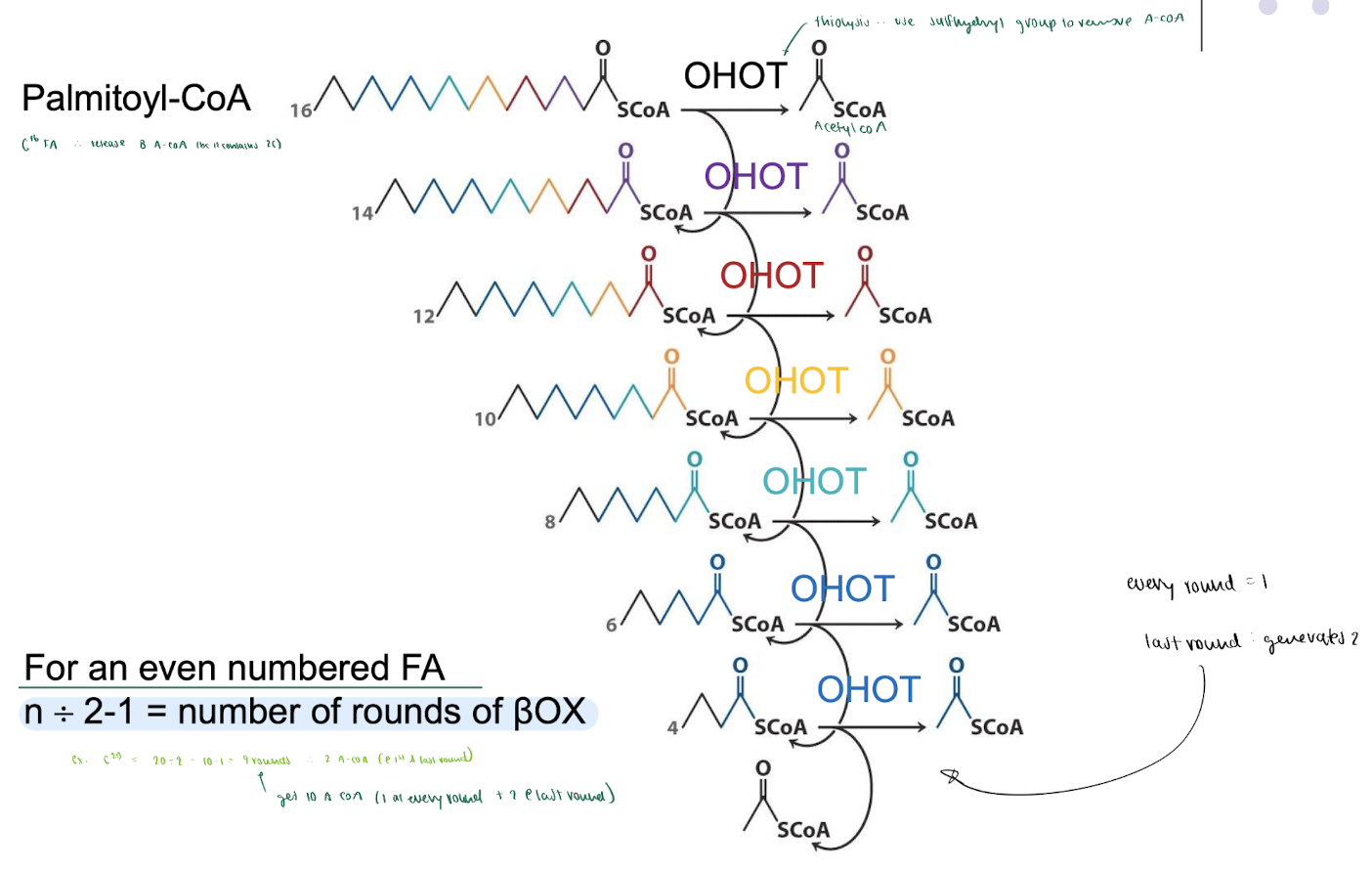
Catabolism (breakdown) of Fatty acids: 3. B-Oxidations 4 Repeated Reactions
1 round of B-OX : 4 rxns that release 1 A-CoA (remove 2c from FA)
last round releases 2 A-CoA (remove 4c from FA)
overview

step 1 of B-OX : Oxidation
matrix enzyme (acyl-CoA dh/ AD) oxidizes fatty Acyl-CoA to Enoyl-CoA
mobile carrier in matric (ETFox) accepts electrons from AD
enzyme assoc with IMM (ETF:ubiquinone oxidoreductase) accepts electrons from ETF & reduces Q in ETC → QH2
QH2 in mito ETC passess electrons on to synthesize ATP & produce H2O
→ acyl-CoA dh removes 2H’s from acyl-CoA to generate Enoyl-CoA
electrons of H’s removed form FADH2 for ETC

note: ETF is the electron transferring flavoprotein
note: Q is a cosubstrate, NOT a prosthetic group
the electrons from this are one of the various sources of e- to Q

Step 2 of B-OX: Hydration
→ hydratase uses H2O to convert Enoyl-CoA → Beta-Hydroxyacyl-CoA
by using H2O to form -OH group at C3 where the c=c was
Enoyl-CoA HAS to be trans ∆2

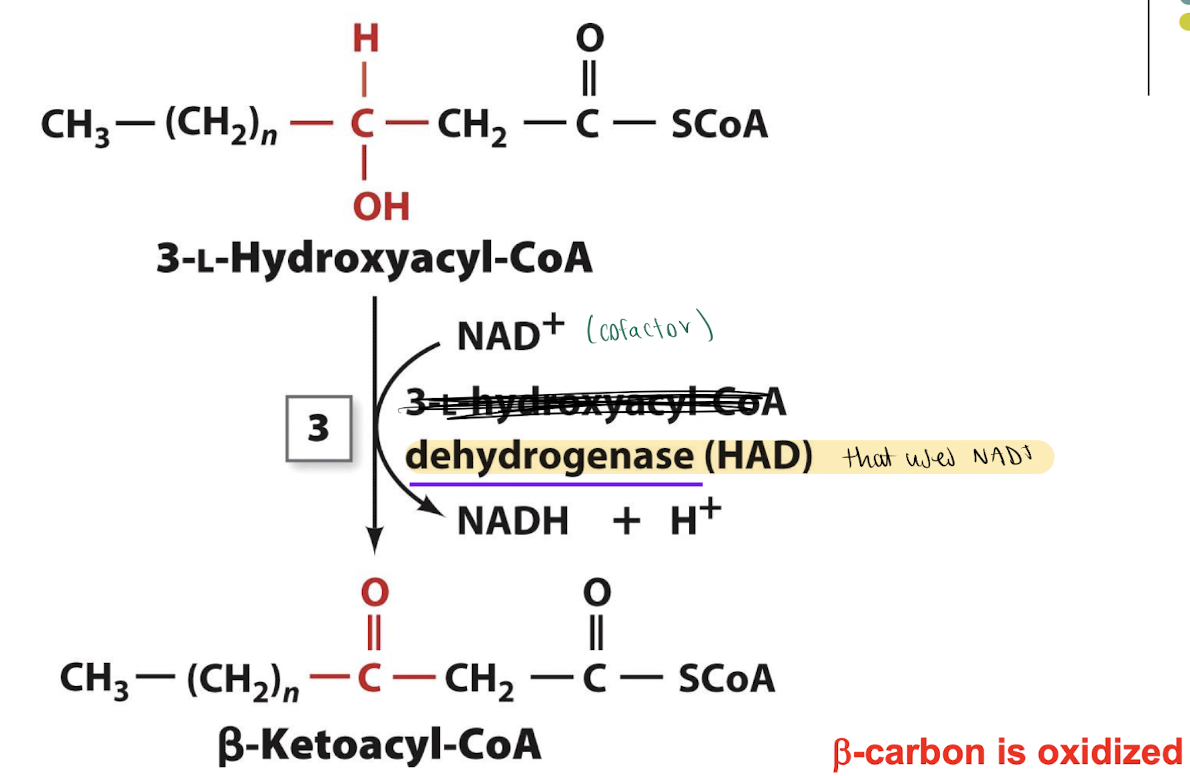
Step 3 of B-OX: oxidation
→ Dehydrogenase uses NAD+ to convert Beta-Hydroxyacyl-CoA → Beta-ketoacyl-CoA
oxidizes the B-carbon using NAD+ as a cofactor
produces NADH
Step 4 of B-OX: Thiolysis
→ Thiolase uses CoASH’s sulfhydryl group to break bond ofBeta-ketoacyl-CoA → Fatty acyl-CoA (2c atoms shorter) that enters the next round + Acetyl-CoA thats released
generates fatty Acyl-CoA (2c shorter) that reenters B-oxidation in next round
releases 1 Acetyl-CoA
released A-CoA is used to make ATP in CAC or to make ketone bodies in the right gluconegoenic conditions

last round of B-OX for FA’s with an EVEN # of carbons: last round of B-ox generates 2 molecules of A-CoA

How are the steps of B-oxidation similar to other pathways?
→ the dehydrogenation to generate a C=C & FADH2, followed by hydration of the DB to form OH & then oxidation of the alcohol to form a carbonyl group & NADH
these 3 steps are found in: B-OX of FA, oxidation of certain AA, and sorta in the PPP


Calculating the number of ATP molecules produced via complete oxidation of saturated (NO DB) fatty acids
B-OX of fatty acids: each round produces 1 FADH2 & 1 NADH & 1 A-CoA
# of rounds of B-OX for EVEN # FA : (n ÷ 2) -1
each A-CoA released from FA enters CAC (bc its says complete oxidation): generates 3 NADH, 1 GTP, 1 FADH2
# of A-coA released for EVEN # FA: n ÷2
ex. What is the net number of ATP molecules produced via the complete oxidation of C16 : 0?
B-OX: # of rounds: (16 ÷ 2) = 8 - 1 = 7→ 7 NADH & 7 FADH2
7 NADH (2.5 ATP) = 17.5 ATP
7 FADH2 (1.5 ATP) = 10.5 ATP
→ B-OX: 28 ATP
CAC: # of A-coA released: n ÷ 2 = 16 ÷ 2 = 8 A-CoA enter CAC
(3 NADH, 1 GTP, 1 FADH2) x 8
24 NADH (2.5 ATP) = 60 ATP
8 FADH2 (1.5 ATP) = 12 ATP
8 GTP = 8 ATP
→ CAC: 80 ATP
gross = 80 + 28 ATP = 108 ATP
net = 108 ATP - 2 ATP invested = 106 ATP
Calculating the number of H2O molecules produced via ETC during complete aerobic oxidation of saturated (NO DB) fatty acids
→ every NADH & FADH2 generate 1 H2O via ETC
B-OX: ( n ÷ 2 ) -1 of FA= # of rounds w each generating 1 FADH2 & 1 NADH
each round uses 1 H2O
CAC: n ÷ 2 of FA = # of A-CoA entering CAC, withe each generating 3 NADH, 1 FADH2, 1 GTP
when looking at H2O we don’t use GTP for calc
each cycle uses 2 H2O
ex. How many molecules of water are produced by the ETC during compete aerobic oxidation of 1 molecule of palmitate (C16:0) to CO2 and water? 46 H2O
B-OX : (16÷2) -1 = 7 → 7 NADH & 7 FADH2
each round uses 1 H2O
→ 14 H2O from B-OX
CAC: 16÷2 = 8 → get 8 A-CoA → 8x (3 NADH, 1 FADH2, 1 GTP)
THUS, 24 NADH, 8 FADH2
each cycle uses 2 H2O
→ 32 H2O from CAC
gross = 14 + 32 = 46 H2O
net = 46 H2O - 24 invested (16 invested during CAC & 7 invested during B-OX) = 22 H2O
ex. What is the net number of water molecules produced during the compete aerobic oxidation of 1 molecule of palmitate (C16:0) to CO2 and water? 22 H2O
net = 46 H2O - 24 invested (16 invested during CAC & 7 invested during B-OX) = 22 H2O