Inorganic Quiz 2: Molecular Structure and Bonding
 Call Kai
 Learn
 Practice Test
 Spaced Repetition
 Match
 Flashcards
 Knowt Play
1/26

There's no tags or description
Looks like no tags are added yet.
27 Terms
covalent bond
non-metals and metalloids only
sharing of electrons
metallic bond
pure metals and alloys
metal atoms lose electrons to a common “sea of electrons
the metal cations are cemented by the “electron sea”
ionic bond
metal with non-metal(s)
electrostatic attraction between ions
bond dissociation energy of H-H bond
436 kJ/mol
strong covalent bond
do H2 molecules attract each other?
only very weakly with dispersion forces
covalent bond directionality and localization
directional and localized
the bond has a specific orientation and the electrons sit in the region between the atoms.
bond dissociation energy of Li-Li bond
102 kJ/mol
a weak covalent bond
what state are Li2 molecules found at high T and room T?
high T: lithium vapor
room T: molecules stick together and lose 217 kJ/mol of energy and form 3D solid lithium metal
metallic bond directionality and localization
non-directional and delocalized
the bonds don’t point a certain way. electrons are part of an “electron sea".

what phase will Na atom and Cl atom bond to make NaCl?
gas phase
bond dissociation energy of Na-Cl bond
411 kJ/mol
directional and highly polar, 80% ionicity
what happens to NaCl molecules at room T?
they stick together, lose 230kJ/mol of energy and form a 3D crystal with 100% ionicity
ionic bond directionality
multidirectional
the cation is surrounded by anions and vice versa, so bonding can be in any direction you choose. no distinct molecules so we call them formula units.
diagram that predicts bonding based on electronegativity of the elements
Van Arkel - Ketalaar triangle

which of the bonding theory models work well together?
Lewis, VSEPR, and valence bond (VB) theory work well together
they are relatively simple and adequately describe the structure of most organic and many inorganic molecules
bonding theory that works well for molecular ionization and excited states
molecular orbitals (MO) theory
bonding theory that works well for s- and p-elements but not d- and f-
Lewis model
also not applicable to metallic bonding
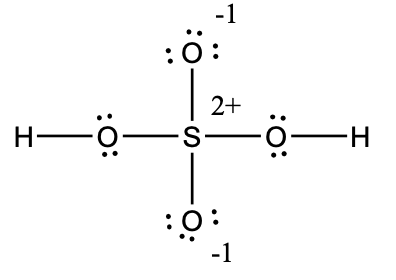
how to calculate formal charge
count electrons in lone pairs and half the electrons it shares with other atoms. then, subtract that from the number of valence electrons.
formal charges vs oxidation numbers
oxidation numbers are determined by assuming full polarization and assigning all bonding electrons to the more EN atom (not sharing half like with formal charges)
structure of oxyacids and oxyanions
a central atom surrounded by OH groups and O atoms
no O-O (peroxy) fragments; they are weak
three exceptions to the octet rule
free radicals, electron deficient molecules (less than 8 Ve-), expanded octet (more that 8 Ve-)
unstable, short-lived molecules that tend to pair up to form stable molecules
free radicals
nitrogen monoxide exception (it is stable). MO theory needed to explain why.
element that commonly forms stable molecules with only 6 electrons in Lewis structures
boron (metalloid)
also hydrogen with only 2 electrons
why are expanded octets possible?
octet can be expanded for atoms in the 3rd period or below because:
they are large enough to accommodate more than eight electrons
3d, 4d, or 5d orbitals may participate in bonding
bond enthalpy
same as bond energy
the amount of energy required to break a bond
shorter bonds are generally stronger (higher bond enthalpy)
polar bonds are stronger than non polar bonds
reaction enthalpy (delta Hrxn)
bond enthalpies of bonds broken - bond enthalpies of bonds formed
for gas phase reactions
only an approximation; better to use enthalpies of formation, experiments, or Hess’s law
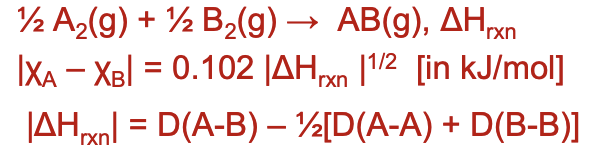
how did Linus Pauling base his scale of ENs on?
on the difference between enthalpy of the polar bond compared to the average of the non polar bonds in the elements