Quarter 1 Quizzes
 Call Kai
 Learn
 Practice Test
 Spaced Repetition
 Match
 Flashcards
 Knowt Play
1/82

There's no tags or description
Looks like no tags are added yet.
83 Terms
The anode heel effect is an important consideration in mobile radiography. Which of the following will produce a more pronounced heel effect?
1. Short SID
2. Large field size
3. Use of low kVp techniques
a. 1, 2, and 3
b. 1 and 3
c. 2 and 3
d. 1 and 2
d. 1 and 2
During a mobile exposure, the radiographer should be how far from the patient or part being radiographed?
a. 5 feet
b. 4 feet
c. 6 feet
d. 10 feet
6 feet
During mobile radiography, the least amount of scattered radiation will occur at what angle to the patient or part being radiographed?
a. 70 degrees
b. 90 degrees
c. 50 degrees
d. 45 degrees
b. 90 degrees
Which position is recommended for a mobile AP chest examination on a critically ill patient?
a. Seated upright at a 45-degree angle
b. Supine
c. Seated upright at a 90-degree angle
d. Left lateral decubitus
b. Supine
Which term refers to the restriction of the exposure field?
a. Collimation
b. Filter
c. Central ray (CR)
d. Shuttering
a. Collimation
The single most effective means of radiation protection during mobile radiography is:
a. distance.
b. choice of kVp.
c. use of a nongrid technique.
d. exposure time.
distance.
According to federal regulations, the source-to-skin (SSD) distance during mobile radiography may not be less than _____ inches.
a. 10
b. 15
c. 24
d. 12
12
Which of the following attire is worn by the radiographer when entering a droplet isolation room for a mobile radiography examination?
1. Mask
2. Gown
3. Gloves
a. 1 and 2
b. 1 and 3
c. 2 and 3
d. 1, 2, and 3
d. 1, 2, and 3
Which of the following common obstacles in the performance of mobile radiographs results in a grid cutoff error?
a. Orthopedic trapeze prevents use of recommended SID.
b. Intubation to an artificial respiration device prevents raising the patient to upright.
c. Isolation precautions result in the inclusion of artifacts.
d. Hospital mattress is well worn.
Hospital mattress is well worn.
Which of the following preliminary steps should the radiographer perform before beginning a mobile x-ray examination?
1. Invite family members to remain in the room.
2. Introduce oneself to the patient and family.
3. Determine that the correct patient is in the room.
a. 1 and 2
b. 2 and 3
c. 1 and 3
d. 1, 2, and 3
b. 2 and 3
The magnitude of the tube angle:
a. is expressed as a negative value when angled toward the foot of the patient.
b. is measured between the Central Ray and the plane of the Image receptor.
c. is expressed as a negative value when angled toward the head of the patient.
d. is the variance of the Central Ray from perpendicular to the plane of the image receptor.
d. is the variance of the Central Ray from perpendicular to the plane of the image receptor.
Which two of the following are true for the preferred geometry (least distortion) of an x-ray projection?
a. The Central Ray is directed parallel to the Image receptor.
b. The Image Receptor is perpendicular to the long axis of the body part.
c. The body part is as close to the Image Receptor as possible.
d. The Central Ray is directed perpendicular to the long axis of the body part.
c. The body part is as close to the Image Receptor as possible.
d. The Central Ray is directed perpendicular to the long axis of the body part.
Two lines that intersect at exactly ninety degrees.
a. Parallel
b. Perpendicular
c. Similar
d. Congruent
b. Perpendicular
Increased OID increases which two of the following?
a. magnification
b. image brightness
c. edge blur
d. SID
a. magnification
c. edge blur
The collimated x-ray beam is shaped like a:
a. cylinder
b. cone
c. rectangle
d. pyramid
d. pyramid
The total area of the beam landing on the Image Receptor is called:
a. Broadcast zone.
b. Display area.
c. Field- of view (FOV).
d. The rectangle.
c. Field- of view (FOV).
Using a tube angle other than perpendicular creates:
a. beam divergence.
b. size distortion (magnification)
c. shape distortion (elongation)
d. increased radiopacity.
c. shape distortion (elongation)
A plane passing vertically through the body from side to side is termed:
a. oblique.
b. coronal.
c. sagittal.
d. horizontal.
b. coronal.
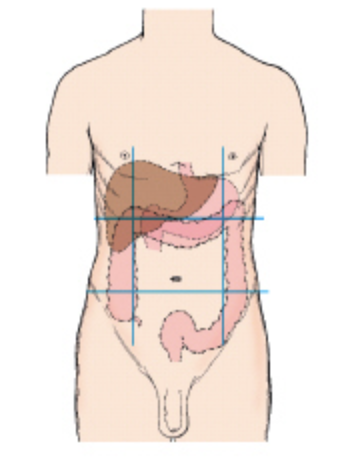
The lower, center region on this figure is termed the:
a. inguinal.
b. epigastrium.
c. lumbar.
d. hypogastrium.
d. hypogastrium.
L4 and L5 are located at the level of the:
a. umbilicus.
b. superior iliac spine.
c. superior aspect of the iliac crests.
d. costal margin.
c. superior aspect of the iliac crests.

The external landmark indicated by the arrow in this figure is the:
a. mastoid tip.
b. transverse process.
c. gonion.
d. vertebra prominens.
d. vertebra prominens.
All of the following are types of body habitus, except:
a. atrophic.
b. sthenic.
c. hypersthenic.
d. asthenic.
a. atrophic.
A rounded process at an articular extremity is called a:
a. styloid.
b. malleolus.
c. condyle.
d. tubercle.
c. condyle.
Which of the following is an x-ray “projection”?
a. Recumbent
b. RPO
c. LAO
d. Dorsoplantar
d. Dorsoplantar
If the central ray enters the anterior body surface and exits the posterior body surface, the x-ray projection is termed:
a. AP.
b. axiolateral.
c. PA.
d. lateral.
a. AP.
The term used to describe the act of placing the patient appropriately for a radiographic examination is:
a. position.
b. supine.
c. recumbent.
d. projection.
a. position.

The patient in this figure is placed in which of the following positions?
a. Ventral decubitus
b. Right lateral decubitus
c. Dorsal decubitus
d. Left lateral decubitus
c. Dorsal decubitus

The movement shown in this figure is:
a. extension.
b. flexion.
c. adduction.
d. abduction.
b. flexion.
Rotation of the arm toward the midline of the body from the anatomic position is termed:
a. supination.
b. lateral rotation.
c. medial rotation.
d. pronation.
c. medial rotation.
If the foot is turned inward at the ankle joint, the body movement is termed:
a. flexion.
b. eversion.
c.extension.
d. inversion.
d. inversion.
The jugular notch is located at the level of:
a. L2-L3.
b. T4-T5.
c. T2-T3.
d. L4-L5.
c. T2-T3.
Which specific type of joint permits only flexion and extension?
a. Hinge joints
b. Pivot joints
c. Saddle joints
d. Gliding joints
a. Hinge joints
Reference toward the head of the body is termed:
a. external.
b. proximal.
c. cephalad.
d. caudad.
c. cephalad.
A serious fracture in which the bones are not in anatomic alignment is called:
a. impacted.
b. compression.
c. displaced.
d. nondisplaced.
c. displaced.
When a fractured bone is shattered into many pieces, it is called:
a. compression.
b. spiral.
c. comminuted.
d. transverse.
c. comminuted.

The body plane indicated by the arrow in this figure is the:
a. transverse.
b. midsagittal.
c. midcoronal.
d. horizontal.
b. midsagittal.
The vertebrae located at approximately the same level as the xiphoid process are:
a. L2-L3.
b. T9-T10.
c. C7-T1.
d. T1-T2.
b. T9-T10.
The part of the lung that extends above the clavicle is termed the:
a. ingula.
b. base.
c. apex.
d. hilum.
c. apex.

The area identified in this figure is the:
a. hilum.
b. mediastinum.
c. lingula.
d. pulmonary veins.
a. hilum.
Why is the upright left lateral position the most commonly used for lateral radiographs of the chest?
a. Less chance of body rotation
b. Patient’s heart is closer to the image receptor
c. There is greater magnification of the heart
d. Easier to visualize interlobar fissures
b. Patient’s heart is closer to the image receptor
What is the optimal respiration phase for a PA or lateral chest radiograph?
a. Second breath, full expiration
b. First breath, full expiration
c. Second breath, full inspiration
d. First breath, full inspiration
c. Second breath, full inspiration
After entering the hilum, each primary bronchus divides. How many primary branches are in the right lung?
a. Five
b. Three
c. Two
d. Four
b. Three
What is the central-ray angle for a PA projection of the chest?
a. degrees caudad
b. Perpendicular
c. 5 to 7 degrees caudad
d. 5 degrees cephalad
b. Perpendicular
Which plane must be accurately parallel with the IR to prevent distortion of the thoracic structures during a lateral chest radiograph?
a. Horizontal plane
b. Midsagittal plane
c. Transverse plane
d. Coronal plane
b. Midsagittal plane
Oxygen and carbon dioxide are exchanged by diffusion within the:
a. alveolar duct.
b. alveoli.
c. terminal bronchioles.
d. bronchioles.
b. alveoli.
Each lung is divided into specific segments called:
a. fissures.
b. bronchopulmonary segments.
c. pleura.
d. lobes.
d. lobes.
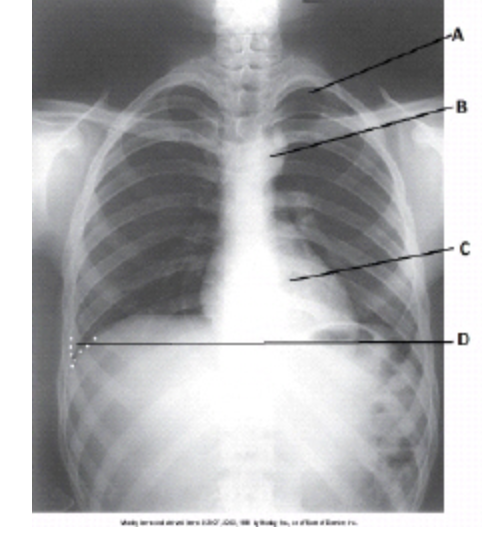
What anatomy is labeled as letter D and outlined with white dots in the image below?
a. Apex of left lung
b. Costophrenic angle of right lung
c. Costophrenic angle of left lung
d. Apex of right lung
b. Costophrenic angle of right lung

What anatomy is labeled as letter C in the image below?
a. Heart
b. Lingula
c. Thymus gland
d. Aortic arch
a. Heart
The longest lungs will be found in which type of body habitus?
a. Asthenic
b. Sthenic
c. Hypersthenic
d. Hyposthenic
a. Asthenic
Which of the following is not an Image receptor?
a. DR flat panel detector
b. Fluoroscopic image Intensifier
c. Display monitor
d. PSP
c. Display monitor
mA refers to:
a. the woman who raised you
b. a large amount of electric current
c. the pull on the electrons
d. a small amount of electric current
d. a small amount of electric current
Exposure times are usually fractions of a:
a. minute
b. hour
c. day
d. second
d. second
The total number of photons produced is directly proportional to:
a. the mA only.
b. the exposure time only.
c. the product of mA and exposure time.
d. the kVp.
c. the product of mA and exposure time.
kVp is in control of:
a. the total number of photons.
b. the penetrability of the beam.
c. the tube current.
d. the display image brightness.
b. the penetrability of the beam.
In the shotgun analogy, mAs is
a. the amount of gunpowder in the shell.
b. the amount of shot pellets in the shell.
c. the choke that controls spread.
d. the primer charge.
b. the amount of shot pellets in the shell.
In the shotgun analogy, kVp is
a. the amount of gunpowder in the shell.
b. the amount of shot pellets in the shell.
c. the choke that controls spread.
d. the primer charge.
a. the amount of gunpowder in the shell.
A thicker body part would require which change?
a. more mAs.
b. more kVp.
c. increased SID.
d. less exposure time.
b. more kVp.
To reduce the possibility of motion on an image:
a. Decrease kVp.
b. Decrease mA.
c. Increase exposure time.
d. decrease exposure time.
d. decrease exposure time.
To reduce dose to the patient:
a. Lower kVp.
b. Raise kVp.
c. Raise mAs.
d. Lower mAs.
d. Lower mAs.
The most commonly performed abdominal examination is referred to as a(n):
a. EXU.
b. IVP.
c. IVC.
d. KUB.
d. KUB.
Where is the center of the IR positioned for an AP abdominal image performed with the patient in the upright position?
a. L3
b. Iliac crests
c. 2 inches above the iliac crests
d. Lower rib margin
c. 2 inches above the iliac crests
The central-ray angulation for an AP abdominal image is:
a. 5 degrees cephalad.
b. 7 degrees cephalad.
c. 0 degrees.
d. 5 degrees caudad.
c. 0 degrees.
Which structures are outlined with dots in this AP image of the abdomen?
a. Stomach
b. Kidneys
c. Liver
d. Psoas muscles
b. Kidneys
All of the following are used to evaluate rotation on a KUB image, except:
a. superimposed posterior ribs.
b. ischial spines, if visible, are symmetric.
c. alae of the ilia are symmetric.
d. lumbar spinous processes in the center of the vertebral body.
a. superimposed posterior ribs.
A properly exposed abdominal image will exhibit all of the following, except the:
a. lower border of the liver.
b. pancreas.
c. transverse processes of the lumbar vertebrae.
d. psoas muscles.
b. pancreas.
The stomach is positioned the highest in which type of body habitus?
a. Hypersthenic
b. Hyposthenic
c. Sthenic
d. Asthenic
a. Hypersthenic

The portion of the abdominal cavity labeled as B in this figure is the _____ quadrant.
a. left upper
b. left lower
c. right upper
d. right lower
c. right upper
In which quadrant of the abdomen is the appendix usually located?
a. RUQ
b. RLQ
c. LUQ
d. LLQ
b. RLQ
Which structure can be palpated by an imaging professional to locate the level of the pubic symphysis?
a. Iliac crest
b. ASIS
c. Coccyx
d. Greater trochanter
d. Greater trochanter
Which of the following might be provided to distract and reduce anxiety for pediatric patients and their parents in the waiting room?
a. Brochures for medical insurance
b. Gender-neutral toys and activities
c. Comfortable seating
d. Informational pamphlets on imaging procedures
b. Gender-neutral toys and activities
Which pediatric age-groups benefit from a warmer exam room?
a. Premature infants and neonates
b. Preschoolers and school-age
c. Toddlers and adolescents
d. All pediatric age-groups
a. Premature infants and neonates
Respecting the need for privacy is an important patient care consideration for:
a. school-agers.
b. toddlers.
c. preschoolers.
d. adolescents.
d. adolescents.
Which body parts can be imaged on pediatric patients using the Pigg-O-Stat immobilizer?
a. Upper and lower limb
b. Head and neck
c. Chest and abdomen
d. Pelvis and lower limbs
c. Chest and abdomen
Which of the following can protect children from unnecessary radiation exposure?
1. Appropriate use of filters
2. Precise collimation
3. Gonad shielding always
a. 2 and 3
b. 1, 2, and 3
c. 1 and 3
d. 1 and 2
a. 2 and 3
Traditional positioning for a chest radiograph may be difficult for the elderly patient. An alternative would be to:
a. position the patient for an AP
b. have a CT scan for the chest
c. wrap his or her arms around the chest stand
d. leave arms down at the side of the body
c. wrap his or her arms around the chest stand
When conversing with a child, you should ____________ so that you can look them eye to eye.
a. lay down
b. stand up straight
c. kneel or sit
d. lean foward
c. kneel or sit
Exposure factors for the elderly:
a. do not require any changes
b. may need longer time settings
c. call for increased kVp
d. often require lower kVp
d. often require lower kVp
All of the following are universal approaches to working with children except:
a. making eye contact.
b. being authoritative and firm.
c. setting limits.
d. addressing their fears.
b. being authoritative and firm.
What is one of the leading causes of death among the elderly?
a. pneumonia
b. pancreatitis
c. bronchitis
d. emphysema
a. pneumonia
When imaging the upper or lower limbs on geriatric patients, keep in mind that:
a. many projections can be combined to decrease time and discomfort
b. mobility and flexibility is often decreased
c. long bones shrink as age increases
d. scatter radiation is greater in those with osteoporosis
b. mobility and flexibility is often decreased
The aging experience is individual and is affected by:
(1) attitude
(2) lifestyle choices
(3) heredity
a. 1 and 2
b. 1 and 3
c. 2 and 3
d. 1, 2, and 3
d. 1, 2, and 3
Which of the following musculoskeletal conditions increases in incidence as age increases?
(1) osteoporosis
(2) degenerative joint disease
(3) Osgood-Schlatter's disease
a. 1 and 2 only
b. 1 and 3 only
c. 2 and 3 only
d. 1, 2, and 3
a. 1 and 2 only
The Hendrich II fall scale evaluates risks for falling. One of the factors this scale uses in assessment is:
a. Body weight
b. Race
c. Hair color
d. Gender
d. Gender