Protist Lab
 Call Kai
 Learn
 Practice Test
 Spaced Repetition
 Match
 Flashcards
 Knowt Play
1/19

There's no tags or description
Looks like no tags are added yet.
20 Terms

What is this?
Amoeba
Pseudopod of amoeba
False foot used for movement and capturing food via phagocytosis
Nucleus of amoeba
DNA
Plasma membrane of amoeba
semi-permeable double-layer of lipids and proteins
Food vacuole of amoeba
Breaks down food

What is this?
Foraminifera
“Test” of foramina? Chemical composition? Is the test chambered?
Shell
CaCO3
Chambered shell with small pores
Extension in Live Forams
Pseudopodia extend through the small holes in the test for feeding and locomotion

What is this?
Apicomplexa
What is malaria caused by?
Plasmodium (from apicomplexa)
Hosts Required for Malaria
Humans and mosquitoes
Malaria host type (intra or intercellular)
Intracellular parasite

What is this?
Paramecium
Paramecium — Structures & Feeding
Cilia: Hair-like structures used for movement and sweeping food. Macronucleus: Controls day-to-day metabolic functions.
Oral Groove: Indentation where food particles are swept in. Feeding Mechanism: Sweeps food through oral groove into food vacuoles; digests intracellularly
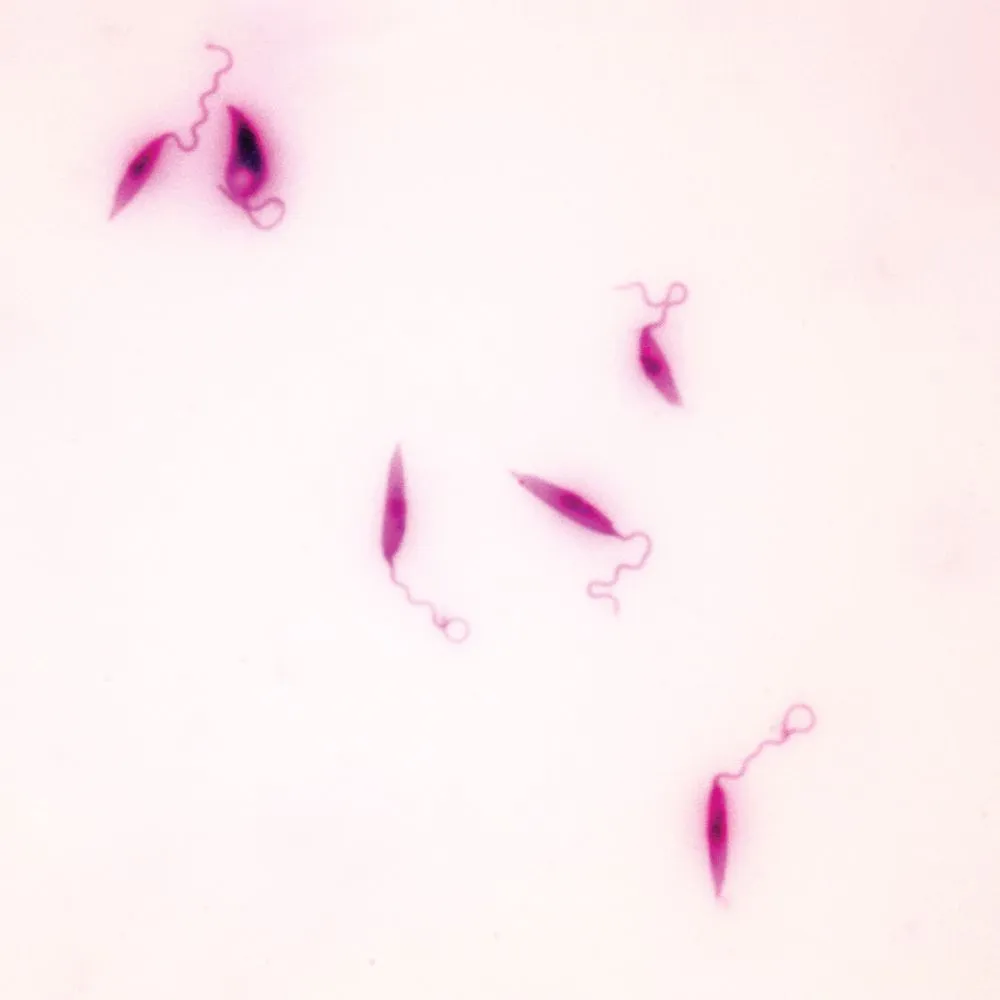
Trypanosoma — Disease, Transmission & Parasite Type
Disease Caused: African Sleeping Sickness
Vector/Transmission: Bitten by the Tsetse fly.
Immune Evasion: Changes surface proteins with each generation. Parasite Type: Intercellular parasite (lives between host cells in blood plasma).
Trypanosoma — Locomotion
Locomotion: Moves using a single flagellum attached along an undulating membrane.

Euglena — Movement & Key Structures
Flagellum: Long whip-like tail used for swimming/locomotion. Eyespot (Stigma): Light-sensing organelle used to orient toward light for photosynthesis. Chloroplasts: Site of photosynthesis.

Diatoms — Test Features & Shell Structure
Test Material: Silica / glass-like.
Structure: Consists of two overlapping halves
Shapes: Radial symmetry.

Dinoflagellates — Distinctive Features
Flagella Structure: Possesses two perpendicular grooves containing flagella.
Movement: Whirl-like spinning movement caused by flagella within the grooves.

Spirogyra (Chlorophyta) — Structure & Reproduction
Type: Multicellular, filamentous green alga.
Chloroplasts: Distinct spiral/helical arrangement.
Reproduction: S3xual reproduction via conjugation; genetic material passes through a conjugation tube from one filament to another to form a diploid zygote.