Chemical Carcinogenesis and Mutations
 Call Kai
 Learn
 Practice Test
 Spaced Repetition
 Match
 Flashcards
 Knowt Play
1/18

There's no tags or description
Looks like no tags are added yet.
19 Terms
Learning objectives
Explain the difference between an initiator and a promoter and the role of each in carcinogenesis.
Describe the difference between an indirect and direct carcinogen and explain how cells convert indirect carcinogens into direct carcinogens.
List the types of DNA damage caused by carcinogens.
List common DNA repair mechanisms and the types of damage each one repairs.
List the different types of mutations and chromosomal alterations and describe how they contribute to cancer.
Explain the rationale for using carcinogenic agents as cancer therapies.
What is a carcinogen (provide examples)
any agent or exposure with the capacity to cause cancer
high energy radiation
X-ray, UV, Gamma Radiation
Biologic
Viruses (HBV, HPV)
Bacteria (H. Pylori)
Hormonal
estrogen, progesterone
natural
tabacco,
chemical
Initiators and promoters

Initiation and initiators
Most carcinogen-mediated DNA damage does not result in Initiation.
Initiation only occurs if the damaged DNA is not repaired leading to a mutation, AND the mutation alters a gene with a critical role in cellular growth, escape from senescence, survival, growth factor signaling (oncogenes mostly, but some tumor suppressor genes as well).
Initiation is irreversible but Initiated cells must pass mutated genes to daughter cells for carcinogenesis to continue.
Initiation does not equal transformation, it is just the first step and cells have many checkpoints to safeguard the genome and eliminate initiated cells, so most initiated cells will not progress to cancer.
Additional mutations or epigenetic events are needed to drive the transformation of an initiated cell
Promoters and promotion
Promoters drive the clonal expansion of initiated cells resulting in a preneoplastic clone and eventually hyperplasia or the abnormal growth of cells.
Additional Promotion allows for additional mutations to accumulate resulting in a malignant tumor.
Promoters are not tumorigenic in absence of initiating mutations
promoters can be
exogenous (chemicals)
endogenous such as
Unopposed estrogenic stimulation of the endometrium and breast
Chronic inflammatory (e.g., inflammatory bowel disease, chronic hepatitis, and Barrett esophagus)
Chronic wound or tissue repair
How do carcinogens influence cancer progression even after the tumor forms?
they can promote the accumulation of additional mutations
What is a DNA adduct
a segment of DNA covalently bound to a chemical moiety (foreign chemical or toxin)
How do carcinogens cause mutations to DNA + ex of DNA damage
Carcinogens typically do not directly change the DNA sequence. They instead cause DNA damage (DNA adducts or strand breaks).
If not repaired properly the adduct can result in errors during DNA replication resulting in a mutation.
examples
Single base modifications- a base is chemically altered without dramatically altering the double-helix structure (oxidation, deamination, or alkylation)
Bulky” Adducts - single base adduct that disrupts helix structure
Dimers - 2 bases on the same strand (interstrand) or opposite strands (intrastrand) are covalently crosslinked
Strand breaks - single or double-strand breaks in DNA
List common carcinogens and how they damage DNA
Ionizing Radiation (X-Ray, Gamma-Ray) causes chromosome breakage, translocations, and some point mutations
UV Radiation – Causes cross-linking pyrimidine bases
Chemical – Cause mostly single base DNA adducts and sometimes dimers
Aromatic Amines, Amides, Azo Dyes
Natural –Aflatoxin B1 - metabolized to epoxides- forms DNA adducts, associated with p53 and Ras mutations and liver carcinogenesis
Betel Nut- forms DNA adducts
Benzopyrene and other Polyaromatic Hydrocarbons in cigarette smoke - metabolized to epoxides- forms DNA adducts
Hormonal - tumor promoters
esrogen, progesterone
Biological - Deliver oncogenes or inactivate TS genes. Can also act as promoters
Viruses (HBV, HBC, HPV, etc.), Bacteria (H. Pylori)
Define indirect and direct carcinogens and explain how indirect carcinogens are converted to direct carcinogens.
Direct or Ultimate Carcinogens
Can directly react with DNA, RNA, or other molecules in cells causing damage
Typically electrophilic (electron-deficient) so react with nucleophilic (electron-rich) molecules (DNA, RNA, Proteins)
Indirect or Procarcinogens
Require metabolic activation by cells to form a Direct carcinogen
Most carcinogens act Indirectly
Metabolic activation of carcinogens
Indirect Carcinogens are metabolized by two sets of enzymes.
The Phase I enzymes use oxidation, hydrolysis, and reduction to generate a reactive species
which Phase II enzymes then prepare for excretion by detoxifying and conjugating to make it water-soluble.
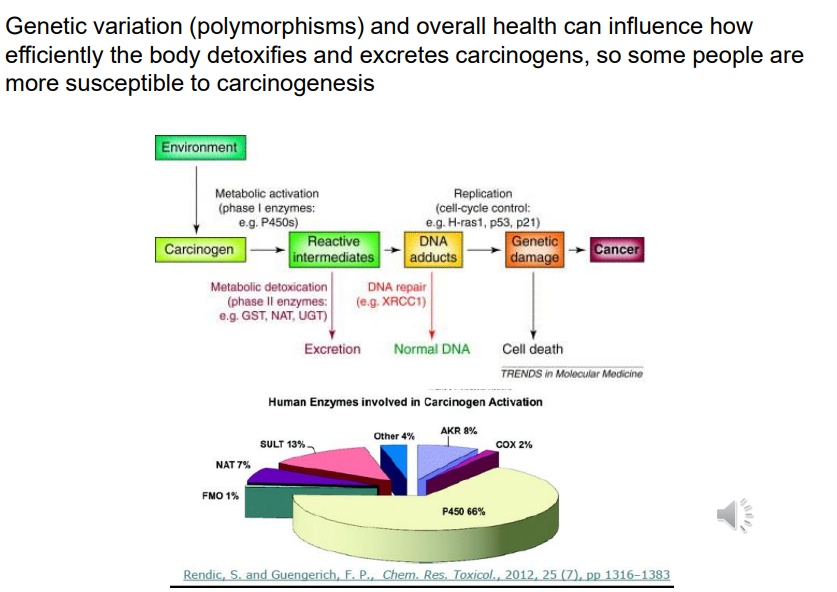
Common DNA repair Mechanisms
Mismatch Repair (MMR) replaces inserted, deleted, and mis-matched bases (usually due to replication errors) using the complementary strand as a template.
Base Excision Repair (BER) corrects single base lesions that do not significantly distort the DNA helix structure or single strand breaks by excising/replacing the base
Nucleotide Excision Repair (NER) removes bulky DNA lesions (bulky adducts and dimers from crosslinks by excising a small fragment of DNA from one strand. Opposite strand is used to replace excised bases.
Homologous Recombination (HR) Repairs double-strand breaks and some intrastrand crosslinks by using the either sister chromatid or homologous chromosome as a template.
Non-homologous End Joining (NHEJ) Repairs double-strand breaks without homologous DNA by joining the ends of the break.
List examples of familiar cancer syndromes that involve DNA repair and the genes that are mutated in each
Li-Fraumeni syndrome: extremely high risk of developing cancers due to inherited mutations in p53
Familial breast and ovarian cancer -is associated with inherited defects in homologous recombination repair genes (like BRCA1, BRCA2)
Bloom syndrome: developmental anomalies and increased risk of developing many different types of cancer due to inherited loss-of-function mutations in a helicase that is required for homologous recombination repair
Image diagram of chemical carcinogenesis steps (includes initiation and promotion)

Chemotherapy as a carcinogen
DNA reactive agents are often used as therapies for cancer
these reactive agents are themselves carcinogens
the goal is to create enough DNA damage to these rapidly dividing cells to cause cell death
the possibility for new initiating events and secondary cancers exists
Some of the main causes of cancer
Exposure to environmental carcinogens is thought to play a causal role in more than 90% of all cancers
Exposure to avoidable carcinogens (cigarette smoke, alcohol, poor diet, and UV radiation) contributes to a high percentage of human cancers
genes contribute to only about 5-10% of cancer
What are the 6 DNA mutation types
point mutation
silent: do not change amino acid
missense: chnage amino acid to another amino acid which could be conservative or nonconservative
nonsense: premature stop codon
substitution: one or more bases are replaces by the same number of bases
insertion: one or more bases are added
deletions: one or more bases are removed
inversions: The sequence of bases is reversed
frameshift
3 Different chromosomal alterations and how they lead to cancer
Amplifications: increased copies of a gene
typically proto-oncogenes
deletions: part of the chromosome is lost during DNA replication
deletion of tumor suppressor genes
deletion of the RB gene are common in retinoblastoma
translocations: a chromosome abnormality caused by the exchange of parts of 2 non-homologous chromosomes
can increase protooncogene expression by promoter or enhancer substitution
generation of oncogenic fusion proteins
in what genes and what mutations would you predict would promote cancer
carcinogenesis would involve nonsense mutations or non-conservative mutations or a frame shift in tumor supressors and gain of function missense mutations in proto-oncogenes
loss of function
P53
PTEN
BRCA1/2
APC
Gain of function
RAS
BRAF
RTKS