Unit 2: Chapter 5: integumentary System
 Call Kai
 Learn
Learn Practice Test
 Spaced Repetition
 Match
Match Flashcards
 Knowt Play
1/15

Earn XP
Description and Tags
This unit contains a study of the cells, tissues and the Integumentary system.
Name | Mastery | Learn | Test | Matching | Spaced | Call with Kai | Chat |
|---|
No analytics yet
Send a link to your students to track their progress
16 Terms
What is the Integumentary system?
Consists of the Skin and its accessory structures, including hair, nails, and glands
What is another name for skin?
Cutaneous membrane and it’s the largest organ
What are the 2 regions of the skin?
Epidermis and Dermis
What is the Epidermis?
Keratinized stratified squamous epithelium
What is the Dermis?
Inside layer of the skin, it is loose CT and dense irregular CT
What are the Accessory structures?
Sweat glands, sebaceous glands, hair, nails
What are the Sensory receptors for?
Detect heat, cold, pain, pressure
What is the Arrector pili muscles?
Smalls bands of SMC associated with hair
What SMC means?
It means Smooth Muscle Cell, associated with the hair
What is the Epidermis?
It is avascular
It transports of oxygen and nutrients via diffusion
Is the dermis vascular or avascular?
The dermis is vascular (blood)
What is the Hypodermis?
It is also known as superficial fascia or subcutaneous fat, is deep to dermis
Not part of skin, anchors skin to deeper structures
Loose CT and adipose
Vascular
What is Cellulite?
Dimpled or “orange peel” appearance of skin when collagen bands form around adipose tissue
Thighs, hips and gluteal area; due to genetics, gender age, adipose tissue
Normal Condition (Not disorder)
Minimize with a healthy diet and regular exercise
What are the Functions of the Integumentary System?
1) Protection - Mechanical trauma, pathogens and environment
2) Sensation - Perceive changes in the body’s internal or external environment
3)Thermoregulation - Relies on negative feedback loops to maintain stable internal temperature (due to muscle activity and metabolism)
4) Excretion - Process where waste products and toxins are eliminated (sweat)
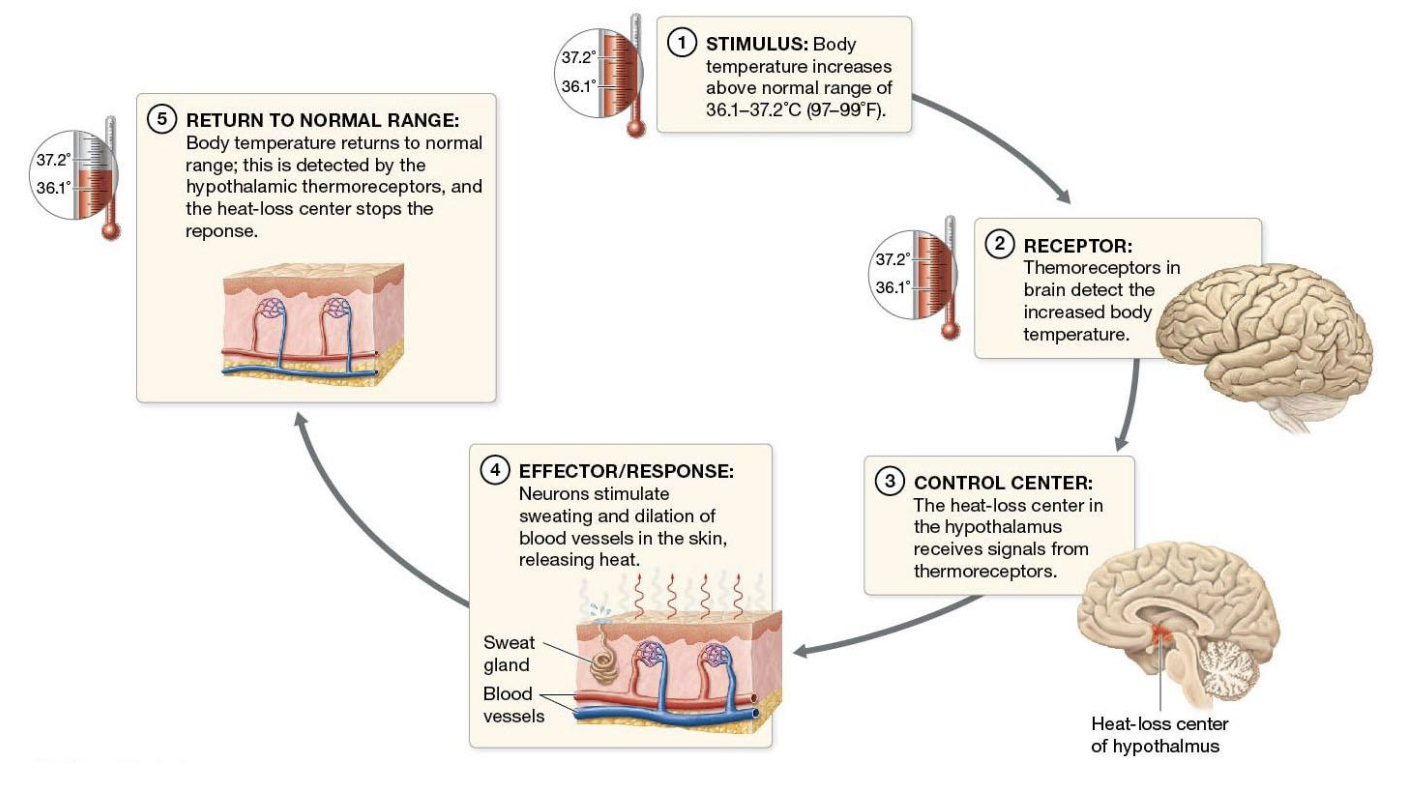
How Negative feedback loops works when is too hot? (Thermoregulation)
Stimulus- Body is too hot
Receptor- Detect an increase in temperature
Control Center- in brain (hypothalamus) acts as a thermostat
Effector//Response- Control center stimulates sweating and vasodilation (VD) of vessels in dermis
Return to normal range (homeostasis)
How Negative feedback loops works when is too cold? (Thermoregulation)
Stimulus- body temperature drops below normal range, too cold
Thermoreceptors- detect drop in temperature and relay information to hypothalamus
Control center reacts
Effector/response- blood vessels in dermis vasoconstrict (VC), decreased sweating; shivering
Return to normal range (Homeostasis)