ARC2701 Heavy Order -- Romanesque Architecture
 Call Kai
 Learn
Learn Practice Test
 Spaced Repetition
 Match
Match Flashcards
 Knowt Play
1/45

There's no tags or description
Looks like no tags are added yet.
Name | Mastery | Learn | Test | Matching | Spaced | Call with Kai | Chat |
|---|
No analytics yet
Send a link to your students to track their progress
46 Terms
Churches sprang up all over the Christian world to accommodate a population increase enabled by relative ___ and ___
stability, prosperity
___ brought in donations, so they were big business for the cathedrals and monasteries who owned them.
Therefore, these churches needed to be ___ enough to accommodate flocks of the faithful.
Relics, large
___ was the medieval equivalent of tourism. Pilgrimage routes developed along the major roads, and these routes included numerous relic-holding churches to visit along the way.
Pilgrimage
___ architecture is the style of architecture prevalent in
Medieval Europe in the late middle ages, approx. 1000 – 1200 CE
Romanesque
Romanesque architecture was characterized by ___ ___ and ___ ___, similar to earlier Roman construction as filtered through Early Christian and some Byzantine sensibilities.
heavy mass, round arches
A ___ is a linear space set crosswise /
perpendicular to the main nave, creating a
cruciform church plan.
Transept
The plans of Romanesque show the basilica form of Early Christian churches
(the norm), Now transformed into a ___ (cross-shaped) plan with the
addition of the ___
CRUCIFORM, TRANSEPT
7 Key Characteristics of Romanesque Architecture:
R___, H___, D___, H____, T___, C___, I___ / v___ compared to earlier churches
Round arches, Heavy Mass, Decorative Masonry, Horizontal Banding, Towers, Cylinders, Increased height / verticality
___ ___ were used in great
abundance; as structure, to define
openings (windows/doors), in
arcades, as barrel and groin vaults,
and also as decoration (blind
arcades and blind arches).(First key characteristic of Romanesque arch)
Round arches
A ___ is a succession of contiguous
arches, with each arch supported by a
colonnade of columns or piers.
Exterior arcades are designed to
provide a sheltered walkway for
pedestrians.
Arcade
A ___ ___ is one that is composed
of a series of arches that has no actual
openings and that is applied to the
surface of a wall as a decorative
element. Can be made with pilasters or
engaged columns.
blind arcade

A blind arcade can be made with ___ or engaged columns.
pilasters

A blind arcade can be made with pilasters or
___ ___.
engaged columns
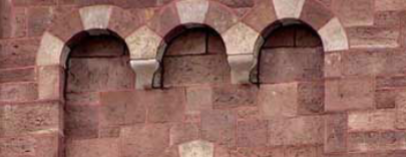
___ ___ are ones attached to wall or
other surface, for decorative purposes.
(usually used in a repeating line on wall).
Blind arches

___ ___– Thick masonry walls with small openings; and thick structural piers, pilasters, and buttresses to support the outward thrust of high arched forms.(2nd key characteristics of Romanesque architecture)
Heavy Mass
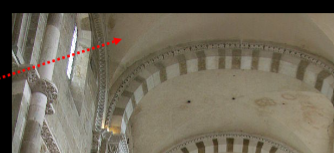
___ ___ are extremely heavy and difficult
to construct. To support them, Romanesque
churches have massive piers or compound
columns and thick walls that could only be
interrupted by small windows. External
buttresses helped as well.
stone vaults

A structural ___ in
Romanesque architecture is a
massive vertical masonry support
designed to carry the heavy
weight and outward thrust of
rounded stone arches and vaults.
pier
A ___ ___ is a clustered masonry support
made of a central core with
attached vertical shafts, half-
columns, or pilasters.
compound pier

A ___ is a projecting structure
for supporting or giving stability
to a wall or building.
buttress

A ___ is a shallow, rectangular
architectural element that projects
slightly from a wall, giving the
visual appearance of a supporting
column.
pilaster

___ ___ – ornamentation is primarily done through the
elaboration of the brickwork or stonework, and as bas-relief sculpture.(3rd key characteristic of Romanesque Arch)
Decorative Masonry
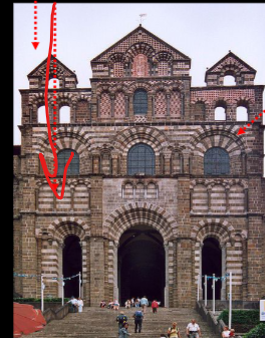
___ ___ – articulation of decorative layers of the building in
contrasting lines of material. We see this in banding of main walls and contrasting voussoirs of arches. (4th key characteristic of Romanesque Arch)
Horizontal Banding

___- large and solid, serving as
landmarks for the city. Often paired
on a façade, and/or located at the
crossing of transept and nave.(5th key characteristic of Romanesque Arch)
Towers

___– Multiple cylindrical
forms around building (multiplying
the apse)(6th key characteristic of Romanesque Arch)
cylinders
Romanesque buildings gain their impact through their___ and simple, horizontally-focused arrangement of architectural forms
monumentality
___ ___ – The beginning of the style, where the structures have
more of the austerity of Early Christian churches, but bigger and more
masonry articulation. Basically, a grey zone of overlap.
Early Romanesque
“___” Romanesque – The main body of what we call Romanesque, with
all the traits we associate with the style.
Main
___ Romanesque – Where the style becomes more elaborate in
decoration, with layering, arcading, more decorative contrast, and more
external sculpture. (This is the transition into the Gothic.)
High

Toulouse, France (1080 – 1120 CE), Romanesque Architecture
The Basilica of Saint-Sernin

A ___ is a tapering conical or
pyramidal structure on the top of a
building, particularly a church tower.
spire

Floor plan of The Basilica of Saint-___
Sernin
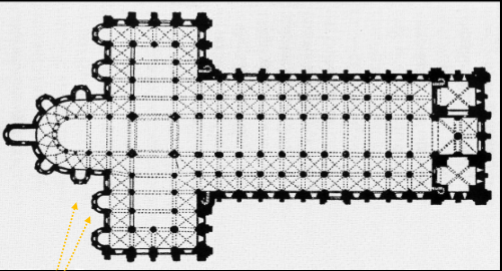
___ ___: smaller
projecting apses around the
transept and main apse for the
display of relics.
Apsidiole Chapels
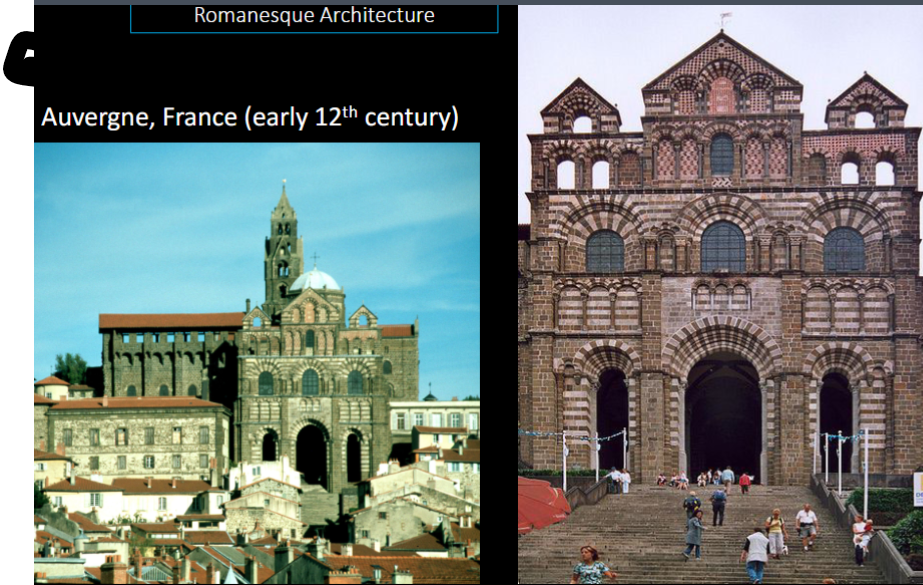
Auvergne, France (early 12th century), Romanesque Architecture
Le Puy Cathedral

A ___ is a covered walk in a
convent, monastery, college, or
cathedral, typically with a wall on one
side and a colonnade open to a
quadrangle on the other. A cloister is
usually the area in a monastery
around which the principal buildings
are ranged, affording a means of
communication between the
buildings.
Cloister
Common Italian church layout:
Main church basilica
Round or octagonal ___
Detached or semi-detached ___
baptistery, campanile

Limburg Cathedral

The Limburg Cathedral ___ decorative masonry
Polychromatic
Elaborate ___ arcades holding sculpture
becomes more common in High Romanesque
blind

Florence Baptistery
The Florence Baptistery is decorated with bands of white and green
____
marble
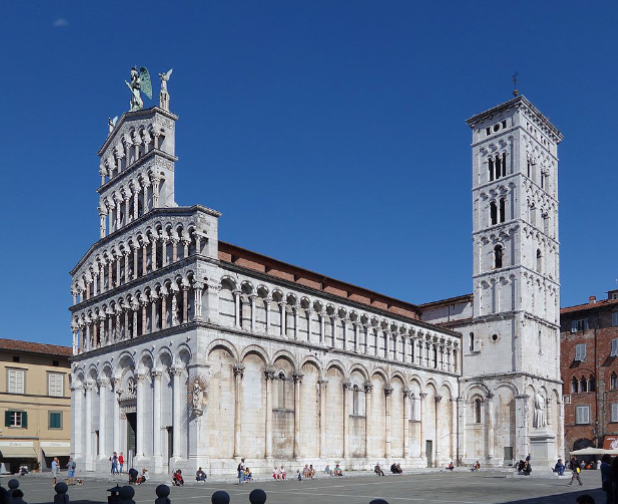
Lucca, Italy (11 th century CE)
Church of San Michele
The Church of San Michele has elaborate ____ with
a wide variety of ____ also more common in High
Romanesque
arcades, columns

Campanile - Bell tower
The Leaning Tower of Pisa
Common Italian church layout:
___
___ baptistery
___ campanile
Main church basilica, Round or octagonal, Detached or semi-detached

Italy (1215-1263 CE)
Siena Cathedral

Which cathedral has this interior?
Siena Cathedral