Lifesci 7a - Week 8 Recombinant DNA & DNA Replication
 Call Kai
 Learn
 Practice Test
 Spaced Repetition
 Match
 Flashcards
 Knowt Play
1/38

There's no tags or description
Looks like no tags are added yet.
39 Terms
You have determined that the newly synthesized strand of DNA in your sequencing reaction has the sequence 5'-ACTACCGAGT-3'. What is the sequence of the template strand?
The sequence of the template strand is antiparallel to the synthesized strand and inferred from complementary base pairing as 5'-ACTCGGTAGT-
3'.
How do the properties of DNA determine how it moves through a gel, is cut by restriction enzymes, and hybridizes to other DNA
Fragments of DNA are negatively charged, so pieces will move through a porous gel when an electric current is passed through it. The distance that the DNA pieces move through the gel is based on their size, with larger fragments moving through the gel more slowly and smaller fragments moving quickly. To obtain these fragments of DNA, restriction enzymes are used. Each enzyme recognizes a particular sequence of DNA (the restriction site) and cleaves each strand of the DNA at this site. In addition, DNA can hybridize to other DNA strands if their nucleotide sequences are complementary to each other.
In making recombinant DNA molecules that combine restriction fragments from different organisms, researchers usually prefer restriction enzymes such as BamHI or HindIII that generate fragments with "sticky ends" (ends with overhangs) rather than enzymes such as Hpal or Smal that generate fragments with "blunt ends" (ends without overhangs). Can you think of a reason for this preference?
The advantage of sticky ends is that they give the researcher greater control over which restriction fragments can come together and be attached. Sticky ends can pair only with other sticky ends that have complementary 3' and 5' overhangs. Thus, restriction fragments produced by BamHI can combine only with other fragments produced by BamHI, and not with fragments produced by, for example, HindIII. However, any blunt end can be attached to any other blunt end; for example, a Hpal end can be attached to a Smal end.
How can recombinant DNA techniques be used to express a mammalian gene in bacteria?
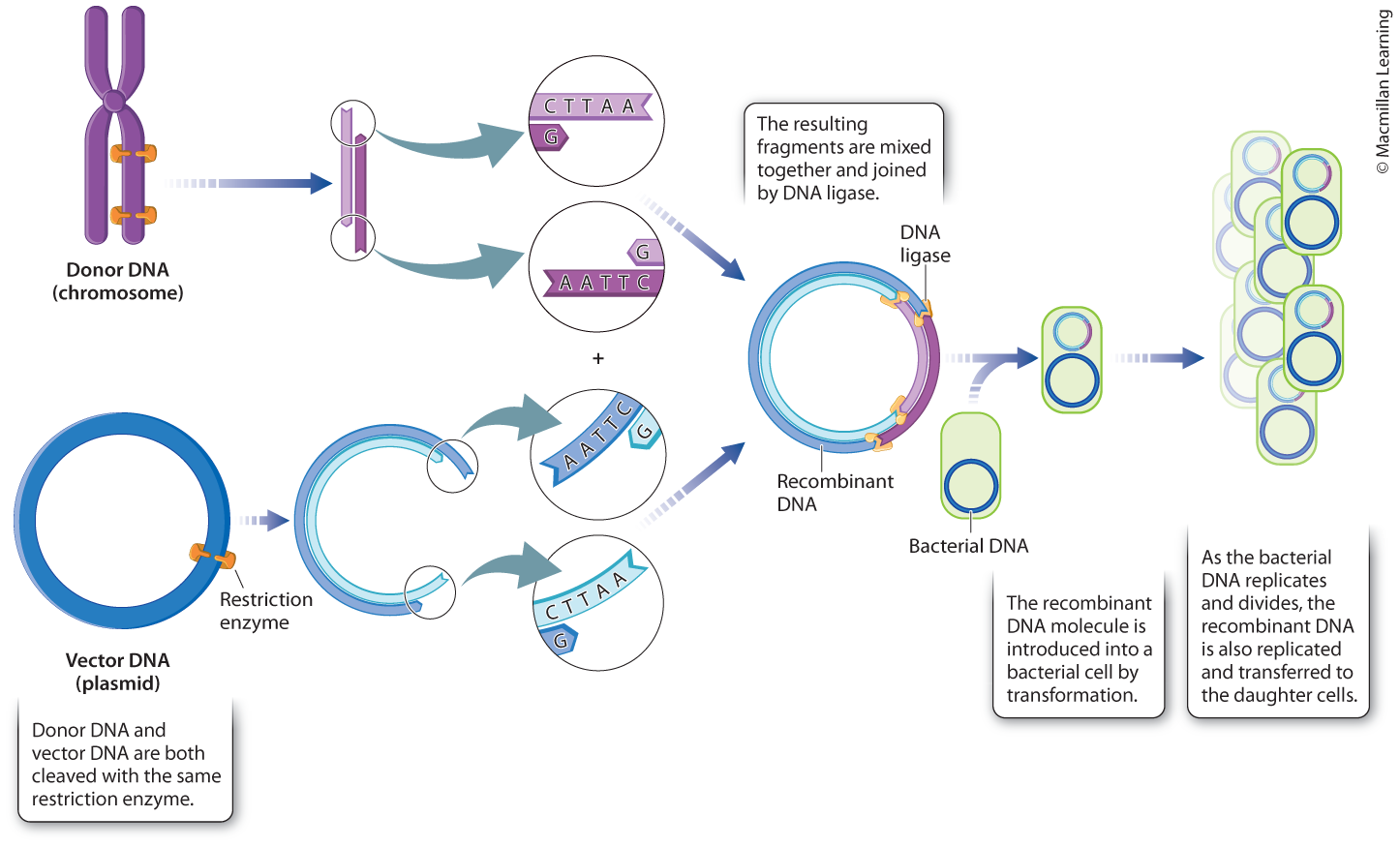
The mammalian gene (donor DNA) can be expressed in a bacterium through its insertion into a vector DNA that can be replicated in the bacterium. The same restriction enzymes are used to cut the donor DNA and the vector DNA so that they now have complementary ends. A ligation reaction is then performed to insert the donor DNA into the vector DNA. The vector DNA is then inserted into the bacterium and replicated through the normal method that also replicates the donor mammalian gene at the same time.
Restriction enzymes are known to…
recognize and cut specific DNA sequences
Restriction enzymes cleave double-stranded DNA at the sites that show a particular type of symmetry; these sequences read the same on both strands and are called palindromes. Which of the sequences is not a palindrome?
5′-GGTTGG-3′
One characteristic of restriction enzymes is that they cut…
double-stranded DNA at specific sites.
A DNA molecule is cut with two different restriction enzymes known to cleave it only once each. After gel electrophoresis, three different DNA fragments are detected.
This result means that the original DNA molecule was:
linear
T/F: Restriction enzymes recognize certain DNA sequences and are known to always leave an overhang at both ends of the cut for easy hybridization of genetic probes later on.
False
T/F: If a restriction site of AatII is 5′-GACGTC -3′ then 3′-GACGTC-5′ is also an AatII restriction site.
False
The transformation step in creating bacteria genetically engineered to produce human proteins involves…
bacteria taking up the recombinant DNA in the form of the vectors.
Which of the statements best describes one step in the process of engineering bacterial cells to produce a human protein?
Use a specific restriction enzyme to cleave both the donor DNA and the vector DNA.
What features of DNA make it possible to make recombinant DNA in the lab?
Two double helices from different sources can be ligated together.
A graduate student wants to create a recombinant DNA molecule and introduce this molecule into bacteria.
Based on the list below, what is the proper order of steps that they should follow?
1. join fragments via DNA ligase
2. choose plasmid/donor DNA
3. transform bacteria
4. cut with restriction enzymes
2 → 4 → 1 → 3
How and why do researchers bring DNA strands back together?
Why: to determine whether a gene in one species is present in the DNA of a related series (when nucleotide sequence of the gene is unknown)
How: researchers determine whether a sequences from one species can base pair with complement of a similar gene in the DNA of another
Define renaturation
The opposite of denaturation; base pairing of complementary single-stranded nucleic acids
What are some requirements of recombinant DNA?
Requires a donor fragment (e.g. coding sequence of human insulin gene)
Requires a vector sequence
Vector: a carrier of the donor fragment, usually a plasmid (where donor fragment is inserted)
Plasmid: small, circular molecule of DNA found in certain bacteria that can replicate when bacterial genomic DNA replicates
How do researchers obtain a DNA fragment with only the protein-coding region?
Reverse transcriptase: an enzyme that produces a double stranded DNA from a single-stranded RNA
Example: insulin mRNA —> add reverse transcriptase —> DNA donor molecule (complementary DNA - cDNA)
How is cell division similar and different in prokaryotic cells and eukaryotic cells?
Prokaryotic cells reproduce by a process called binary fission. During this process, the cell replicates its DNA, increases in size, and divides into two daughter cells, each having one copy of the parental DNA. Eukaryotic cells divide by mitotic cell division. In this process, cells first replicate their chromosomes in the nucleus. The nuclear envelope then dissolves and each pair of chromosomes is separated. Once the two full sets of chromosomes are separated, a nuclear envelope forms around each one. The cell then goes through a process called cytokinesis, where it is split into two new daughter cells. Binary fission is similar to mitotic cell division in that one parent cell gives rise to two daughter cells, and the two daughter cells are genetically identical to each other and the parent cell, except for rare mutations.
The two processes differ in a few key aspects…
The size and shape of the genetic material; bacteria have a single circular chromosome, whereas eukaryotic cells have one or more linear chromosomes.
The DNA of prokaryotes is attached to the plasma membrane, allowing separation of DNA into the daughter cells by cell growth. In eukaryotic cells. the chromosomes are not attached to the cell or nuclear membrane.
What do you predict would be the consequence of a mutation in FtsZ that disrupts the function of the protein it encodes?
A mutation that disrupts the function of the FtsZ protein will block cell division (specifically, cytokinesis).
How does the structure of DNA itself suggest a mechanism of replication?
DNA consists of two antiparallel strands, meaning that the 3'-hydroxyl end of one strand is opposite the 5'-phosphate group of the other strand. In the antiparallel helical coil, a purine base (A or G) of one strand base pairs with a pyrimidine base (Tor C, respectively) of the other strand. This mechanism allows for one strand to dictate the sequence of the other.
When DNA replication occurs, the two strands separate ("unzip") from each other, and both are used as a template for the replication of two new DNA strands.
How does the chemical structure of deoxynucleotides determine the orientation of the DNA strands, and how does this affect the direction of DNA synthesis?
The orientation of the two DNA strands is antiparallel. This means that the 3'-hydroxyl end of one strand is opposite the 5'-phosphate group of the other strand. When the two strands separate and DNA replication begins, nucleotides are added to the 3' end of both strands, so DNA replication occurs in the 5'-to-3' direction in both strands.
What are the differences and similarities in the way the two daughter strands of DNA are synthesized at a replication fork?
The synthesis of the two daughter strands is similar in that they the chemistry of strand elongation is the same and, for both strands, replication occurs in the 5'-to-3' direction. The two strands are different in the way that they are replicated: one is the leading strand, and the other the lagging strand. The leading strand has the 3' end of its DNA pointed toward the replication fork and thus is synthesized as one long, continuous polymer. The replication of the other strand, or lagging strand, is a little more complex due to its 5' end pointing toward the replication fork. Because DNA can only be replicated in the direction of 5'to 3', the lagging strand is synthesized in short, discontinuous pieces. Each new piece, or Okazaki fragment, is elongated at its 3' end until it reaches the piece in front of it.
Why is replicating the ends of linear chromosomes problematic?
Replicating the ends of linear chromosomes is problematic because during the synthesis of the lagging strand, about 100 base pairs at the 3' end are not replicated. This is due to the fact that the RNA primer synthesized on this strand is about 100 nucleotides from the end.
How does the cell overcome the challenge of replicating chromosome ends?
The loss of sequence at the ends of replicated chromosomes is restored through an enzyme called telomerase, which is most active in germ and stem cells. The enzyme telomerase caps eukaryotic chromosomes with a repeating sequence called the telomere, which does not encode any genes. When 100 nucleotides of the telomere are lost, the telomerase replaces them. This shortening and lengthening of the chromosome are not detrimental to the cell because there are no coded genes in this region.
Order the correct sequence of steps in the eukaryotic cell cycle from the list below:
1. G2
2. G1
3. Cytokinesis
4. S phase
5. Mitosis
6. G0
2 → 4 → 1 → 5 → 3
The division of genetic material in a eukaryotic cell is called…
mitosis
What is the purpose of the protein helicase during DNA replication?
Separating the two strands of DNA
Given that when DNA is replicated each new double helix contains one parental strand and one newly synthesized daughter strand, DNA replication is known as a ____ process.
Semiconservative
Which of the choices is not needed for DNA replication?
ribosomes
The enzyme responsible for joining Okazaki fragments together during DNA replication is…
DNA ligase
As a piece of linear DNA is replicated, the leading strand will have _____ RNA primer(s) and the lagging strand will have _____ RNA primer(s).
one; many
Which statement best describes the role of the DNA strands during replication?
Both strands act as template strands for the synthesis of their respective daughter strand.
DNA polymerase, one of the fundamental enzymes in DNA replication, can only add nucleotides to an already existing chain. To solve this problem, the cell…
Utilizes RNA primers to initiate replication.
What is the purpose of the protein DNA polymerase during DNA replication?
Increasing the chain length of the growing DNA molecule
What function could telomeres potentially perform in a circular chromosome?
They would likely serve no purpose.
A eukaryotic chromosome has _____ origin(s) of replication, and a bacterial chromosome has ______ origin(s) of replication.
many, one
In contrast to circular DNA replication, linear DNA replication typically…
has a multiple origins of replication.