Chapter 13: Processes of Evolution
 Call Kai
 Learn
 Practice Test
 Spaced Repetition
 Match
 Flashcards
 Knowt Play
1/32

33 Terms
Evolution
Change in the genetic composition of populations over time
These changes can be observed and measured, allowing for the study of biological diversity
Evolutionary theory
The understanding of evolutionary change processes, achieved through a large body of evidence
Enables greater biological development, understanding, and prediction
Term refers to the scientific understanding of change rather than simple observations
Jean-Baptiste Lamarck
A scientist that, in 1809, presented strong evidence for the fact of evolution but lacked a viable explanation of how it occurred
Charles Darwin
A scientist who developed the foundations of evolutionary biology through his observations of finches on the Galapagos Islands, presenting his book On the Origin of Species in 1859
Species change over time
Divergent species share a common ancestor, and have diverged over time
Changes in species can be explained by natural selection
What were Darwin’s three propositions for explaining evolutionary change?
Descent with modification
The divergence of two different species from their original common ancestor
Natural selection
The increased survival and reproduction of some individuals compared to others, based on differences in their traits
More individuals of most species are born than survive to reproduce
Offspring are not identical to their parents
Humans had selected plants and animals based on desirable traits, resulting in changes
What were Darwin’s prior observations supporting his theory of natural selection?
Artificial selection
The selective breeding process, as performed by humans, in order to cultivate desirable traits that were not necessarily advantageous in nature
Alfred Russel Wallace
An English naturalist that presented his ideas of evolutionary theory alongside Charles Darwin in 1858, following his studies of plants and animals in the Malay Archipelago
Population
A group of individuals of a single species that live and interbreed in a particular geographic area at the same time
Evolution acts on these, not individuals

Mutation
Any change in the nucleotide sequences of an organism’s DNA, performed at random
Natural selection acts on this depending on whether this is beneficial or harmful
Enables genetic variation even without other evolutionary processes, accumulating over time

Alleles
Different forms of a gene that exist as a result of mutation
Individuals have no more than two of these

Gene pool
The sum of all copies of all alleles at all loci found in a population, representing the total variation

Allele frequency
The proportion of each allele in the gene pool

Genotype frequency
The proportion of each genotype among individuals in the population
Adaptation
A favored trait that spreads in a population by natural selection, created through genetic variation
Can be identified through measuring reproduction rates among organisms
Seen with wing tails on moths distracting predation by bats
Gene flow
The migration of individuals and movements of gametes between populations
This can change allele frequencies, adding new alleles or changing proportions
Genetic drift
Random changes in allele frequencies from one generation to the next, potentially with non-biological causes like natural disasters
Can accumulate to produce large changes in frequencies over time
Creates even larger effects with dramatic size reductions in a population bottleneck

Population bottleneck
Environmental events where only a few individuals survive out of a typically large population, potentially creating vastly different allele frequencies and reduced genetic variation
Founder effect
A shift in genetic drift that occurs after a few individuals move to a new region, having effects similar to a population bottleneck
Nonrandom mating
This occurs when individuals in a population do not choose mates at random, such as plants preferentially performing self-fertilization
Increases the frequency of homozygous genotypes (when mating with similar genotypes) or heterozygous genotypes (when mating with different genotypes)
Only results in allele frequency changes if reproductive success increases, such as with sexual selection

Sexual selection
A type of nonrandom mating that occurs when individuals of one sex mate preferentially with particular individuals of the opposite sex rather than at random
Seen with bright colors and courtship displays in males of many species, improving either competitiveness or attractiveness
Primarily focuses on reproductive success, not survival (such as bright colors attracting a predator later on)
Fitness
The reproductive success of a particular phenotype, relative to other phenotypes
Qualitative traits
Traits that are distinguished by discrete qualities, such as smooth or wrinkled pea texture
Quantitative traits
Traits that are likely to show continuous qualitative variation, such as body size

Stabilizing selection (purifying selection)
Natural selection on quantitative traits favoring average individuals
Reduces variation while maintaining the mean
Often selects against deleterious mutations to the usual gene sequence
Most common action of natural selection

Directional selection
Natural selection on quantitative traits favoring one direction away from the mean of the population
For a specific variant, this is referred to as positive selection due to the increase in frequency
Seen with Texas Longhorns evolving longer horn length due to predation in the wild

Disruptive selection
Natural selection on quantitative traits favoring both directions away from the mean of the population
This increases variation in the population
Polymorphism
The presence of two or more variants of a character in the same population
Natural selection often preserves variation in this way

Frequency-dependent selection
Selection that changes in intensity with the proportion of individuals in a population having the trait
Seen with P. microlepis, which prey on fish from one side in equal numbers in order to preserve their distorted mouth characteristic in nature
Heterozygote advantage
The advantage of having two different alleles in an organism compared to having two of the same alleles due to greater adaptability to environments
Seen with the Colias butterflies of the Rocky Mountains, due to their need to survive in cold and hot temperatures seasonally
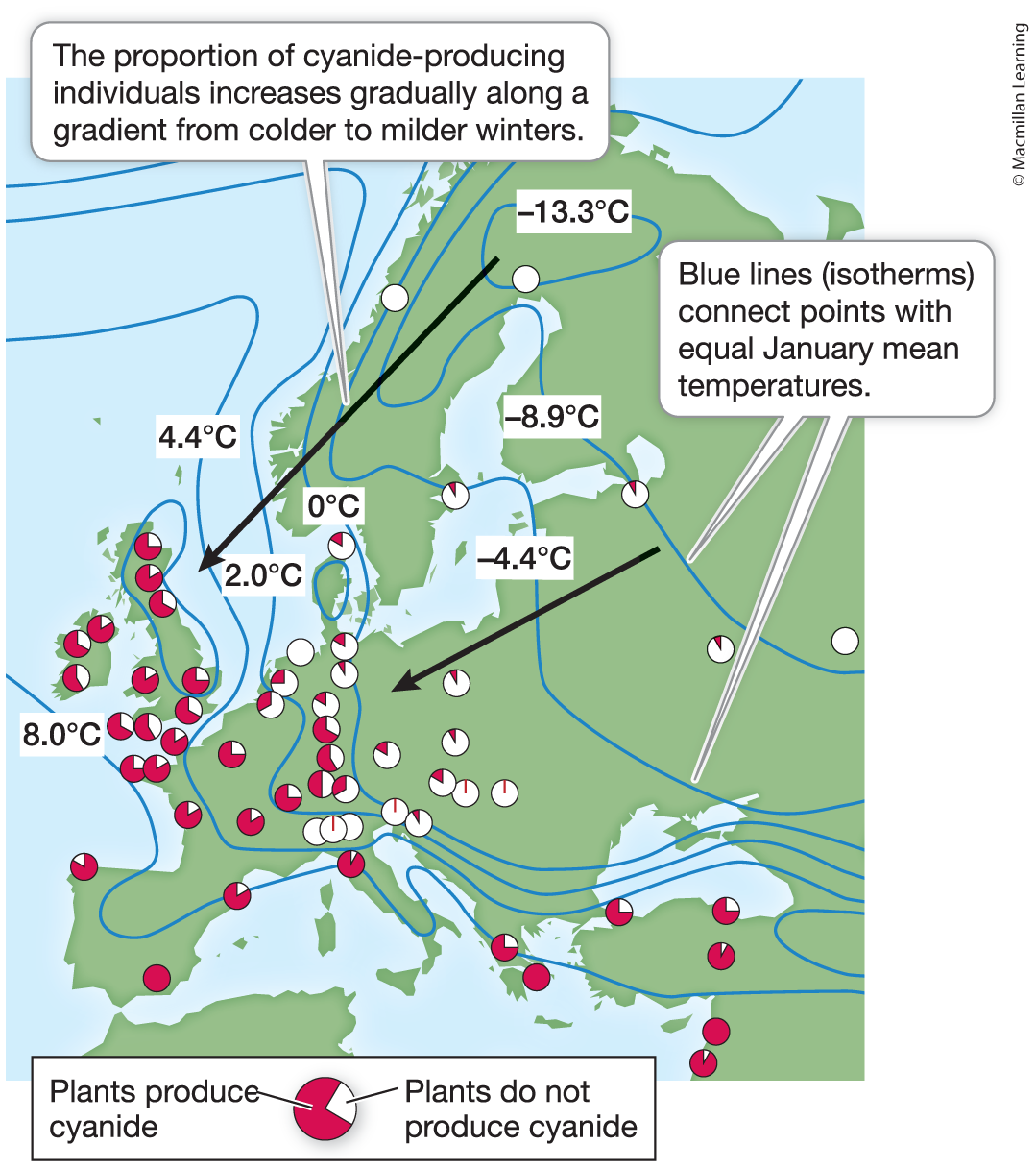
Clinal variation
A pattern of gradual change in phenotype across a geographic gradient due to environmental changes
Seen with T. repens clovers producing varying levels of cyanide due to European temperature differences making production hazardous in colder areas