rahimian 3: pt 1
 Call Kai
 Learn
 Practice Test
 Spaced Repetition
 Match
 Flashcards
 Knowt Play
1/25

There's no tags or description
Looks like no tags are added yet.
26 Terms
Laminar flow
Blood tends to flow in a streamlined fashion.
The center layer moving fastest and outermost layer moving slowest.
Turbulent flow
Interrupted
Blood passes a constriction,sharp turn, rough surface.
Blood Pressure (BP)
• arterial pressure.
Measure of force exerted by blood against the wall.
• Capillary blood flow is directly proportional to arterial BP,
regulated by a combination of neuro-hormonal mechanisms.
Measurement of Blood Pressure
Mercury (Hg) manometer, pressure in millimeter of mercury (mmHg)
Blood moves through vessels because of blood pressure
auscultatory method of bp
Measured by listening for Korotkoff sounds produced by turbulent flow in arteries as pressure released from blood pressure cuff connected to a sphygmo-manometer
blood pressure measurement
start w/ a high pressure, NO SOUND
sound first heard
korotkoff sounds
sound disappears

blood flow
volume of blood moving through a vessel in a given time period
Directly proportional to pressure differences,
inversely proportional to resistance (R).
flow= P1-P2 / R

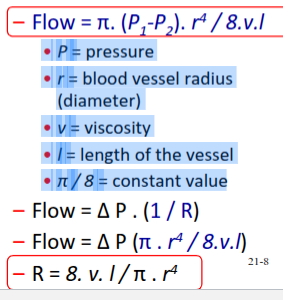
Poiseuille’s Law
Flow decreases when resistance increases.
• P = pressure
• r = blood vessel radius (diameter)
• v = viscosity
• l = length of the vessel
• π / 8 = constant value
Resistance
Any force that is against of movement.
• Resistance of venous system is very low
Peripheral resistance (PR)
resistance of peripheral vasculature mainly determined by arterioles and pre-capillary arterioles
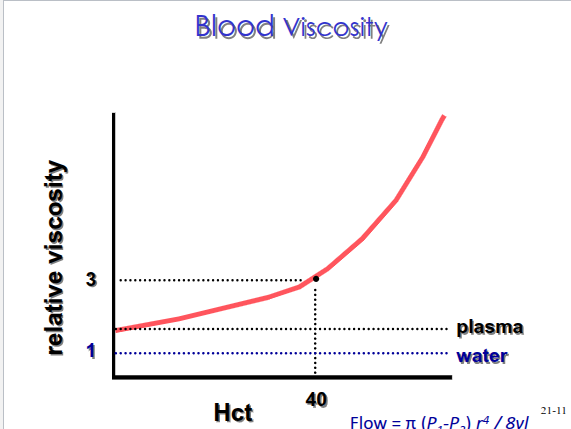
Viscosity
Measure of resistance of liquid to flow
viscosity inc = pressure req to flow inc
Viscosity of whole blood = 3.0 - 4.5
Influenced largely by hematocrit
ratio of volume of packed red blood cells to the volume of whole blood.
Critical closing pressure
Pressure at which a blood vessel collapses, and blood flow stops.
Laplace’s Law
Force acting on blood vessel wall is proportional to diameter of the vessel times blood pressure
F = D x P
• F = force
• D = vessel diameter
• P = pressure
Vascular Compliance
Tendency for blood vessel volume to increase as blood pressure increases
More easily the vessel wall stretches, the greater itscompliance.
Measure of distensibility (expansion) of the volume produced by a unit pressure change (eg. rubber is very compliant).
Compliances: equation
Compliances = increase in volume (ml) / increase in pressure (mmHg)

what does venous system act as
blood reservoir, has large compliance
Elasticity
quality of recoiling or returning to an original form after the removal of
arterial pressure during ventricular diastole
arterial pressure drives blood flow through the vasculature
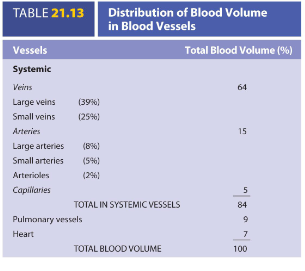
Blood volume distribution
Cross-Sectional Area of blood vessels
diameter dec = total cross-scetion area inc & blood flow dec
Pressure within the Cardiovascular
Aortic pressure fluctuate (120 -80 mm Hg)
aorta: 100 mmHg
right atrium: 0 mmHg
where does greatest drop in pressure occurs
arterioles —> which regulate blood flow through tissues
No large fluctuations in capillaries and veins
what happens when venous vessels constrict
compliance decreases
venous pressure increases, favoring venous return (VR) and increases stroke volume.
Venous return to heart increase bc
increase in venous tone
increase blood volume
Pulse Pressure
Difference between systolic and diastolic pressures
determine heart rate and rhythmicity
Increases when stroke volume increases or vascular compliance decreases
weak pulse indicates
decrease stroke volume caused by increased constriction of arteries