Mendeleev
 Call Kai
 Learn
Learn Practice Test
 Spaced Repetition
 Match
Match Flashcards
 Knowt Play
1/32

Earn XP
Description and Tags
The one who organized the elements by increasing the atomic mass and make the same elements in the same row have similar properties.
Name | Mastery | Learn | Test | Matching | Spaced | Call with Kai | Chat |
|---|
No analytics yet
Send a link to your students to track their progress
33 Terms
Mendeleev
The one who organized the elements by increasing the atomic mass and make the same elements in the same row that have similar properties.
Moseley
The one who rearranged the elements by increasing atomic number.
Periodic law
“when elements are arranged in order of increasing atomic number, there’s a periodic pattern in their physical and chemicals properties.”
Period
the horizontal rows of the periodic table.

Group
The vertical rows of the periodic table.

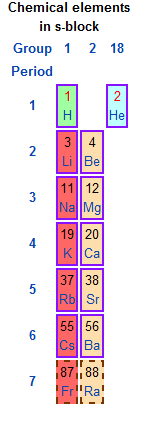
S block
Representative elements
P block
Representative elements

D block
Transition metals

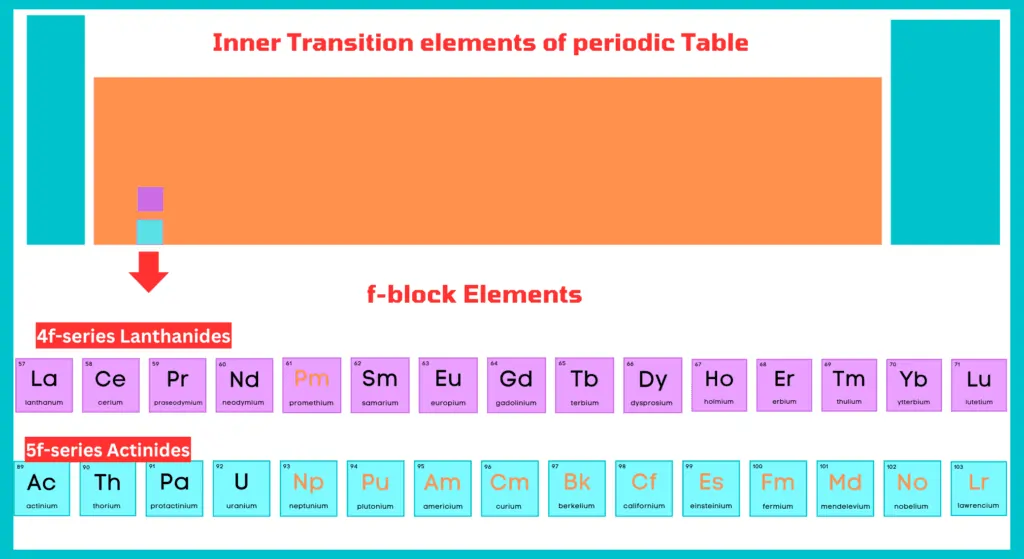
F block
Inner transition metals
Alkali metals
Highly reactive chemical elements in group 1 of the periodic table
Li, Na, K, Rb, Cs, Fr
Alkaline earth metals
Highly reactive and shiny chemical elements located in group 2
Be, Mg, Ca, Sr, Ba, Ra
Transition metals
Large blocks of metallic element are in group 3 through 12.

Halogens
Highly reactive nonmetallic elements in Group 17
Noble gases
Stable, odorless, colorless, nonmetallic gases in group 18.
Metal
Lustrous, malleable, and good conductors of heat and electricity located on the left of the staircase.
Non metal
Non-lustrous, brittle, and poor conductors located on the right side of the staircase (include H).
Metalloids
Touch the staircase and have properties of both metals and non metals.
Electron configuration
How electrons are distributed.
Principal energy levels
Describes the average distance of an electron from the nucleus.
Sublevels
Correspond to the different areas an electron can be located in an atoms.
Atomic orbitals
Each sublevel is oriented differently in 3D space, and each orbitals can hold only two electrons.
Aufbau Principle
Electrons enter sublevels with the lowest energy first.
Orbital nation
Uses circles to represent atomic orbitals with a label underneath to indicate sublevel and energy level.
Pauli Principle
Atomic orbitals can only hold two electrons at most and they must have opposite spins.
Hund’s Rule
in a sublevel with more than one orbital, put one electron into each orbitals before putting 2 electrons into any one orbital.
Isoelectronic
Two atoms have the same number of electrons.
Valence Electrons
Electrons located in the outermost energy level.
Atomic radius
½ of the distance between the nuclei of two like atoms.
Nuclear charge
Magnitude of attraction from nucleus.
Shielding effect
The inner electrons “shield” or block the attraction from the nucleus.
Ionization energy
The amount of energy required to remove an electron from a gaseous atom.

Ionic size
The size of an atom changes according to its charge: it’s larger if the charge is negative and smaller if it’s positive.

Electronegativity
Tendency for an element to attract electrons when chemically combined with another element.
