AP BC Calculus Flash Cards
 Call Kai
 Learn
 Practice Test
 Spaced Repetition
 Match
 Flashcards
 Knowt Play
1/40

There's no tags or description
Looks like no tags are added yet.
41 Terms
The domain of y=lnx is the set of…
all positive numbers x>0
The range of y=lnx is the set of…
all real numbers -∞<y<∞
y=lnx characteristic on domain
continuous and increasing everywhere on its domain
ln(ab)=
lna + lnb
ln(a/b)=
lna - lnb
lnar =
rlna
y= lnx < 0 if…
0< x < 1
lim x→+∞ lnx =
+∞
lim →0+ lnx =
-∞
logax =
lnx/lna
What is the unit circle?
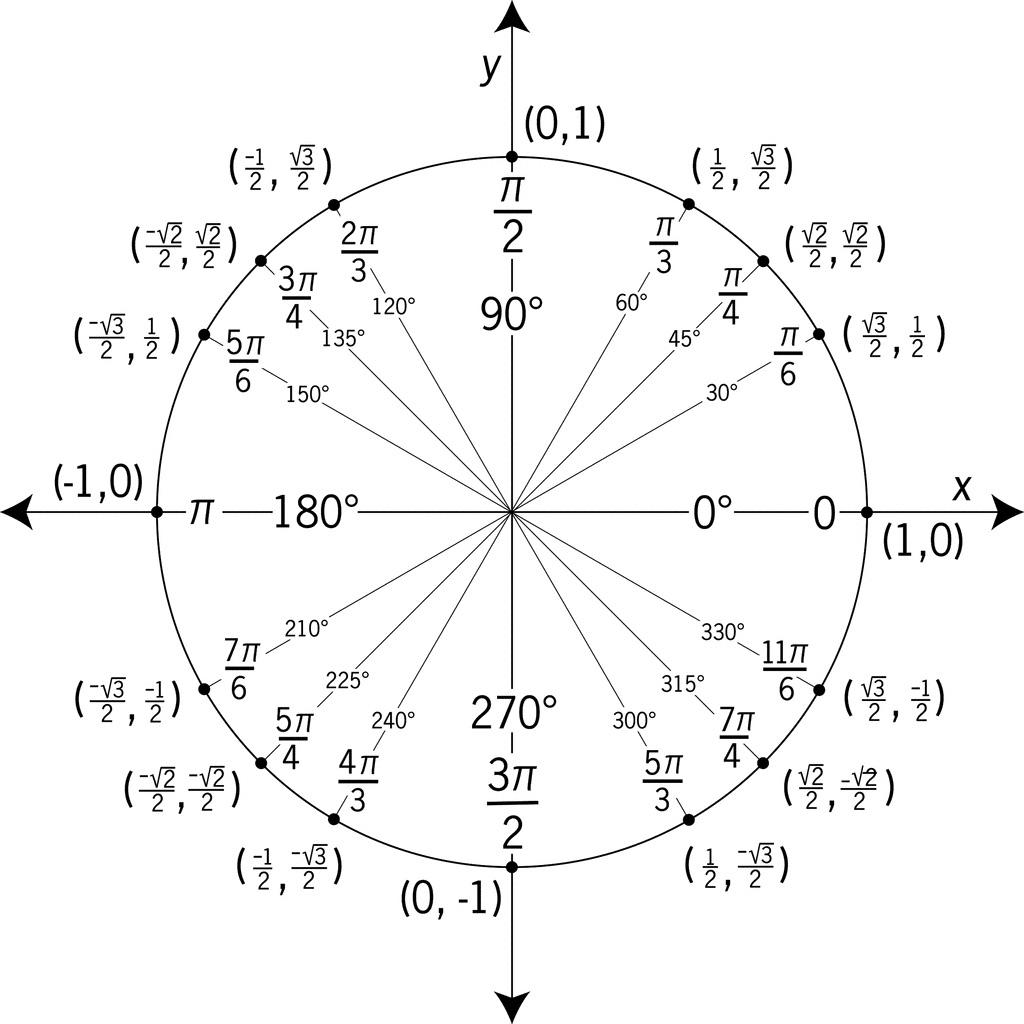
lim x→0 sinx/x =
1
Definition of Derivative
m= f’(x) =
lim h→0 f(x+h) - f(x) / h
lim h→0 eh-1 / h =
1
Alternative definition of derivative at a point
f’(a) =
lim x→a f(x) - f(a) / x - a
lim h→0 cos h - 1 / h =
0
d/dx ex =
ex
Power rule
d/dx xn =
nxn-1
d/dx ax =
axlna
d/dx lnx=
1/x
Product Rule
d/dx (uv) =
u’ v + u v’
Quotient Rule
d/dx (u/v) =
u’ v - u v’ / v2
df/dx = d/dx (c) =
0
Constant Multiple Rule
d/dx (cu) =
c (du / dx)
Sum and Difference Rule
d/dx (u+- v) =
du/dx +- dv/dx
d/dx logb x =
1/xlnb
Chain rule
d/dx f(g(x))=
f’ (g(x)) g’(x)
d/dx (sin x) =
cosx
d/dx (cosx) =
-sinx
d/dx (tanx)=
sec²x
d/dx (cscx) =
-cscxcotx
d/dx (secx)=
secxtanx
d/dx (cotx)=
-csc²x
d/dx sin-1x=
1/√1-x²
d/dx cos-1x=
-1/√1-x²
d/dx tan-1x=
1/x²+1
d/dx cot-1x=
-1/x²+1
d/dx sec-1x=
1/|x|√x²-1
d/dx csc-1x=
-1/|x|√x²-1
Derivative of Inverses
If g(x) is the inverse of f(x) and f(a) = b then
g’(b) = 1/f’(a)
Trapezoidal Approximations
∫ f(x)dx=
h/2 (y₀+2y1+2y2+…2yn-1+yn)