Study Guide (3): Unit 1 - PSYC 311 (Cognitive Psychology): Perception
 Call Kai
 Learn
Learn Practice Test
 Spaced Repetition
 Match
Match Flashcards
 Knowt Play
1/20

Earn XP
Description and Tags
* - not in the study guide
Name | Mastery | Learn | Test | Matching | Spaced | Call with Kai | Chat |
|---|
No analytics yet
Send a link to your students to track their progress
21 Terms
What is Sensation?
An irreducible unit of experience produced by stimulation of a sensory receptor, producing basic awareness of a stimulus
Or, the physical process of detecting environmental stimuli through sensory organs
What is Perception?
The organization, identification, and interpretation of sensory information in order to represent and understand the presented information or environment
Or, the psychological process of organizing and interpreting those signals in the brain
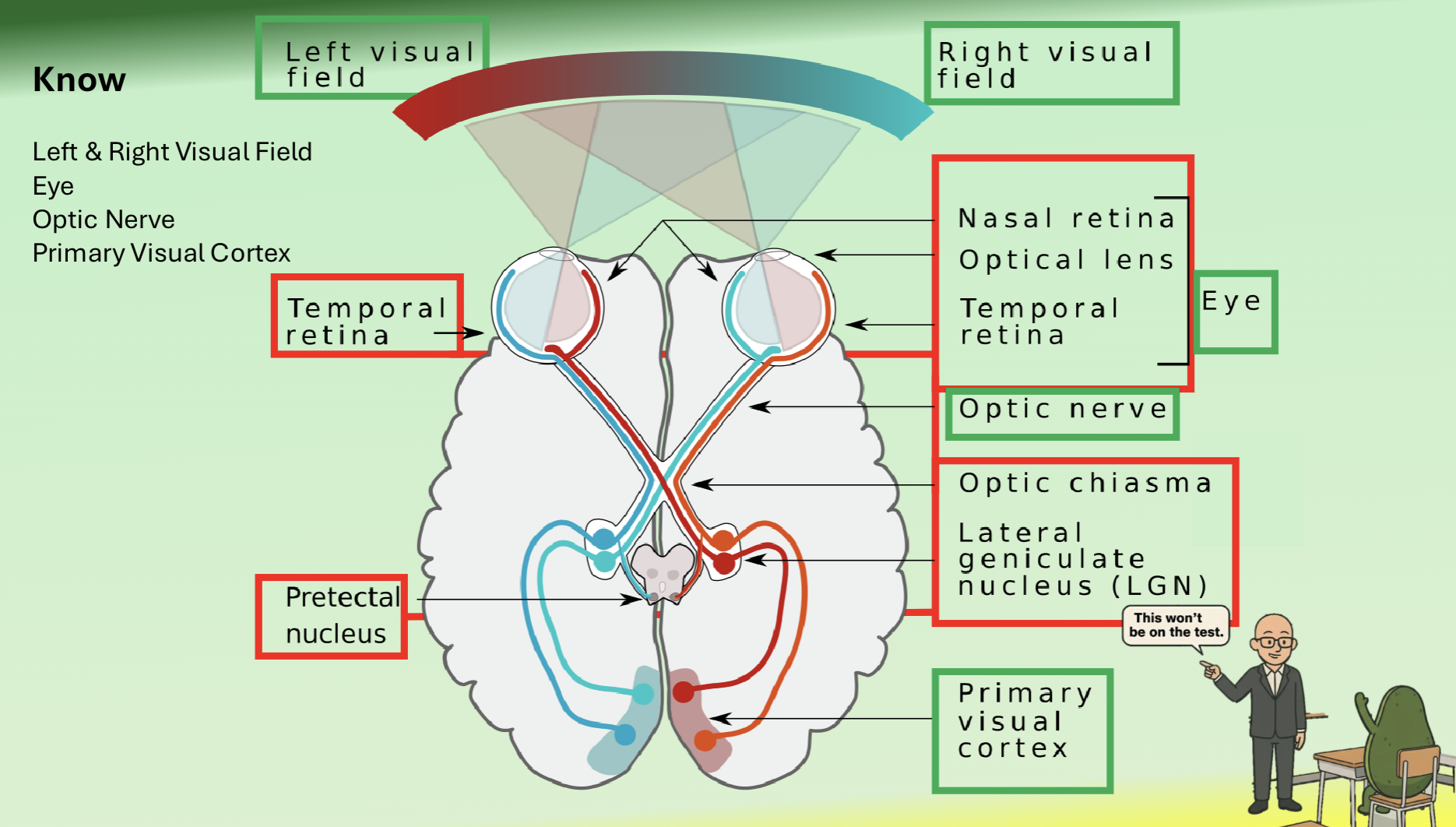
Where is light that enters the eyes through the left visual field ultimately end up processed in the brain (on what side, and in what lobe)?
Light entering the eyes through the left visual field is ultimately processed on the right side (hemisphere) of the brain in the occipital lobe.
What is Bottom-Up Processing?
Processing which is driven entirely by an
external stimulus itself, insulated from
pre-existing knowledgeSensation is typically bottom-up
Or, your brain builds a perception based strictly on the raw data coming in through your senses, without any help from your past experiences, expectations, or background knowledge
Example:
Lines and Contrast: Your eyes naturally detect sharp borders and bright vs. dark areas instantly, without you having to "decide" to see them.
What is Top-Down Processing?
Processing which draws from pre-existing knowledge or brain states, modifying new information that enters the system with pre-existing knowledge
Deliberate behavior is typically top-down
Or, your brain uses pre-existing knowledge, memories, context, and expectations to interpret the raw sensory data coming in
Example:
A bistable image is a visual illusion that can be seen in two completely different ways—like the famous drawing that can look like either a vase or two facing faces. The raw sensory data (the black and white lines) never changes. However, your perception shifts back and forth because your top-down focus dictates which mental concept you expect to see, completely changing your conscious reality.

What is the Template Matching Theory of Vision, and what are its Cons?
The Template Matching Theory of Vision:
The idea that perception occurs by comparing visual sensations to a store of templates in memory
Or, whenever you look at something (a visual sensation), your brain tries to recognize it by comparing it to an internal library of exact, pre-saved images (templates) stored in your memory.
The Cons:
Your brain would have to store an impossibly large set of ‘templates’
There would be an exponential, unmanageable surge in processing demands that happens when the brain tries to store and compare a unique mental template for every possible variation of an object (Mental-Computational explosion)
You can easily recognize an object if it is tilted, flipped, or upside down, but template matching fails here because the angled object no longer perfectly lines up with your standard, straight-on template (Non-canonical orientations)
When an object is partially blocked or hidden from view (ex. a car parked behind a tree), its shape changes, meaning it will no longer match your full memory template even though you still know what it is (Occlusion)
What is the Affordance Theory of Vision? What is the Affordance you perceive when looking at a mug?
The Affordance Theory of Vision:
The Idea that perception is supported by automatically extracting rich information from the environment
Or, organisms perceive their environment directly in terms of the action possibilities it offers, rather than as a neutral collection of shapes and colors
What is the Affordance you perceive when looking at a mug?:
When looking at a mug, the primary Affordance you perceive is that the handle allows you to hold it, and the hollowed-out shape allows you to pour liquid into it and drink from it without spilling.
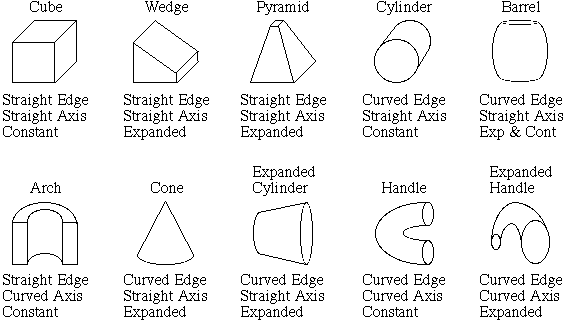
What is a Geon?
Geons:
Perception is supported through the dynamic
combination of a set of core shapes into a 3-D
model that is then matched against a template
(or prototype)
Or, geons are simple, three-dimensional geometric shapes—such as cylinders, cones, blocks, and wedges—that serve as the basic building blocks of object recognition in psychology.
What is Shape Constancy?
Shape Constancy:
We perceive stimuli to have constant properties in the world even though sensory information may change
Close/Far: As sensory information changes with distance we typically perceive objects at a constant size
Occlusion: Partial occlusion does not influence our perception
Non-Cannonical Orientations: Changing to strange angles rarely seen does not break shape perception
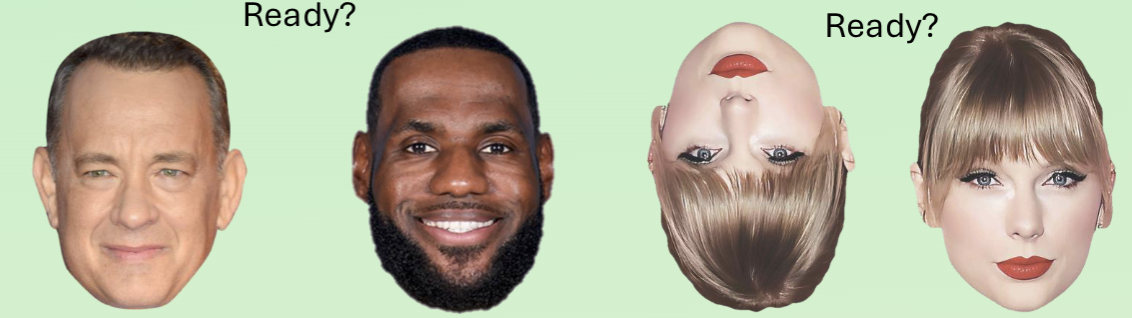
What is the Face Inversion Effect?
The Face Inversion Effect:
Is a phenomenon in which identifying upside-down faces compared to upright faces is much more difficult and slower than doing the same for non-facial objects.
What types of stimuli are processed in special ways by the Visual System?
Contrast
Line
Shape
Movement
What are the Anatomical and Functional Regions of the brain that process a special visual category?
Anatomical Regions:
V1 (Primary Visual Cortex): Processes contrast/edges
V2 (Secondary Visual Cortex): Processes lines/boundaries
V4: Processes shapes and colors
MT: Processes movement and speed
Functional Regions:
Parahippocampal Place Area (PPA): Processes scenes
Lateral Occipital Cortex (LOC): Processes objects
Visual Word Form Area (VWFA): Processes letters and words
How are Functional Regions located in the Brain?
Frontal Lobe
Motor Cortex: Controls physical body movement
Prefrontal Cortex: High executive processing, such as problem-solving, decision-making, goal orientation, thinking, and abstract thought
Broca’s Area: Speech production
Parietal Lobe
Somatosensory Cortex: Enables tactile sensations; also responsible in the feeling of physical pain
Temporal Lobe
Wernickes Area: Speech comprehension
also the Fusiform Face Area (FFA): Processes faces (on Ventral Surface)
Occipital Lobe
The Primary Visual Cortex: Processes contrast/edges
What are the 6 Gestalt Properties of Vision?
They are rules that explain how the human brain automatically organizes individual visual pieces into a meaningful whole.
the "whole is different than the sum of its parts"
There are 6 of them:
Closure
Figure Ground
Similarity
Proximity
Good Continuation
Common Fate
Gestalt Properties of Vision: Closure
We perceive incomplete forms as complete, synthesizing the missing units so as to perceive the image or sound as a whole
Example shown: Kanizsa Triangle

Gestalt Properties of Vision: Figure Ground
Perception requires segmentation of the focus from the background
Or, your brain cannot make sense of what you see until it decides what is the main object (the figure) and what is just the backdrop (the ground)

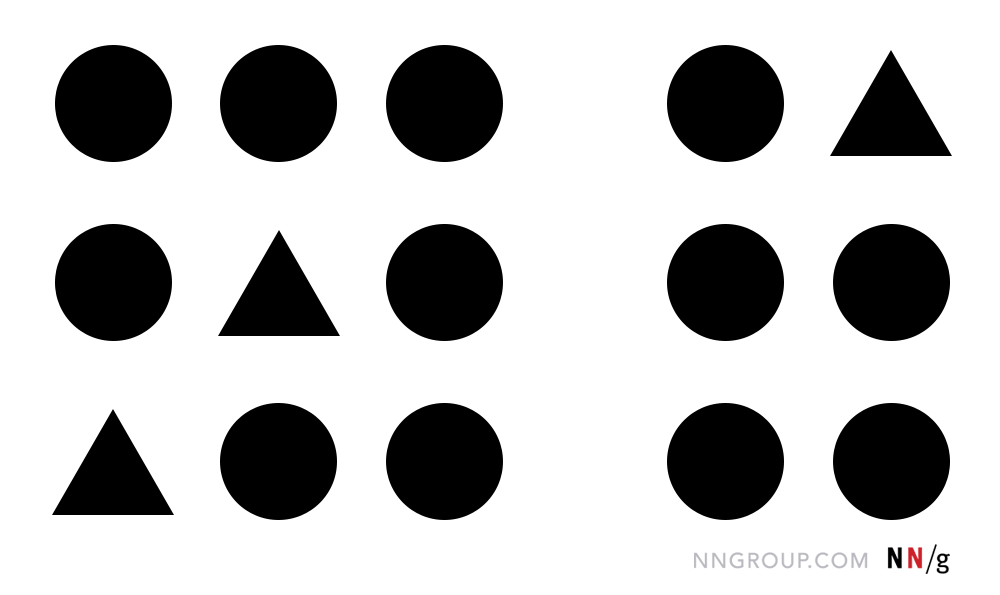
Gestalt Properties of Vision: Similarity
People tend to organize objects with similar qualities into a perceptual group and interpret them as a whole

Gestalt Properties of Vision: Proximity
We typically group objects close to each other into a perceptual group and interpret them as a single entity
Gestalt Properties of Vision: Good Continuation
We tend to perceive objects in alignment as forming smooth, unbroken contours

Gestalt Properties of Vision: Common Fate
We typically group together stimuli that share similar patterns of movement
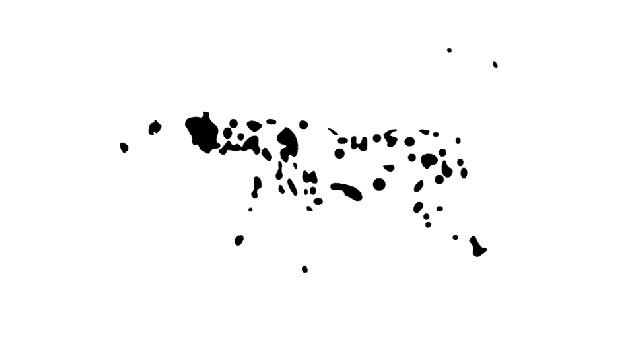
What is Perceptual Learning? Give one example.
Perceptual Learning are the changes in perception that occur as a function of practice or experience with the stimuli
Or, training your brain to see and perceive things more accurately through practice.
The more experience you get with a specific sight or sound, the better you become at processing it.
Example:
Identifying Musical Pitches: Music students practice listening to notes over and over until they can instantly tell the difference between two closely related musical pitches or tones