CT 2: Review Exam 1
 Call Kai
 Learn
Learn Practice Test
 Spaced Repetition
 Match
Match Flashcards
 Knowt Play
1/73

There's no tags or description
Looks like no tags are added yet.
Name | Mastery | Learn | Test | Matching | Spaced | Call with Kai | Chat |
|---|
No analytics yet
Send a link to your students to track their progress
74 Terms
Which slice thickness results in less noise in the image?
Thick slices
Which of the following is not a synonym for the preliminary (or localizer) image taken at the start of a CT exam?
Spiral
What is the pitch in the following scenario:
16-slice scanner
0.5 mm slice thickness
Table movement of 12 mm per rotation
1.5
Miscentering the patient during localizer acquisition can cause:
Incorrect tube current calculation with AEC
Please match the CT parameter to it's definition:
The technical parameter controlling a CT system of temporal resolution. It is how fast the gantry rotates and how fast the images are acquired.
Gantry Rotation Speed
Please match the CT parameter to it's definition:
Described as the movement of the table throughout a helical scan divided by slice thickness
Pitch
Please match the CT parameter to it's definition:
The dimension of the CT slice along the longitudinal direction of acquisition (z-axis), in MDCT it is controlled by detector configuration
Collimation
Please match the CT parameter to it's definition:
Performed after the initial prospective reconstruction to slice thickness
Reconstructed Slice Thickness
Please match the CT parameter to it's definition:
The distance between the center of one CT section to the center of the next adjacent section
Slice Interval
Overextending the scan region in MDCT can lead to:
Increased radiation dose
If an image was taken of the abdomen using a 25-cm display field of view (DFOV), what is necessary to reconstruct the image with a larger DFOV?
The SFOV must be larger than 25cm and raw data must be available.
Soft kernels or low spatial resolution are preferred for:
Soft tissue structures
If the main tissue of interest is the liver, which of the following is the best approximate window level setting?
50
A precise set of steps to be performed in a specific order to solve a problem describes:
An algorithm
All of the following are scan parameters except:
Matrix
Pitch
Slice thickness
mAs
Matrix
Increasing the scan field of view (SFOV):
Increases the number of detector cells collecting data
Which of the following is a parameter than cannot be changed by the technologist?
Patient size
What is it called when a patient breathes differently with each data acquisition and areas of anatomy seem to be misplaced in the z-axis?
Misregistration
Accurate patient positioning is important because:
It ensures proper image annotation and orientation.
A decrease in kVp _____________ image noise and ___________ radiation dose if other parameters are held constant.
Increases; decreases
What determines the area, within the gantry from which raw data are acquired and determines the number of detector cells collecting data?
SFOV
What determines how much of the collected raw data is used to create an image? Changing the _____ will affect image quality by changing the pixel size. Because the data selected for ______ are a subset of all the scan data available, the _____ cannot be larger than the SFOV.
DFOV
What determines the amount of tube current or the number of x-ray photons?
mAs
What determines tube potential?
kVp
What is the normal pulse range for infants?
100 to 160 bpm
When verbal and nonverbal messages conflict, which do people typically believe?
The nonverbal message
Which of the following is considered a normal oral temperature?
97.7 degrees F
How many methods of verifying a patient's identity are required?
At least two
What do social psychologists estimate as the percent in loss of meaning in the transmission of messages from sender to receiver?
40% to 60%
What, as a general rule, is the normal range for prothrombin time (PT)?
11 to 14 sec
Which lab test is NOT typically used to assess kidney function?
PT
Which is not a goal of the questions included on the CT history?
Choosing the proper radiologist to dictate the exam
Among healthcare workers, what has been cited as the primary reason for not talking more with patients?
Lack of time
Which barrier occurs when patients interpret only what they want to hear?
Receiver distortion
Which of the following is considered the normal range for BUN?
7-25 mg/dL
Which of the following behaviors can dehumanize patients?
Referring to them as 'the chest CT' or 'the brain in Room 2'
For interventional CT procedures, which labs are important to assess bleeding risk?
PT, PTT, and platelet count
Why is it important for the technologist to note the patient's breathing, skin coloration, and overall health before the exam begins?
It will help the technologist notice signs should adverse effects occur during the scanning process.
Who typically determines the proper initial protocol for a CT examination?
A radiologist
Which is true about meanings with respect to communication?
Meanings are not entirely contained in the message. They are interpreted by the message receivers.
Which is a communication habit to avoid?
Using false reassurance
All of the following fall within the normal range for serum creatinine, except:
0.7 mg/dL
1.0 mg/dL
1.5 mg/dL
2.0 mg/dL
2.0 mg/dL
______________ is the peak pressure in the arteries, occurring near the beginning of the cardiac cycle.
Systolic pressure
Basic consent is appropriate for:
Routine, noninvasive procedures
_____ is the leakage of fluid from a vein into the surrounding tissue during IV administration.
Extravasation
What drug and how much is given as premedication to patients that have experienced an allergic reaction to contrast from a prior contrast study 13 hours before the procedure?
Prednisone, 50 mg
By how many Hounsfield units must two tissues differ to be visibly different on a CT scan?
At least 10 Hounsfield unit (HU)
What is the typical single dose of iodinated contrast agents for a routine CT examination?
Between 100 and 150 mL
What is the most common formula for calculating the dose of intravascular contrast for pediatric CT studies?
2 mL/kg
In a patient who is lactating, what percent of the dose of contrast agent given is excreted into breast milk?
Between 0% and 1%
Please match the correct definition to the terms below.
Contains molecules that dissociate into ions in solution
Ionic Agents
Please match the correct definition to the terms below.
Contains molecules that do not dissociate
Nonionic Agents
Please match the correct definition to the terms below.
How easily contrast can be injected
Viscosity
Please match the correct definition to the terms below.
Possess a higher density than surrounding structures
Positive Contrast Agents
When does contrast enhancement typically reach a near-peak in the aorta?
From 15 to 22 seconds after the start of the injection
Which is the preferred venous access site when a mechanical injector is used?
Antecubital or large forearm vein
For what flow rate is a 20-gauge or larger catheter preferable?
3 mL/s or higher
Warming a contrast agent ______ viscosity.
Reduces

Match image to phase:
It is defined by at least 30 HU density difference between the aorta and ivc. The contrast is in the arteries that is why there is such a difference in density between the aorta and ivc.
Bolus (Arterial) phase
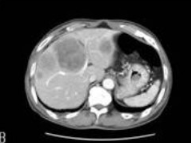
Match image to phase:
occurs not to long after injection (approx. 60 – 90 secs)it is defined by a density difference between the abdomen aorta and ivc of 10 and 30 HU. The contrast is being pushed from the capillaries into the veins therefore decreasing the density between the aorta and ivc.
Non-Equilibrium (Portal Venous) Phase

Match image to phase:
occurs minutes after injection and is defined by a density difference of less than 10 HU between the aorta and ivc. Concentration of contrast in the veins and arteries are similar.
Equilibrium phase
Gastrointestinal contrast media is essential to the GI tract to differentiate loops of bowel from which of the following:
Cysts
Abscesses
Neoplasms
All of the choices listed.
All of the choices listed.
If conventional barium is utilized as oral contrast for a CT examination, it will:
Obscure pertinent anatomy due to streak artifacts.
_____ is the acute impairment of renal function occurring after intravascular CM administration, excluding other causes.
Contrast Induced Nephropathy (CIN)
Match brand/generic name contrast:
iohexol(generic name) LOCM non ionic
Omnipaque(brand name)
Match brand/generic name contrast:
iopamidol (generic name) LOCM non ionic
Isovue(brand name)
Match brand/generic name contrast:
ioversol (generic name) LOCM non ionic
Optiray (brand name)
Match brand/generic name contrast:
iodixanol (generic name) Isomolar non ionic contrast
Visipaque (brand name)
Match brand/generic name contrast:
diatrizoate meglumin/diatrizoate sodium (generic name)- Oral contrast
Gastrografin(brand name)
Normal Blood urea nitrogen (BUN) values:
5-20 mg/dl
Normal creatinine values:
0.7-1.5 mg/dl
Normal Partial thromboplastin time, activated (APTT) values:
30-40 seconds
Normal Platelet count:
150,000-400,000/mm³
What is GFR?
Stands for glomerular filtration rate and it is a more accurate measure of renal function.
Is an approximation of creatinine clearance or the rate by which creatinine is filtered from the blood stream.
Is calculated using the patient’s measured serum creatinine level and takes into account the patient’s age, sex and race.