Kearns Microbiology Final Exam Prep (BIOL-M 250 Multiple Choice)
 Call Kai
 Learn
 Practice Test
 Spaced Repetition
 Match
 Flashcards
 Knowt Play
1/57

There's no tags or description
Looks like no tags are added yet.
58 Terms
Which part of lipopolysaccharide is a long repeating polysaccharide that can differ between strains of the same species?
a. core
b. lipid A
c. O-antigen
d. teichoic acid
c. O-antigen
Protein folding driven by hydrophobicity/hydrophilicity of amino acid R-groups is called:
a. primary
b. secondary
c. tertiary
d. quaternary
c. tertiary
In bacteria, there are ___________ different monomers that make up proteins.
a. 64
b. 20
c. 12
d. 4
b. 20
Which is not a function of extracellular polysaccharides:
a. energy storage
b. adhesion to surfaces
c. impairs engulfment by eukaryotic predators
d. draws water out of environment
a. energy storage
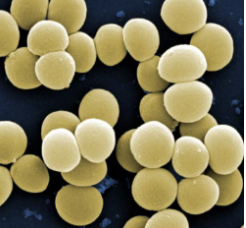
What word best describes the shape of the bacteria shown at the right:
a. rod
b. vibrio
c. coccus
d. spirillum
e. prosthecate
c. coccus
peptidoglycan is an especially stable cell wall polymer for all of the following reasons except:
a. It contains β-linked sugars.
b. It contains D-form amino acids
c. It contains peptide bonds.
d. It prevents water from passing through it.
d. It prevents water from passing through it.

you have isolated a new bacterium: Megabacter honkinbigii that looks like a massive sphere larger than the head of a pin. In TEM cross-section, you realize the actual cytoplasmic volume of M. honkinbigii is thin because the cell is hollow with a large open space connected to the outside environment (see figure to right). Considering the large size of the organism, what is the most likely function of the open space?
a. site of nutrient storage
b. contains the chromosome
c. provides structural support
d. increase surface area relative to volume
d. increase surface area relative to volume
16S rRNA is a good molecular chronometer for global phylogenetic analysis for all of the
following reasons except:
a. it has regions of low sequence similarity between some organisms
b. it has regions of high sequence similarity between some organisms
c. it has different functions in different organisms
d. it is present in all organisms being compared
c. it has different functions in different organisms
16S rRNA is found in the:
a. nucleoid
b. ribosome
c. periplasm
d. membrane
b. ribosome
in bacteria, there are ___________ different monomers that make up RNA.
a. 64
b. 20
c. 12
d. 4
d. 4
Which of the following is responsible for giving bacterial cell bodies their characteristic
shape?
a. phospholipids
b. peptidoglycan
c. cytoplasm
d. nucleoid
b. peptidoglycan
The resolution of light microscopy is ultimately limited by:
a. the wavelength of light
b. numerical aperture
c. lens strength
d. focal length
a. the wavelength of light
A bacterial species is defined as a group of bacteria with:
a. the ability to exchange genetic material
b. greater than 50% similarity by trait comparison
c. greater than 70% similarity by DNA/DNA hybridization
d. greater than 95% similarity by 16S rRNA sequencing
c. greater than 70% similarity by trait comparison
this protein compacts DNA.
SMC
this protein acts as a guide for peptidoglycan synthesis
MreB
this protein makes a vibrio cell, vibrio-shaped
CreS
this protein increases membrane permeability.
Porin
this protein connects the outer membrane to the peptidoglycan.
Braun’s Lipoprotein
the largest macromolecule in the cytoplasm is made of _______________.
nucleic acud
the most abundant macromolecular class (by mass) inside the cell is ____________.
protein
______________ is defined by α and β linkages between the monomer.
polysaccharide
peptidoglycan is made of _______________.
*structure has properties of more than one macromolecular class
bacterial pili are made of _______________
protein
which macromolecular class would most likely contain
the structure to the right?

protein

which macromolecular class would most likely contain
the structure to the right?
nucleic acid

which macromolecular class would most likely contain
the structure to the right?
lipid
in scanning __________________, the electron emitter and detector are on the same sides of the sample
electron microscopy
in _____________________, the light source and detector are on the same sides of the sample.
fluorescence microscopy
________________ is a way of classifying pathogens based on antibody reactivity.
serotyping
______________ kill cells by disrupting the membrane
detergents
______________ were once bacteria
chloroplasts
Bacteria use siderophores to transport:
a. glucose
b. iron
c. protons
d. electrons
b. iron
the generation time is:
a. the time it takes for a population to enter exponential growth phase
b. the time it takes for a population to enter stationary phase
c. the time when the growth rate and the death rate is equal
d. the time it takes for a cell population to double
d. the time it takes for a cell population to double
if the generation time of an organism decreases 3 fold, the growth rate _________.
a. increases
b. decreases
c. remains constant.
d. cannot be predicted because the two values are unrelated
a. increases
there are 1000 bacteria in a test tube growing exponentially. After 3 generations, how many
bacteria will there be?
a. 3,000
b. 6,000
c. 8,000
d. 60,000
c. 8,000
heat kills bacteria because it damages the functional organization of all of the following
structures except:
a. phospholipids
b. peptidoglycan
c. proteins
d. DNA
b. peptidoglycan
Dessication kills bacteria by damaging:
a. phospholipids
b. peptidoglycan
c. proteins
d. DNA
d. DNA
A chemo-organo-heterotroph is aerobically respiring glucose. Which of the following
statements is not true?
a. The cell obtains electrons from glucose.
b. The cell obtains carbon from CO2.
c. The cell uses an electron transport chain to make proton motive force.
d. The cell consumes oxygen as a terminal electron acceptor.
b. the cell obtains carbon from CO2
An enzyme accelerates a chemical reaction by all of the following mechanisms except:
a. controlling substrate orientation
b. electrically straining chemical bonds
c. increasing local substrate concentration
d. changing the equilibrium concentrations of reactants and products
d. changing the equilibrium concentrations of reactants and products
Cofactors will most likely be used by bacteria to:
a. participate in transport mechanisms
b. extend the chemistry of proteins
c. assemble macromolecules
d. stabilize membranes
b. extend the chemistry of proteins
Catabolism is:
a. the breakdown of larger molecules into smaller molecules and energy intermediates.
b. the assembly of smaller molecules into macromolecules and biomass.
c. the ability to
d. the sum of all enzymatic reactions in the cell.
a. the breakdown of larger molecules into smaller molecules and energy intermediates
An obligate fermenting bacterium is fermenting glucose to lactate. How does the bacterium
produce proton motive force?
a. F1F0 ATPase
b. Reverse F1F0 ATPase
c. Electron transport chain
d. Reverse electron transport chai
b. Reverse F1F0 ATPase

bacterium with fastest growth rate
bacterium A

bacterium that has greatest biomass yield
bacterium C
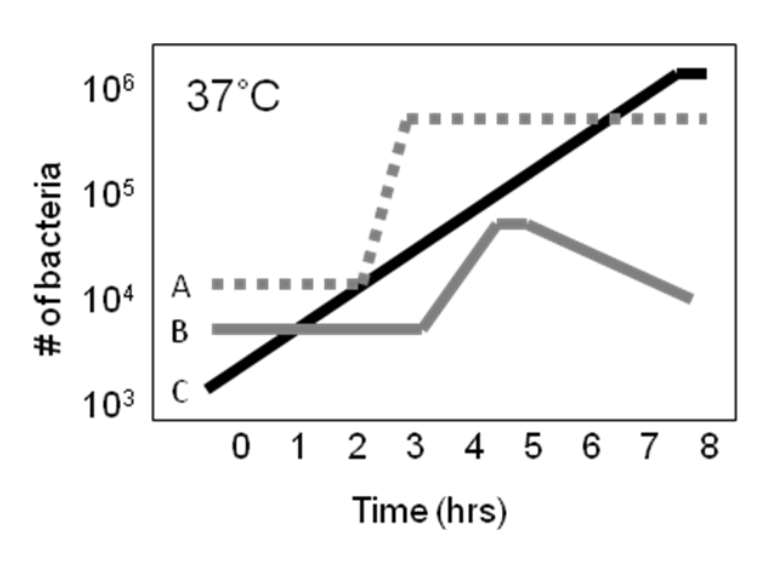
bacterium that can grow at the highest temperature
cannot tell from the graph
his protein cleaves peptidoglycan.
LytF
this protein senses ribosome stalling.
RelA
this protein interacts with the chromosome
SlmA
this protein helps protect the cell from oxygen damage
catalase
this protein is involved in physiological adaptation to stationary phase.
RelA
enzymes are _________
proteins
all _____________ are reversible
chemical reactions
in a chemostat, the bacterial growth rate ______________ as dilution rate increases.
increases
the kinetics of facilitated diffusion versus passive diffusion are shown in the graph to the right. Why does the rate of facilitated diffusion plateau at high substrate concentration?
a. protein channels become limiting
b. substrate becomes limiting
c. protons become limiting
d. ATP becomes limiting
a. protein channels become limiting
Which of the following transport systems is unable to concentrate substrate on the inside of the cell?
a. secondary active transport
b. primary active transport
c. facilitated diffusion
d. none of the above
c. facilitated diffusion
which phase of the batch growth curve is initiated by either depletion of nutrients or
accumulation of waste-products?
a. lag phase
b. exponential phase
c. stationary phase
d. death phase
c. stationary phase
Which of the following statements concerning secondary active transport is not true?
a. It requires an energetically favorable concentration gradient.
b. It can concentrate substrates on the inside of the cell.
c. It requires a membrane protein channel.
d. It uses ATP as an energy source.
d. it uses ATP as an energy source.