Early Northern Renaissance (Flemish Painting) (1400-1500)
 Call Kai
 Learn
Learn Practice Test
 Spaced Repetition
 Match
Match Flashcards
 Knowt Play
1/19

There's no tags or description
Looks like no tags are added yet.
Name | Mastery | Learn | Test | Matching | Spaced | Call with Kai | Chat |
|---|
No analytics yet
Send a link to your students to track their progress
20 Terms
Oil paint
Flemish painters became famous for their sophisticated use of oil paint. A
llowing artists to create extremely realistic skin, fabric, metal, glass, hair, and light. It also produced rich, luminous colors.
Oil paint = the technical foundation that made much of the Flemish style possible.
Extreme attention to detail
Flemish painters often painted tiny details with extraordinary precision. They might show individual hairs, threads in fabric, reflections in a mirror, or tiny flowers in a landscape.
Detailed naturalism
Flemish artists wanted their people, objects, animals, and environments to look believable. Their figures weren't necessarily idealized like many Italian Renaissance figures; instead, they often included individual physical characteristics and imperfections.
Disguised symbolism / symbolic objects
Flemish painters frequently put symbolic objects into otherwise realistic scenes. The object looks ordinary, but viewers familiar with Christian symbolism would recognize its deeper meaning.
Example: A candle, flowers, fruit, or a particular type of clothing might communicate something about Christ, purity, marriage, death, or sin.
Realistic textures
They could make:
velvet look soft
gold look reflective
glass look transparent
fur look fuzzy
wood look hard
metal look shiny
Rich / luminous colors
Oil paint and glazing techniques allowed Flemish painters to build up layers of transparent color. This created depth and luminosity, especially in reds, blues, greens, and golds.
Intuitive perspective
How it relates: Flemish painters created depth by using things like:
overlapping objects
decreasing size
placement of figures
receding architectural spaces
changes in detail
Definition: Creating a convincing sense of depth without following the mathematically calculated linear perspective system developed in Italy.
Atmospheric perspective
Flemish painters often included extensive landscapes in the background. They used atmospheric effects to make the distant landscape seem farther away.
Detailed landscapes
Flemish painters frequently included landscapes behind their main subjects. They could include mountains, rivers, trees, buildings, roads, fields, and tiny figures.
Individualized portraiture
Definition: A portrait that attempts to show the specific appearance and personality of an individual rather than representing a generic or idealized person.
How it relates: Flemish artists became famous for highly recognizable portraits. They carefully recorded individual features such as wrinkles, facial structure, hair, and expressions.
Religious subject matter
How it relates: Much of Early Northern Renaissance painting was religious because the Church was a major patron of art. Common subjects included:
Christ
the Virgin Mary
saints
the Crucifixion
the Annunciation
the Nativity
the Last Judgment
Domestic interiors
Flemish painters often placed religious or symbolic events in highly detailed interior spaces. The setting might look like a wealthy person's home rather than an obviously religious location.
Everyday objects
Flemish painters were fascinated by ordinary objects because they could demonstrate their realism and, sometimes, communicate symbolic meanings.
Altarpiece, Diptych / Triptych
How they relate: Flemish artists were especially famous for elaborate religious altarpieces and multi-panel paintings.
Patron portraiture
Wealthy patrons often wanted to appear alongside religious figures or scenes. They might be shown kneeling in prayer while the Virgin Mary, Christ, or a saint appears nearby.
Naturalistic light
Flemish painters carefully observed how light falls on faces, fabrics, walls, metal, glass, and other objects. Reflections and highlights could make objects appear three-dimensional and tangible.
Christian symbolism
Christian symbolism is one of the most important features of Flemish painting. A painting could look like an ordinary scene while simultaneously communicating a religious message.
Lily → purity / Virgin Mary
Lamb → Christ
Candle → religious/spiritual ideas, depending on context
Fruit → can symbolize temptation, sin, or other ideas depending on the specific image
Red → can have associations with blood, sacrifice, or love depending on context
year of Early Northern Renaissance (Flemish Painting)
1400-1500
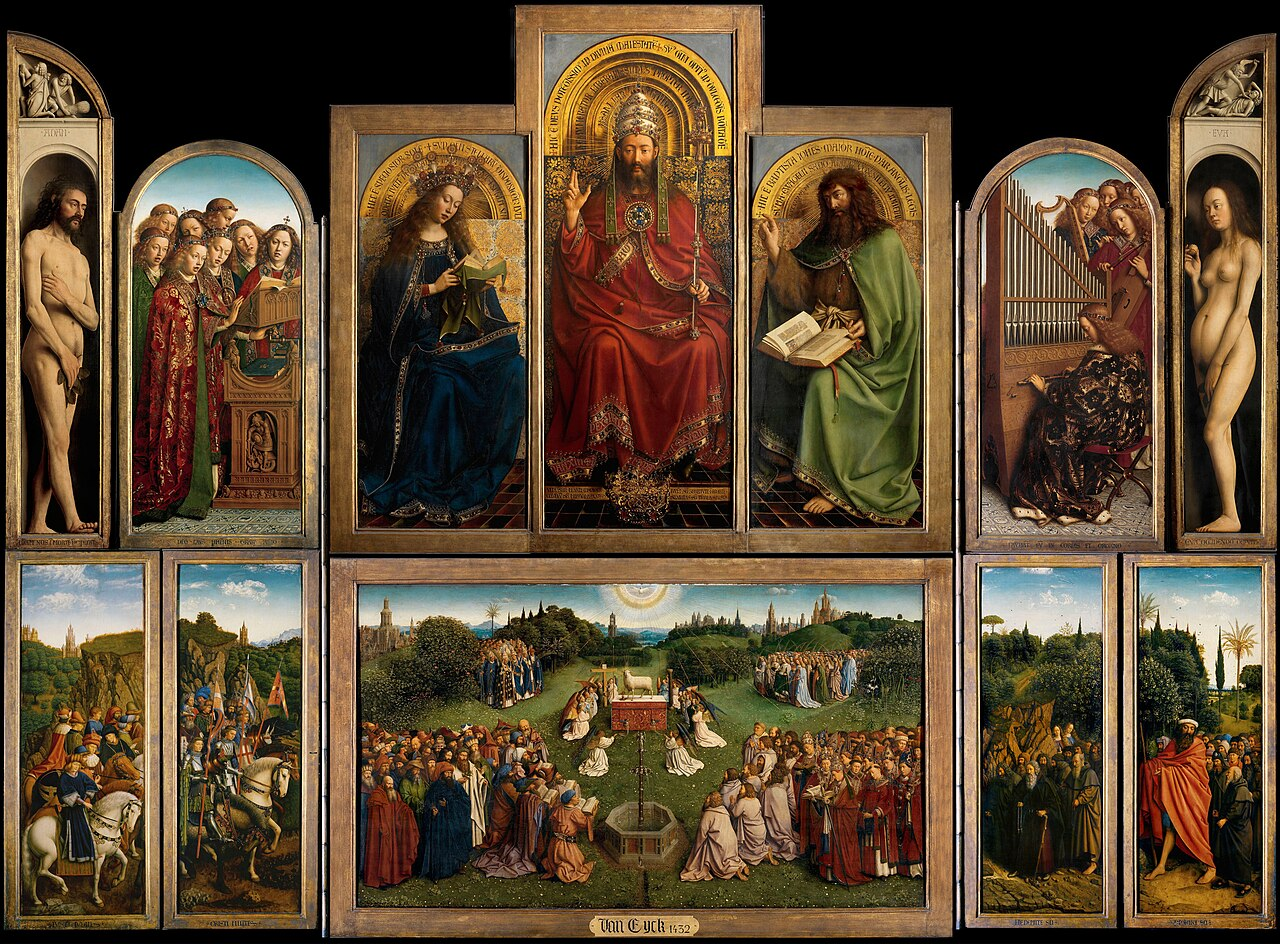
Ghent Altarpiece - Hubert and Jan van Eyck
altarpiece
Extreme attention to detail
Detailed landscapes
Intuitive perspective
Christian symbolism
Rich / luminous colors
Religious subject matter


Merode Altarpiece - campin
Disguised symbolism/symbolic objects
religious subject matter
rich colors
altarpiece
Intuitive perspective
everyday objects