AST lec 16: Asteroids, comets, Dwarf Planets
 Call Kai
 Learn
 Practice Test
 Spaced Repetition
 Match
 Flashcards
 Knowt Play
1/17

There's no tags or description
Looks like no tags are added yet.
18 Terms
What is the Asteroid Belt?
The group of rock and metal objects that obit the sun from between Mars and Jupiter.
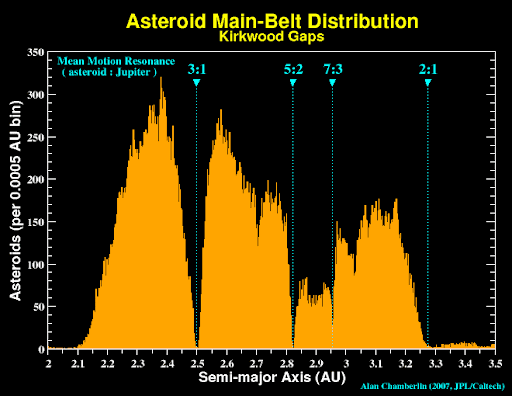
What is the reason for Kirkwood Gaps, for example at 3:1 orbital resonances?
At that specific distance from the Sun, asteroids that would orbit 3 times for every 1 orbit of Jupiter are pulled on by Jupiter’s gravity, until they are displaced into a different orbit.
Ceres, the largest object in the Asteroid Belt, has characteristic white spots of salt, a 4km tall mountain, and ridges with landslides. What do each of these traits tell us about Ceres?
Ceres has a rocky centre, liquid brine layer, and icy crust.
Why is Ceres nearly spherical?
It is large enough that the strength of gravity is stronger than the strength of the rock/ice it is made of.
Vesta, the largest asteroid, has a Nickel/Iron core, a mantle, and crust. What does this tell us about it?
At one point, Vesta was hot enough for the interior to become liquid, allowing for differentiation to happen.
Which of the following is the main distinction between an asteroid and a dwarf planet?
shape
Eros the asteroid is the same density all throughout, and has cratering. What does this tell us about Eros?
Its interior was never liquid thus never differentiated, and it is very old.
Bennu the asteroid’s surface is pile of rock and metal rubble that occasionally float off. By observing these rocks’ orbit of Bennu with a probe and landing on the surface, what was discovered?
Bennu is not really a rock, but a pile of rocks and dirt held together weakly by gravity.
What is the Kuiper Belt?
The group of rock and ice objects including several dwarf planets that orbit the Sun from beyond Neptune.
Pluto has cratered areas, but mostly a smooth white surface. Why is this?
Pluto is part water-ice mountains and part Nitrogen-ice plains.
Pluto’s orbit is inclined off the ecliptic plane, and crosses Nepune’s orbit. Why do they never collide?
It is in a 3:2 resonance with Neptune.

When comets come closer to the Sun, their ice heats up and boils away. Why do Comets tend to have a brighter and a fainter tail?
Solar winds push gas directly away because it is lighter. Dust is heavier, so it trails slightly behind as the comet orbits.
In pictures comets appear blue-grey, but in reality they are almost perfectly black. Why is this?
Their albedo, or reflectivity of sunlight, is very low.
What is the Oort Cloud?
The group of rocky and icy comets that were formed near Jupiter, but were kicked out by gravitational interactions.
Which of the following is the main distinction between an asteroid and a comet?
Composition
A small object that strike the Earth, usually burning up in the atmosphere.
Meteor
A small object that strikes the Earth, making it through the atmosphere.
Meteorite
You are looking at a high-resolution picture of an asteroid. This picture was likely taken by…
A spacecraft flying by it.