5.4 How Enzymes Work: Serine Proteases
 Call Kai
 Learn
 Practice Test
 Spaced Repetition
 Match
 Flashcards
 Knowt Play
1/16

Earn XP
Description and Tags
KNOW RXN MECH
17 Terms
Serine Proteases
Serine Proteases = a hydrolase that uses serine in its active site + H2O to break peptide bond b/w 2 AA
creates a new c-term: COO-
creates a new n-term: NH3+
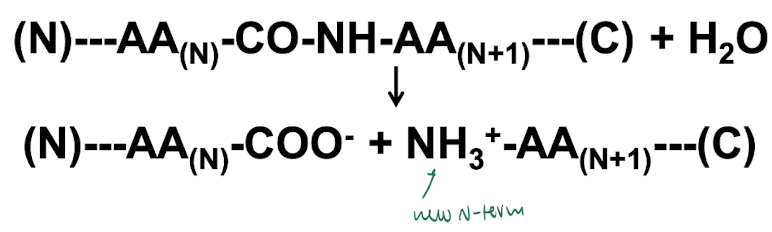
rxn involves:
covalent catalysis - intermed is covalently attached to Ser of enzyme
general acid/base catalysis
intermed/transition state stabilization
Types:
chymotrypsin (EC 3.4.21.1)
trypsin (EC 3.4.21.4)
Serine Proteases: Structure
~240 AA long polypeptide
synthesized as zymogens (inactive precursors) → ACTIVATED by cleavage of peptide chain
inactive before cleavage, bc we dont want digestive enzymes to always be active, thus they’re only active w substrate available/eating protein
contain 2 domains (beta-barrels) w active site @ junction of domains
extracellular proteins w disulphide bonds that connect peptide fragments to e/o
crosslinking 3° structure
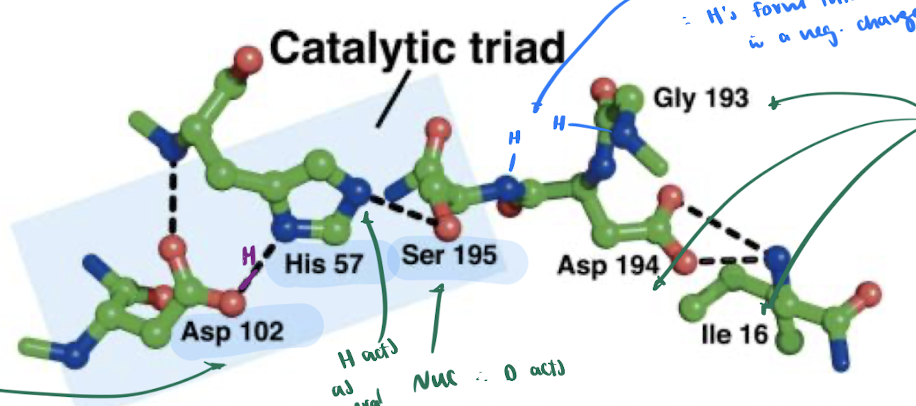
contain the Catalytic Triad = 3 resides critical in rxn mechanism
His 57 (general acid/base)
Ser 195 (Nuc)
Asp 102 (modulation of His 57) - not directly acting in catalytic process
→ specificity of serine proteases is determined by the Specificity Pocket that binds substrate
chymotrypsin: cleaves peptide chain after large PHOBIC AA
trypsin: cleaves peptide chain after (+) AA
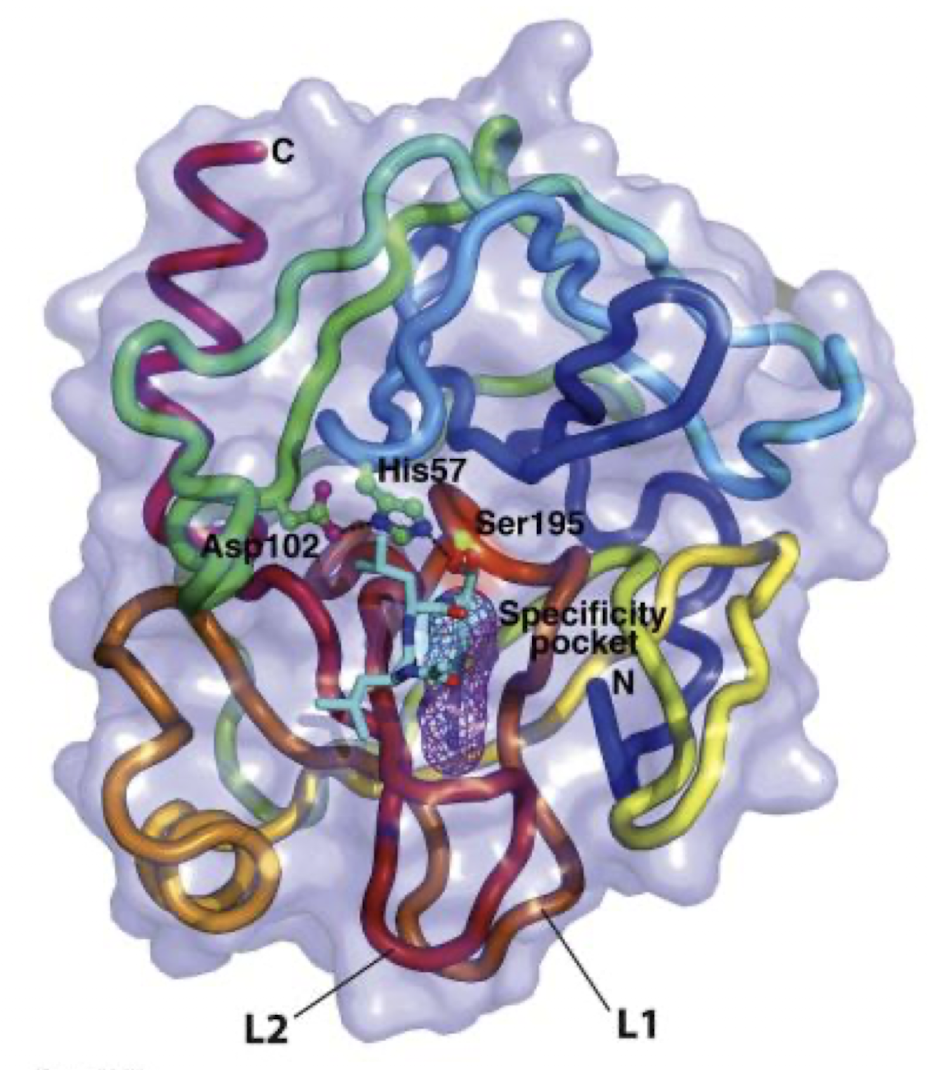
Serine Proteases: Chymotrypsin’s Structure
inactive precursor: 245 AA long polypeptide
note: 1° structure is associated with the cleavage
the catalytic triad are far apart in 1°, but close in 3D
Active form: alpha-chymotrypsin
polypep is cleaved into 3 chains during activation (irreversible covalent mod)
chain 2 contains His 57 & Asp 102
chain 3 contains Ser 195
10 cys form 5 disulfide bonds that link the 3 chains to e/o = 1 covalent structure

contains 2 domains, each with 6-stranded antiparallel beta-barrel
DOESNT have 4° struc (doesn’t have 2 separate polypep)
active site is a cleft b/w the 2 domains

Residue Locations:
Non-poplar side chains: interior
Polar side chains: surface
most of Tyr is on surface, despite phobic section
Disulfides (cys side chains): relatively non-polar compared to thiol, thus interior
crosslinking to stabilize 3° structure

Serine Proteases: Chymotrypsin’s Active SIte
→ AA’s in the active site are separated widely in 1°, but close in 3D space
contains the Catalytic Triad:
Ser 195: sidechain OH acts as Nuc
His 57: side chain acts as general acid/base
Asp 102: maintains orientation & protonation state of His 57
forms H-bond with His57 to ensure N orientation for prot/deprot
contain residues for regulatory processes of chymotrypsin:
Gly 193’s & Ser 195’s NH’s: form oxyanion hole
Oxyanion hole = NH’s of Gly 193 & Ser 195 form interaction w a (-) charged oxygen
stabilizes transient formation of tetrahedral int.
Asp 194 (side chain) + Ile 16’s NH3+: reorganized part of the active site for activation of the zymogen
Q. with a pI of 5.5, what type of ion exchange should we use for chymotrypsin at pH 7.0?
pH > pI, thus protein has (-) charge → binds to positively charged stationary phase of ANION exchanger
A: Anion exchange

Serine Proteases: Specificity Pocket
→ while the mechanisms of serine proteases are similar, substrate specificity is determined by the chemical nature of the Specificity Pocket
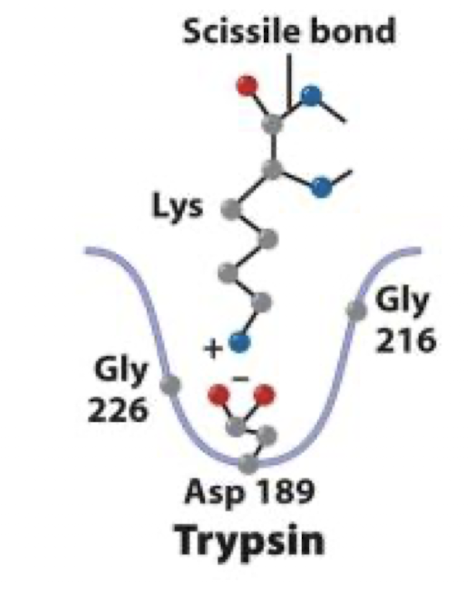
scissile bond = gets cut by serine protease → breaks peptide bond & yields new N & C term
Chymotrypsin: cleaves peptides after large PHOBIC residues
substrate: F, Y, W, L AA’s
specificity pockets contains: Ser 189, Gly 226 & Gly 216 sidechains
substrate binds to Ser 189’s OH group
note: ser 189 allows for Tyr(Y) to also be possible, but prefers PHOBIC aa as substrate

Trypsin: cleaves peptide after (+) charged residues
substrate: R & K
specificity pockets contains: Asp (-) & 2 Gly sidechains
substrate bind to Asp 189’s O-
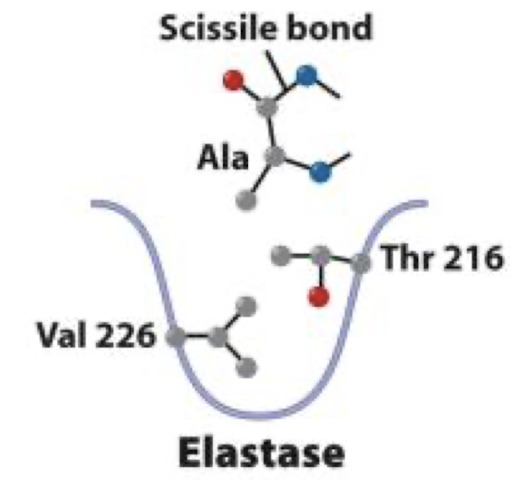
Elastase: cleaves peptides after SMALL, non-polar residues
substrate: A & G
specificity pockets contains: Val & Thr
specificity pocket is smaller than chymotrypsin, by containing Val & Thr to make it tighter for substrate
Serine Proteases: Oxyanion hole
Oxyanion hole = partially positive & forms H-bonding interactions with a negatively charged oxygen that develops during the rxn
involved in TS stabilization
transient formation of tetrahedral intermediate (stabilized by what’s occur at active site)
formed by backbone NH groups of Gly 193 & Ser 195 residues
→ ideal interaction is when the carbonyl carbon C=O of the peptide bond being cleaved (after the specific substrate) is tetrahedral, NOT planar

Chymotrypsin Mechanism
specificity pocket: cleaves peptide bond after large PHOBIC aa
substrate: F, Y, W, L AA’s
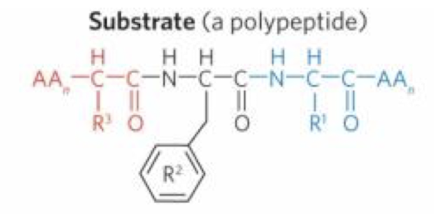
specificity pockets contains: Ser 189, Gly 226 & Gly 216 sidechains
Products:
1st product: new N-term of original substrate

2nd product: new C-term of original substrate

type of mech: covalent catalysis
a transient covalent bond is formed b/e enzyme (chymotrypsin) & substrate
chymotrypsin is a hydrolase
Chymotrypsin Mechanism: step 1
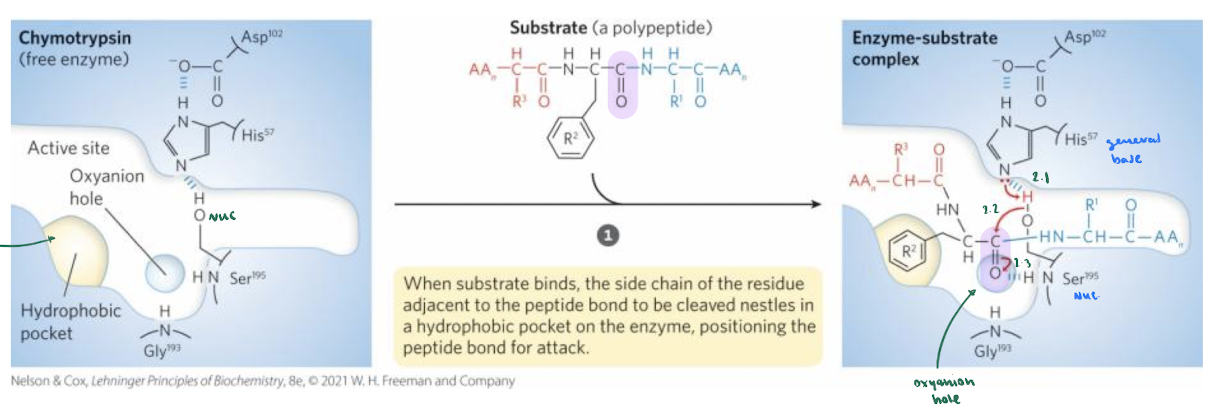
before substrate binds: Asp 102 is stabilizing His 57, His 57’s NH is H-bonded to Ser 195’s O
substrate binds & Large PHOBIC R-group sits in specificity pocket
peptide bond after large PHOBIC R-group is positioned for Ser 195’s O to act as a Nuc and attack the C=O of the peptide bond after this R-group

Chymotrypsin Mechanism: step 2
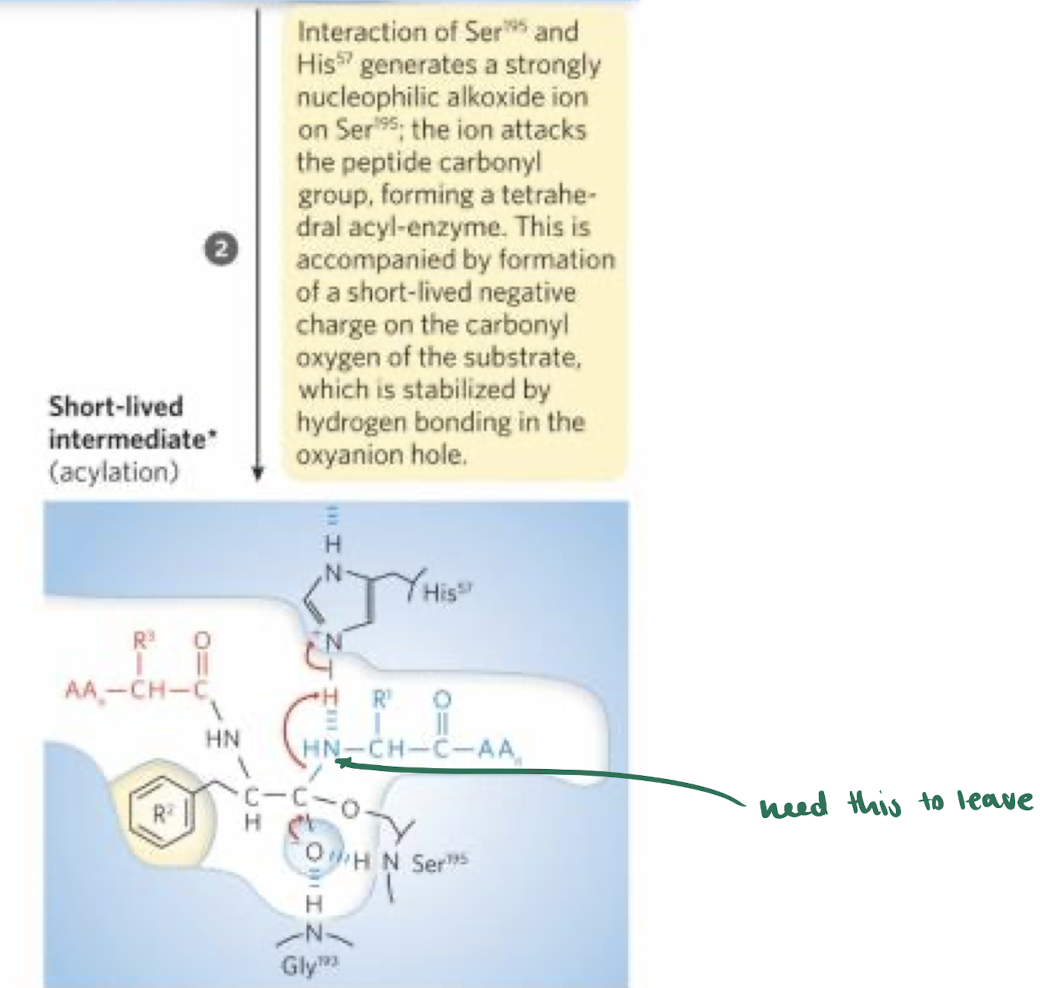
→ His 57 acts as general base: pulls H off of Ser 195’s OH group → forms Ser’s Nuc to attack the substrates carbonyl → form tetrahedral int, where the (-) O of substrate is stabilized by oxyanion hole
2.1 interaction of Ser 195 & His 57 generates a strong Nuc ion on Ser 195 (Ser’s oxygen acts as Nuc)
His 57’s N acts as a general base and pulls H from Ser 195’s O so it can attack the carbonyl of substrate
2.2 Ser 195’s Nuc O ion attacks the peptide carbonyl group after the large PHOBIC res → forms a tetrahedral acyl-enzyme
covalent catalysis forming a covalent bond b/w enzyme & substrate
2.3 results in short-lived (-) charge on the peptide bond’s carbonyl O, which is stabilized by H-bonding in the Oxyanion hole
backbone NH groups of Gly 193 & Ser 195 form H-bonds w negative O of substrate to stabilize TS

Chymotrypsin Mechanism: step 3
→ His 57 acts as a general acid: gives up H as the carbonyl is reformed and H is given to the leaving group to form the new N-term of substrate
product: new N-term of substrate (contains residues after the large phobic side chain)
collapse of oxyanion to ester
3.1 instability of (-) O on the substrate leads to collapse of tetrahedral int → reforming the carbonyl’s DB displaces the bond b/w that C and the amino group of the residue after → breaks peptide bond
3.2 amino leaving group of residue after the large phobic side chain is protonated by His 57 (acts as a general acid) - facilitates its displacement
produce new N-term of substrate (amino group and residues after the large phobic side chain in the speciality pocket)

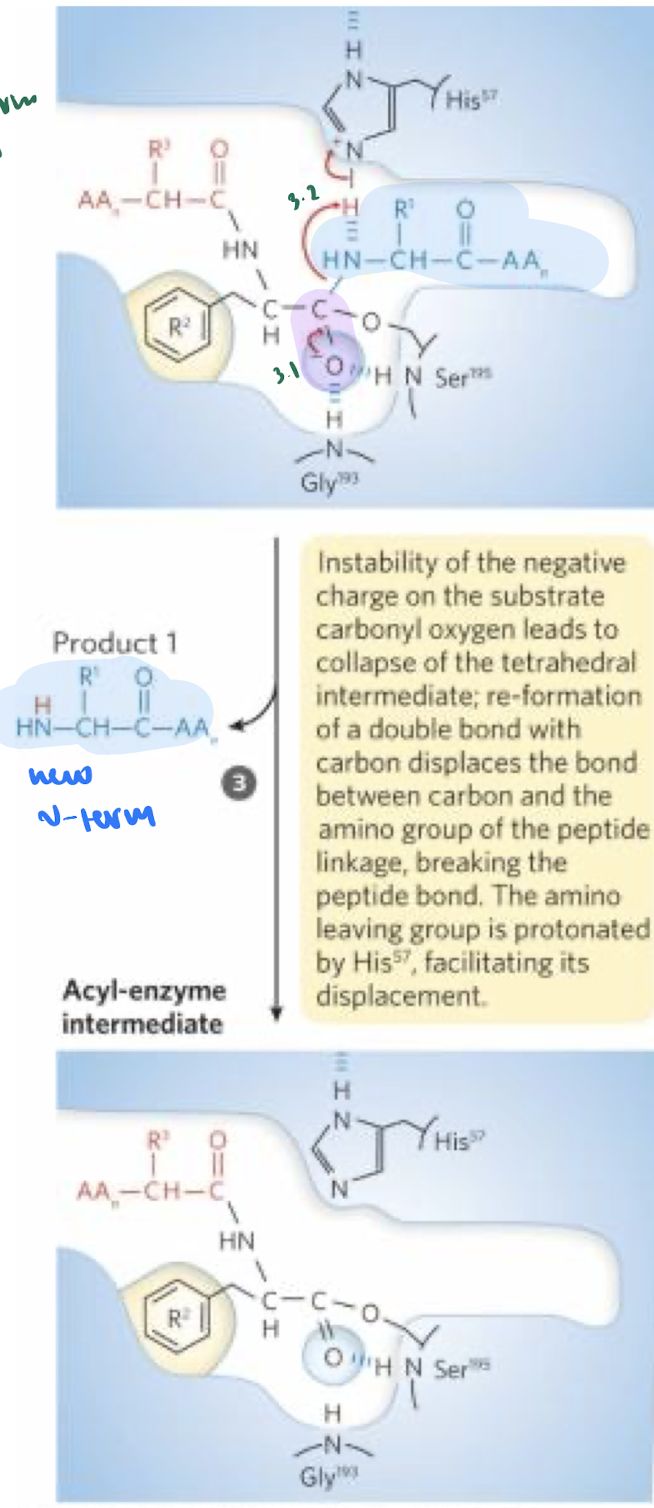
note: can’t keep the enzyme covalently attached to substrate, thus must break ester bond
Chymotrypsin Mechanism: step 4
→ His 57 acts as a general base: deprotonates incoming water → generates Nuc OH- that attacks reformed carbonyl of substrate & forms a 2nd tetrahedral int. → (-) O is stabilized in Oxyanion hole again
as 1st product leaves, water enters adjacent to carbonyl C & His 57 -> deprotonated & forms Nuc
4.1 water enters & is deprotonated by His 57 acting as a general base → forming a strong Nuc hydroxide ion (OH-)
4.2 OH- Nuc attacks carbonyl C, the ester linkage of the acyl-enzyme → forms a 2nd tetrahedral int.
(-) O is stabilized in oxyanion hole again by H-bonds with Gly 193 & Ser 195’s backbone NH’s

Chymotrypsin Mechanism: step 5
→ 2nd tetrahedral int. collapses (reforming carbonyl) & His 57 acts as a general acid to give H to Ser 195
breaks transient bond & forms the 2nd product, a carboxylate anion + displaces Ser 195
deacylation of int.
5.1 instability of (-) O on the substrate leads to collapse of 2nd tetrahedral int → reforming the carbonyl’s DB displaces the bond b/w the substrate & Ser 195’s O → break ester bond
5.2 O of Ser 195’s side chain is protonated by His 57 (acts as a general acid) - facilitates Ser 195’s displacement

Chymotrypsin Mechanism: step 6
→ collapse of the 2nd tetrahedral int. generates the 2nd product
product includes the large PHOBIC side & residues before it, w a new C-term

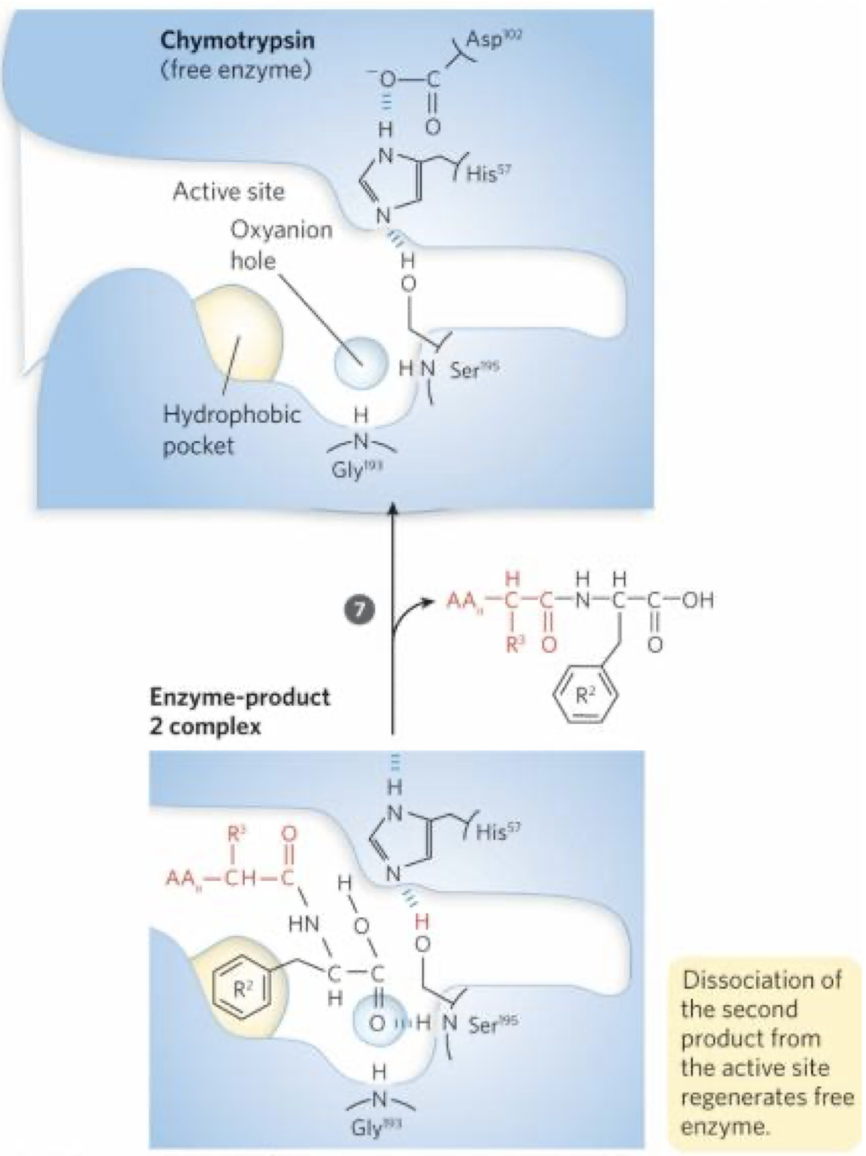
6.1 dissociation of the 2nd product (carboxylate anion) from the active site of the chymotrypsin enzyme
addition of water allowed formation of a new C-term & detached the substrate (polypeptide) from the enzymes active site

Chymotrypsin Mechanism: step 7
→ dissociation of the 2nd product from the active site of chymotrypsin regenerates the free enzyme
back to original state of active site for new substrate to bind
Summary of Chymotryspin Mechanism
substrate binds & Large PHOBIC R-group sits in specificity pocket
peptide bond after large PHOBIC R-group is positioned for Ser 195’s O to act as a Nuc and attack the C=O of the peptide bond after this R-group
His 57 acts as general base: pulls H off of Ser 195’s OH group → forms Ser’s Nuc to attack the substrates carbonyl → form tetrahedral int, where the (-) O of substrate is stabilized by oxyanion hole

His 57 acts as a general acid: gives up H as the carbonyl is reformed and H is given to the leaving group to form the new N-term of substrate
product: new N-term of substrate (contains residues after the large phobic side chain)
collapse of oxyanion to ester

His 57 acts as a general base: deprotonates incoming water → generates Nuc OH- that attacks reformed carbonyl of substrate & forms a 2nd tetrahedral int. → (-) O is stabilized in Oxyanion hole again

2nd tetrahedral int. collapses (reforming carbonyl) & His 57 acts as a general acid to give H to Ser 195
breaks transient bond & forms the 2nd product, a carboxylate anion + displaces Ser 195
deacylation of int.

collapse of the 2nd tetrahedral int. generates the 2nd product
product includes the large PHOBIC side & residues before it, w a new C-term

dissociation of the 2nd product from the active site of chymotrypsin regenerates the free enzyme
back to original state of active site for new substrate to bind

Q. Granzyme B is a serine protease with an identical mechanism to chymotrypsin, but cleaves peptide bonds after aspartame residues. Which of the following statements would you expect to be false for this protein?
a. serine 195 will be conserved
b. the oxyanion hole will be present
c. the active site will include an Asp or Glu
d. Asp 102 will be changed to Arg or Lys
serine 195 will be conserved, oxyanion hole will be present, active site will include an Asp or Glu
a: d is false, Asp 102 is present in the catalytic triad of the active site (maintains orientation & protonation state of His 57), thus it sent changed for the speciality pocket
would expect (+) charges AA’s in the specify pocket for this enzyme to bind Asp for cleavage after, but this is taking abt Asp 102 which is always present in the catalytic triad of the active site
