Animal Science Exam 2 Review Flashcards
 Call Kai
 Learn
Learn Practice Test
 Spaced Repetition
 Match
Match Flashcards
 Knowt Play
1/96

Earn XP
Description and Tags
Vocabulary practice flashcards covering red meat products, by-products, slaughter grading, market classes, wool grading, and reproductive physiology basics for Animal Science Exam 2.
Name | Mastery | Learn | Test | Matching | Spaced | Call with Kai | Chat |
|---|
No analytics yet
Send a link to your students to track their progress
97 Terms
Wholesale Cut
A largely portioned primal meat section prepared for ease in handling and shipping, such as beef chuck, rib, loin, or pork ham.
3 examples of wholesale cut
Chuck, rib, loin
3 example of retail cut
Pot roast, ribeye, steak
What animal produces red meat (5)
Cattle, pig, sheep, goat, horse
What animal has white meat
Poultry
Retail Cut
Consumer-sized meat portions packaged for direct store sale, cut from wholesale primals (such as ribeye steak, pot roast, or bacon).
Order of muscle structure (out to in)
Muscle bundle (fasicle)
Muscle fiber (myofibers)
Myofibril
Sarcomere

What is this
Muscle bundle (fasicle)
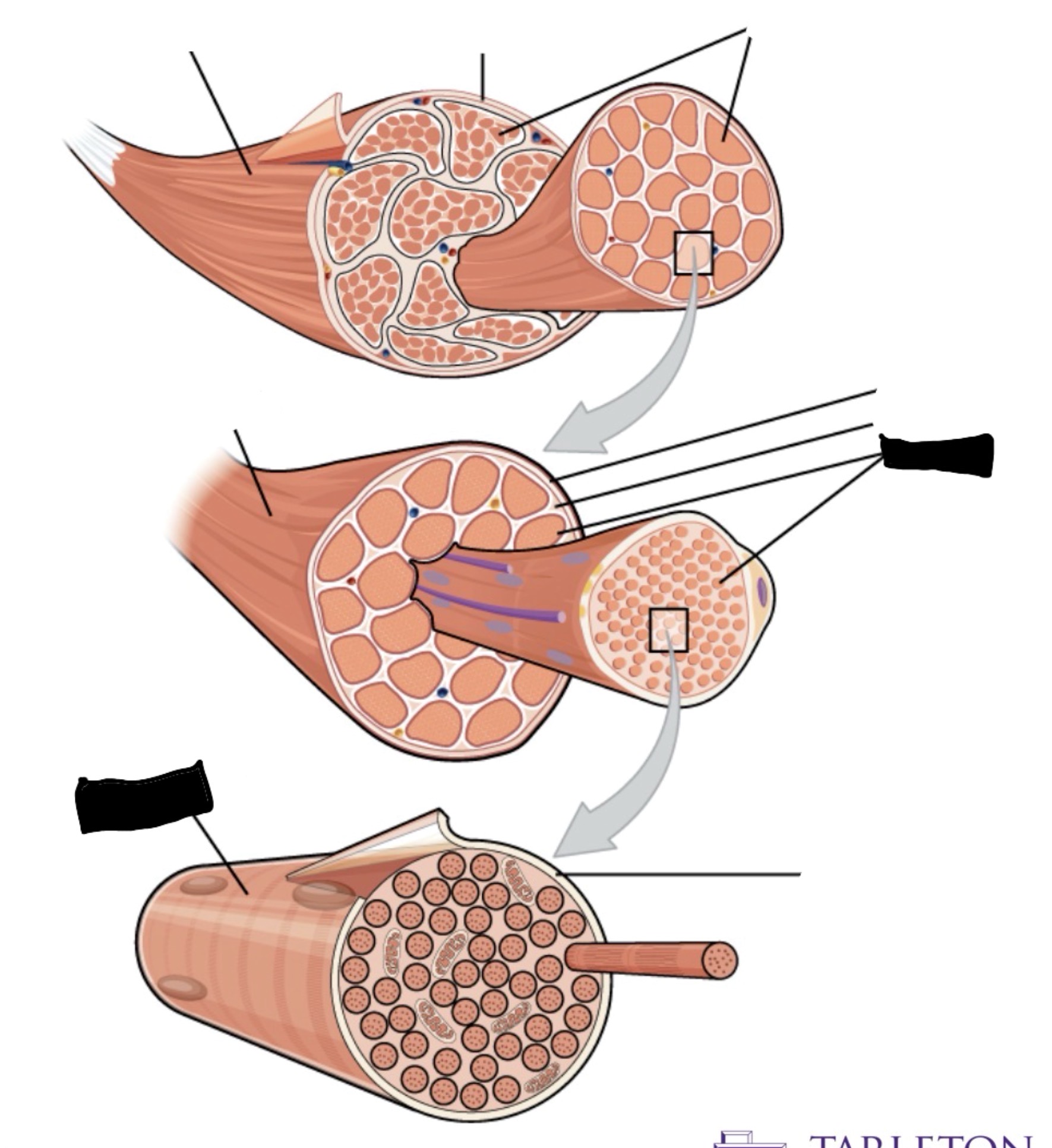
What is this
Muscle fiber (myofibers)

Muscle Bundle (Fascicle)
A group of individual muscle fibers encased by the connective tissue layer known as the perimysium.
Muscle Fiber (Myofiber)
A multinucleated muscle cell made up of rod-like organelles known as myofibrils.
Myofibril
Rod like organelle
Sarcomere
Crontractile unit
Dressing Percentage
Dressing Percentage=(Live WeightCarcass Weight)×100 .
Why is dressing percentage important
Lets you know how much meat is left after removing inedible parts
Hot Carcass Weight (HCW)
The weight of a dressed animal carcass on the rail after the hide and viscera have been removed, measured prior to entering the freezer.
Dressing percentages of these animals
Hogs: 70-74
Cattle: 60-64
Sheep or lamb: 50-54

Solve
62%
Slaughter process (5)
packing plant alive, stunned unconscious (via co2, electric), exsanguination (cut throat or artery), remove hide, remove head and organs
Slaughter process part 2 (5)
Carcass split in half, carcass washed and chilled, aging, chilled carcass cut into wholesale, box up
Exsanguination
The step in the slaughter process where the jugular and/or carotid artery is severed to drain blood from the animal.
Offal
The non-carcass items removed during slaughter, including viscera, head, and other organ by-products.
Fabrication
The post-chilling breakdown process where carcasses are split from primal cuts into retail cuts for packaging and sale.
By-Product
Non meat product from animal
Example: hide, tallow, bones, organ meat
Variety Meats
Edible organ by-products harvested during slaughter, including liver, heart, tongue, tripe, and sweetbread.
Rendering
recycling offal, fat, bone, meat scraps, and carcasses into tallow, protein meals, and other products.
How many pounds of rendering is picked up daily
70 mil
Edible by-product example (3)
Variety meat (longue, heart, liver)
Lard (Pig)
Tallow (cattle and sheep
Inedible byproducts (4)
Tallow and other fat (soap, candle)
Blood and bone meal (fertilizer)
Indedible organs (pet food, chew)
Hide, skin, pelt
Carcass disposal (4)
Render company
Composting
Burn
Bury
Why use grading for livestock (3)
Common reporting language
Group livestock
Makes marketing easier for buyer and seller
Slaughter grading in cattle (2)
US quality grade
US yield grade
Quality Grade (Beef)
Difference in eating quality
Different quality grades (3)
Prime, choice, select
Most recieved quality grade
Choice
Yield grade (1-5) significance
1- lean , muscle
5- very fat
Yield grade (1-5) significance
1- lean , muscle
5- very fat
Most recieved yield grade
3
Cutability
The overall proportion of lean, usable retail meat yielded by a carcass.
What at is this best and worst for quality grade
Prime, canner
Best and worst yield grade
5
Most expensive grade combination
Prime, yield grade 1
Live evaluation of livestocck (7)
Brisket (full)
Ribs (smooth)
Loin (smooth(
Tailhead (flat)
Flank (deep and loose)
Rump
Codd udder (fat)
Ribbing
The process of cutting through the muscle and backbone of a chilled carcass between the 12th and 13th rib in beef (or 10th rib in pork) to expose the ribeye for grading.
Bloom Time
The required 15minute air exposure period after ribbing that permits oxygenation of the ribeye muscle prior to carcass grading.
Preliminary Yield Grade (PYG)
The starting point for carcass yield grade calculation, determined solely by fat thickness measured at the 12th rib
What is the start pyg and fat thickness
2.0
0.0
How much do you add To pyg per 0.1 increase in fat
0.25
Lower yg Is more desirable
True, more bonesless closely trimed meat
What is the algebraic formula for YG
Yg = 2.5+(2.5 x Body fat) + (0.0038 x HCW) + (0.2 x KPH) - (0.32 x REA)
What are the measurements needed and area measurement for PYG
Fat thickness At 12th riB
Area for measurement at 3/4th up the length of the ribeye from split chinbone
Agricultural Marketing Act of 1946
Origninally mandated the standards for feeder-calf grades
What do feeder calf grades offer
A tool for beef cattle marketing
What do the national standards predict
Carcass value and maturity fatness endpoint
What are the predictive variables for beef cattle performance and marketing grades (2)
Frame score
Muscle thickness score
Frame Score
(Large, Medium, Small) evaluating length and height to project finished market weight at 0.5in at the 12th rib of backfat thickness.

Muscle Thickness Score
(US No. 1–4) evaluating the muscle-to-bone ratio at a given degree of fatness.
1 - thick
4 - thin
SWINE GRADING USDA carcass grades what is the number range
1-4
1 - highest yield
4 - lowest yield
Muscle score (swine) number range
1-3
1 - thin
3 - thick
What is pork quality based on (4)
Color (1-6) (pink - red)
Firmness
Excudation
Marbling (1-10) (none- lots of marbling)

RFN
Ideal pork quality
R - redish pink
F - firm
N - non-exudative (holds water in well)
PSE
Undesirable
P - pale pink grey
S - soft
E -exudative
DFD
Undesirable
D - dark purple red
F - vary firm
D - dry
Feeder lamb grades (2)
Frame score
Muscling score
Frame score of feeder lamb
Small medium large
Muscling of feeder lamb
1-3

Break Joint
An unossified growth plate joint on the front shanks of young lamb carcasses (2–14months) that easily breaks apart during slaughter.
Spool Joint
A smooth, solid joint present on the front legs of mature sheep (mutton) where the growth plate has completely ossified into solid bone.
American Blood System
A wool grading method based on the theoretical percentage of Merino bloodline in the sheep, where full blood represents the finest fleece.
Spinning Count System
A wool grading system based on the number of 560yd hanks of yarn that can be spun from 1lb of clean wool.
Micron Diameter System
An objective wool grading technique using specialized instruments to measure individual fiber diameter in microns.
Reproduction Definiton
Specialization in fertility preservation, diagnosing and treating fertility and other reproductive problems
Reproduction purpose
Perpetuation of species
Providing food, fiber and milk
Genetic improvement
Gamete
A mature haploid male (sperm) or female (ovum) germ cell.
Zygote
A fertilized ovum; a diploid cell resulting from the fusion of two haploid gametes.
Cryptorchid
A developmental defect characterized by the failure of one (unilateral) or both (bilateral) testicles to descend into the scrotum.
Standing Estrus
The specific period of female sexual receptivity during the estrous cycle, commonly referred to as standing heat.
Estrous Cycle
The total time interval measured from one ovulation event to the next.
Polyestrus
A pattern of reproductive cyclicity where female animals experience continuous estrous cycles throughout the year (e.g., cows, sows).
Seasonal Polyestrus
A cyclicity type where females display multiple estrous cycles only during specific times of the year dictated by photoperiod (e.g., ewes, mares).
Monoestrus
One cycle per yr
Anestrus
No cycle
Cotyledonary Placentation
A type of placental attachment characterized by button-like specialized sites (caruncles and cotyledons) found in cattle, sheep, goats, and bison.
Diffuse Placentation
A type of placental attachment featuring uniform, widespread contact across the chorionic membrane found in horses and swine.
Corpus Luteum (CL)
An ovarian endocrine structure that develops from the corpus hemorrhagicum after ovulation and secretes progesterone to maintain pregnancy.
Corpus Albicans (CA)
The pale scar tissue remaining on the ovary after the corpus luteum degenerates.
Epididymis
A duct structure located alongside the testicle responsible for the concentration, storage, maturation, and transport of spermatozoa.
Tunica Dartos
A smooth muscle layer located within the scrotal wall responsible for testicular temperature regulation.
Gonadotropin-Releasing Hormone (GnRH)
A hypothalamic hormone that acts on the anterior pituitary to direct the release of FSH and LH.
Luteinizing Hormone (LH)
An anterior pituitary hormone that acts on the gonads to stimulate steroid hormone production and induces ovulation of mature follicles.
Follicle Stimulating Hormone (FSH)
An anterior pituitary hormone that stimulates ovarian follicular growth (folliculogenesis) and testicular sperm production (spermatogenesis).
Progesterone (P4)
A steroid hormone secreted by the corpus luteum that maintains pregnancy and exerts negative feedback on GnRH to suppress ovulation.
Prostaglandin F2α (PGF2α)
A hormone synthesized by the non-pregnant uterus that induces luteolysis (regression of the corpus luteum) to lower progesterone levels.

Hypothalamus-Pituitary-Gonad Axis
The interconnected neuroendocrine feedback pathway where hypothalamic GnRH regulates pituitary gonadotropins (LH, FSH), controlling gonadal sex steroid production.
Proestrus
The stage of the follicular phase (Days 19–21 in cows) before standing heat marked by luteolysis, declining progesterone, rising estrogen, and follicular growth.
Metestrus
The initial stage of the luteal phase (Days 1–4 in cows) following ovulation during which the ruptured follicle forms the corpus luteum.
Diestrus
The longest stage of the luteal phase (Days 5–18 in cows) dominated by high progesterone levels from a fully functional corpus luteum.