PSY359 - Chapter 7: The Psychology of Online Gaming
 Call Kai
 Learn
 Practice Test
 Spaced Repetition
 Match
 Flashcards
 Knowt Play
1/66

There's no tags or description
Looks like no tags are added yet.
67 Terms
video game
encompasses any kind of computer-based game, whether or not Internet access is required
The most important feature is:
interactivity, which separates the video game from more passive media such as television, books, and web surfing
Beyond that, however, video games vary considerably, particularly from a psychological perspective
game
a social interaction, exchange or transaction with set pre established rules of engagement (these rules are usually mutually agreed upon)
Some sort of metaphysical rulebook that can guide how ur characters etc move, or what u can do
genre
Classification of something according to some established set of rules or signifiers
They all have some common themes
Ex. if you say smtg is a horror movie, it is given there will be blood, violence, mature topics, loud sounds etc
Examples of video game genres
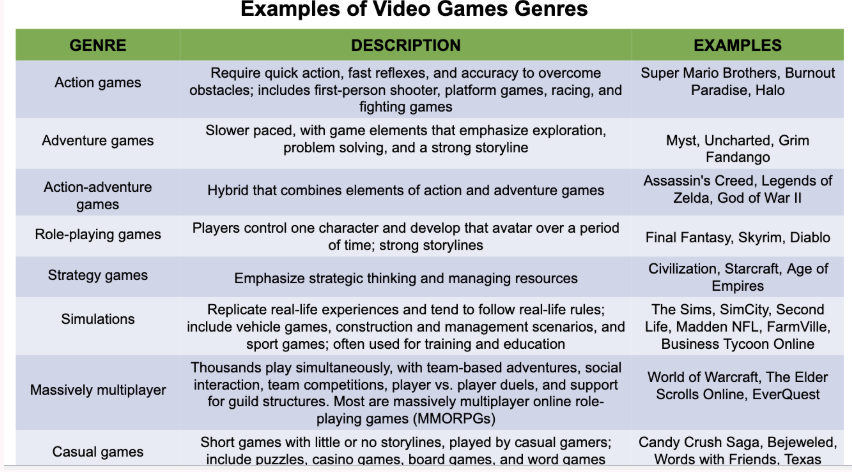
two goals/motives of companies and game designers that create and promote video games
(1) to make their games as “sticky” as possible so that players keep coming back
(2) to attract more players
4 fundamental principles to make games sticky and attract more players
1. Complexity
2. Social interaction
3. Competition
4. Age appropriate content
Complexity
the cognitive effort required to achieve success in a game / needed for gameplay
Some players will lean toward the casual games to keep that effort low, playing for a few minutes between classes or while watching TV
The learning curve is short, although it might take greater effort to actually succeed
Some players prefer more complex games, which can be prohibitive for newcomers, but that can also offer dedicated players a gaming experience rich in narrative and one that can persist over several years
Social Interactivity
examples
the degree of social exchange involved in gameplay
Some games are single player, while other multiplayer games support interactions through text chat, avatar body gestures, voice, or other means
On massively multiplayer online role-playing games (MMORPs), for example, players must interact and coordinate in order to be successful
• World of Warcraft
Multiplayer games also support asynchronous social interaction through social media messaging services
• Farmville
Competition
The skill needed to be successful in achieving game outcomes
Differing levels of skill result in performance outcomes relative to one another
Ex. in a racing game, competition is built into the gameplay
Ppl who are more skilled in that endeavour will usually rank higher than those who are lower in skill!
Ex. competition in Candy Crush
You can see the leaderboard
You can also see ur friends game level
Can be a motivating factor for ppl who were long term committed users
Ex. simulation games
You can need skills to finish tasks or unlock things- higher skill just makes this easier!
Way to introduce paid content down the line
Some single-player games in which the goal is mainly to achieve the next level are low in competition
Games emphasizing competition may task players in a different manner from single-player games in a variety of ways:
• To move up a notch on the “leader board”
• In games that support teams, players might be tackling game world challenges rather than other teams, so competition among players is reduced
• Games that support player versus player (PvP) competition or combat are highest on the competitive dimension
Age Appropriate Content
what do we use in the US to dictate this?
Our use of media is active, not passive! → uses and gratifications theory
We consciously choose what media to consume and why
more choice = more motivation based media use
The amount of adult-oriented action, imagery, and v*olence is another important psychological dimension
In the United States, game publishers use the Entertainment Software Rating Board (ESRB) as the guideline for assigning a rating to games
Rating systems in Europe differ somewhat, though they all attempt to protect minors from games that contain intense violence, blood and gore, and sexual content
Entertainment Software Review Board (ESRB) rating system used in the United States
(chart)


men vs women considering themselves as gamers stats
Half of american adults play video games, but only 10% consider themselves as “gamers”
Men and women both play video games, but men are more likely to call themselves “gamers”
Majority of women (including women who play games themselves) believe most video game players are men
Slides include some graphs about this
uses and gratifications perspective
• Emphasizes the active choices people make when they watch the evening news on TV or stay glued to a sports broadcast
• The focus is NOT on what media does to people; it is about what people do with media, and why
six motives for game use
1. Challenge
2. Competition
3. Diversion
4. Fantasy
5. Social interaction
6. Arousal
1. Challenge
The cultivation of skill in service of achievement
Ex. FNAF
Puzzle game that motivates u with challenges, as puzzles increase in difficulty over the course of the game
Many users enjoy playing video games to push themselves to a higher level of skill or personal accomplishment
2. Competition
performance relative to other game players
To prove to other players who has the best skills and can react or think the fastest
Video game competition served the function of a dominance display among males most often seen in sports
This gratification derives its power from the reactions of others to the dominance shown by the player, establishing a relative position in the peer group’s hierarchy
3. Diversion
Video games are frequently used to avoid stress or responsibilities
Users reported playing video games to fill time, relax, escape from stress, or because there is nothing else to do
4. Fantasy
Video games allow players to do things that they normally would not be able to do, such as drive race cars, fly, etc.
Users spoke frequently about the appeal of being able to do things they can’t do in real life
5. Social Interaction
Social interaction is the main reason many individuals got involved in playing video games as a child
Users mentioned that the arrival of Nintendo brought sleepovers where video game were played, and the need to keep up on the games to be "cool"
Many now use video games to interact with friends and learn about the personalities of others
6. Arousal
The stimulation of the sympathetic nervous system (fight or flight)
Sympathetic nervous system = fight or flight response
High engagement body contact video games, high engagement video games that cause higher body reactions- heart rate increase, sweating, eyes focus in etc.
An exciting experience! → seeking this out can be motivating
The same reason ppl love to see horror movies! They like the sensory experience of being scared, being physiologically aroused in a way u cant seek out in normal IRL
Playing video games to stimulate emotions as a result of fast action and high quality graphics
media affects perspective
Works to produce a physiological response paired with a stimulus
chart describing the connection between gaming and the big five personality traits

men and women differ somewhat in the types of games they enjoy and in how much they play:
Women like online card games, puzzles, trivia quizzes, board games, and arcade-style games more than men
• Men indicate preference for action games that feature sports, fighting, shooting, or racing, and also action-adventure and strategy games
• Men also play games more hours per week compared with women
Reported liking of Video Game Genres by Sex Chart:

One reason there are gender differences in game play
Games are primarily designed by and for males, so they contain themes and activities that appeal to them or that they are especially skilled at
• For example, men typically score higher on competitiveness, and many games make competition a salient component
One such area of behavioral psychology from which developers might draw to achieve the goal of enticing players to play more, click on more ads, bring their friends, or purchase more virtual goods (for real money!)
operant conditioning!
Pavlovian / classical conditioning
Works to produce a physiological response paired with a stimulus
what is operant conditioning
Looks to affect the likelihood or decrease likelihood of a specific behavior
How do we condition ppl to do things we want them to do and disinhibit things we don't want them to do
We reward or punish behaviours
So we provide rewards, get rid of something that is desired, or present something undesired
Learning to associate behaviors with their consequences
Behaviors that are reinforced (lead to satisfying consequences) will be strengthened
Behaviors that are punished (lead to unsatisfying consequences) will be weakened
The Law of Effect (also called “Thorndike’s Law of Effect):
Any behavior that results in satisfying consequences tends to be repeated
Any behavior that results in unsatisfying consequences tends not be repeated
Punishment vs Reinforcement

Reinforcement
Increasing the probability of a response via a reinforcer
Seek to increase the likelihood of a behaviour occuring
punishment
Decreasing the probability of a response via a punisher
Positive vs Negative operant conditioning
Positive - the presentation or addition of a stimulus
Negative - the removal of a stimulus
Think of it like math! Are we adding some stimulus or removing it!

Appetitive Stimulus vs Aversive Stimulus
Appetitive - stimulus that is desired or pleasing
Aversive - stimulus that is unpleasant/undesired

How Positive and Negative Reinforcement and Punishment work in operant conditioning
CHART

positive and negative vs reinforcement and punishment chart

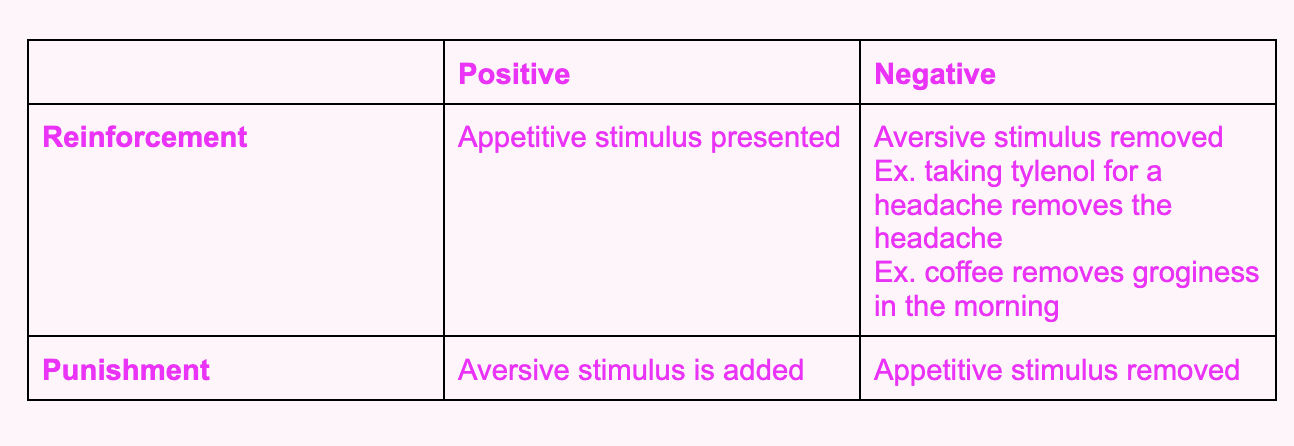
examples of how games use positive vs negative and reinforcement vs punishment —> table

Positive means that _______ and negative means that ________
Positive means that something is presented, and negative means that something is taken away

reinforcement means that the behaviour is _______ and punishment means that _______
Reinforcement means that the behavior is strengthened, and punishment means that the behavior weakened

In positive reinforcement, ________ and in positive punishment, ________
In positive reinforcement, and appetitive stimulus is presented, and in positive punishment, an aversive (unpleasant) stimulus is presented

In negative reinforcement, __________ and in negative punishment, __________
In negative reinforcement, an aversive stimulus is removed, and in negative punishment, an appetitive stimulus is removed

Continuous schedule of reinforcement
reinforcement each time a desired response or behavior is displayed
Tutorial phase of game play - behaviours are rewarded and no punishments are usually assessed
Fixed-interval schedule of reinforcement
rewards distributed based on a specific time period/interval
Daily log in rewards OR set times for in game actions
Ex. animal crossing- you can only harvest radishes on sundays
Habituation
Partial schedule of reinforcement
Reinforcing the desired operant response only part of the time
Partial-reinforcement effect
The finding that operant responses that are reinforced on partial schedules are more resistant to extinction than those reinforced on a continuous schedule
Fixed-ratio schedule
the presentation of a reinforcer each time a fixed number of responses or actions is achieved
You get something each time you complete an activity in a game!
Drives things like:
Duration of gameplay
Ex. to level up you have to collect ten tokens of something
Ex. in mario kart to unlock characters or races, you need to win a set number of races
Ex. you get XP by defeating enemies in order to level up
Variable-ratio schedule
the number of responses/actions or behaviours to obtain a reinforcer varies on each trial, but usually averages across a set number of trials
Produces the highest levels of engagement and lowest levels of extinction
Ex. if you kept mining but never got any diamonds, you'd probably stop trying, but if you got them every now and then, you would continue mining/engaging
Ex. finding diamonds in minecraft is not consistent, but you knew after some time mining consistently, you’d probably find some!
Ex. slot machines !
Superstitions
spurious attribution of behaviour to produce or give a reinforcer
Spurious - relationship between two things that don't actually exist
Ex. lucky socks for athletes
An unjustified (ie. not empirical) belief in spurious causality
For operant conditioning to occur, the reward must follow the behavior, but the behavior doesn't necessarily have to cause the reward
The reward might accidentally follow some behavior, and the operator may end up erroneously associating the two anyway
This often paves the way for superstitions
Media effects
Psychological effect media has on us
Can cause desensitization
Selective exposure
the predisposition to choose media that align with our pre-existing beliefs, habits, tendencies, etc.
Polarization ! more exposure to things = more extreme holding of those views
players have an intrinsic motivation to _______
to seek out ways to satisfy their needs (remember uses & grats!)
Thus, the principles of operant conditioning alone do not necessarily lead to good game mechanics
how to motivate people who are intrinsically motivated to play:
may actually lose interest if there are too many extrinsic rewards:
The extrinsic reward apparently drowned out any intrinsic motivation to tackle the chess challenges just for the enjoyment and mastery
Designers add all kinds of features to satisfy such intrinsic motivations; in-game socializing tools, for instance, can be quite elaborate
Other game mechanics appeal to players’ interest in fantasy, excitement, competition, or diversion
Main two areas of study of video games’ harmful potentials:
1. Compulsive overuse, sometimes called “internet addiction disorder”
While accounts of total dysfunction are often rare, video games are very engaging and some people who may be prone to overuse may find that their gaming is negatively affecting their lives in ways that resemble substance abuse or pathological gambling
We will cover this topic in a different lecture
2. The effects of violence in video games
Violent games differ from nonviolent ones in many ways, not just because they contain violence, but because _________
they may also be more arousing and competitive
affect of arousal from playing video games on aggressive thoughts and actions
the violence in the video games that affects aggressive thoughts and actions, not competition or arousal
people show same level of arousal in violent and non violent games, but those who played violent games handed out more aggressive punishments after playing
repeated exposure to blood, gore, and violence leads to:
desensitization
playing violent video games desensitizes individuals to real-life violence by dulling physiological stress responses
what does desensitization from playing violent video games do?
directly increases aggressive behavior, and habitual play creates lasting desensitization
four benefits of video games
cognitive benefits
motivation and persistence
emotional benefits and flow
social benefits
cognitive benefits of video games
improved Cognitive and perceptual abilities, such as spatial perception, mental rotation, and visual attention
cognitive benefits of action games
(Visual Attention)
Players outperform non-players in identifying objects across visual fields
Possess deeper attentional resource reserves to apply toward visual tasks
Have a wider useful field of view, allowing them to spot targets farther from central focus
cognitive benefits of strategy and RPG games
(Problem Solving)
Strategy games improve problem-solving by requiring players to think through problems, weigh options, and plan actions
RPGs build tactical problem-solving through analyzing boss traits, optimizing gear, assembling teams, and executing attack plans
motivation and persistence
benefits of video games
games provide just enough challenge to maintain persistence in the face of failure, matching the challenges to the player's level
from a study:
amount of video game play per week was significantly correlated with subjects’ self-reported persistence and with greater persistence on the difficult anagrams and puzzles
Subjects who spend a lot of time playing games will spend more time on the unsolved puzzles, that is, the ones they had the most difficulty with
A way to measure how persistent someone will be in the face of failure
computer-based anagram-riddle task
Presents a series of hard and easy anagrams and riddles on screen, one at a time
Feedback is immediate, and the person can choose to skip a missed anagram or try again
Computer records how long each subject persists in trying to solve a difficult anagram or puzzle, and if the subject gave up after a wrong try to skip to an easier question
emotional benefits and flow
of video games
One emotional benefit is FUN
Players play because they enjoy the game—their motives might differ (as previously discussed), but a more positive mood is a common finding
relax, improve mood, and reduce stress
what is flow
a mental state in which the person is completely absorbed in an activity and time just flies by
A highly positive and motivating mental state, associated with certain changes in the brain
if a game is too hard, the person does not experience flow!
Activities that have the potential to create flow have what in common:
They create a delicate balance between the person's ability and the challenge of the task, and they require intense concentration and focus
They also offer clear goals, timely feedback, and a sense of control over what happens
While in the state of flow, the person experiences a loss of self-consciousness and a distorted sense of time
social benefits of video games
what do prosocial games vs violent games promote
a relationship between cooperative game playing and prosocial behavior
students exposed to the prosocial games in which players helped one another were more likely to say they behave in more prosocial ways in real life
Video game content directly drives immediate real-world behavior, with prosocial games encouraging helpfulness and violent games promoting sabotage