Chapter 15 Zoology
 Call Kai
 Learn
Learn Practice Test
 Spaced Repetition
 Match
Match Flashcards
 Knowt Play
1/100

There's no tags or description
Looks like no tags are added yet.
Name | Mastery | Learn | Test | Matching | Spaced | Call with Kai | Chat |
|---|
No analytics yet
Send a link to your students to track their progress
101 Terms
multicellular, eukaryotic, heterotrophic, and lacks cell wall
distinguishing features of animals
heterotrophic
carnivores, herbivores, omnivores, and parasites
specialized tissues (almost all), motile (during some life stage) (can move), reproduce sexually, determined body plan
most animals have…
biomolecules → cells → tissues
most animals have specialized cells organized into tissues
tissues
group of similar cells with a common embryonic origin and perform related function
epithelial tissue
covers body surfaces and lines organs
connective tissue
support, structure, and transport (includes bone and blood)
muscle tissue
contracts to product movement
nervous tissue
transmits electrical signals
meiosis → haploid gametes → fertilization (egg + sperm) → diploid zygote → embryonic development
sexual reproduction
sexual reproduction
produces genetically unique offspring and increases diversity
asexual reproductions
budding, fragmentation, parthenogenesis
produces offspring genetically very similar or identical to parent
budding
a new individual forms from a “loud” or outgrowth of parent
fragmentation
part of animal separates and develops into complete individuals
ex: starfish
parthenogenesis
unfertilized egg develops into offspring
ex: ants
haploid, unfertilized eggs, diploid, fertilized eggs
in ants and honeybees, males are ______ and develop from _____________(parthenogenesis) and females are ______ and develop from _____________ (sexual reproduction)
fertilization, cleavcage, gastrulation, organogenesis
four stages of early development
zygote → morula (eight-cell stage) → blastula → gatrulation → gastrula
development after fertlization
blastocyst
has an “inner cell mass” that forms the embryo
mammalian balstula
trophoblast
outer layer of a blastocyst that forms the placenta
ectoderm
outer layer of gastrula
endoderm
inner layer of gastrula
body plans and embryonic development
scientists classify major groups of animals using characteristics of their…
tissues → symmetry → germ layers → body cavity → embryonic development
classification of animals
all animals
metazoa
parazoa
lack true tissues
includes sponges (porifera)
eumetazoa
have true tissues
includes essentially all other animals
asymmetrical
no pattern or symmetry in the animals body plan
radial symmetry
body plan has multiple planes of symmetry all crossing an axis through the center of the organism
bilateral symmetry
the body plan has only one plane of symmetry that creates two mirror-image sides
ex: humans
germ layers
during embryonic development, most animal species develop layers of tissues that develop into future tissues
diploblasts
develop two germ layers (ectoderm and endoderm)
animals with radial symmetry
simpler body plan
no mesoderm
radial symmetry
what is the body plan of diploblasts
triploblasts
develop three germ layers (ectoderm, mesoderm, and endoderm)
animals with bilateral symmetry
more complex body plan
includes most animal phyla
bilateral symmetry
what body plan do triploblasts have
ectoderm
Skin (epidermis), nervous system, sense organs, hair and nails develop from what germ layer?
ectoderm
outside + nervous system
mesoderm
muscles, bones, connective tissue, blood, hear, blood vessels, kidneys, reproductive organs develop from what germ layer?
mesoderm
movement + support + circulation
endoderm
lining of digestive and respiratory tracts, liver, pancreas, portions of several glands develop from what germ layer?
endoderm
internal linings + digestive organs
body cavities
fluid filled space between the digestive tract and body wall
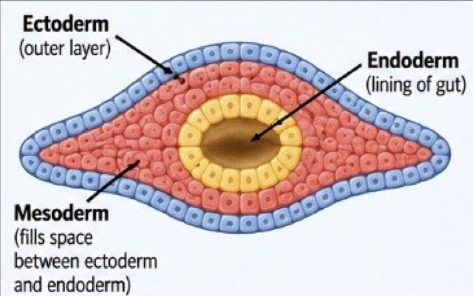
acoelomate
no body cavity

pseudocoelomate
body cavity, not completely lined by mesoderm
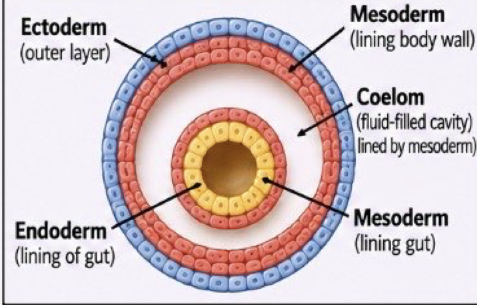
coelomate (eucoelomate)
body cavity
completely lined by mesoderm
body wall
outer tube
digestive tract
inner tube
tissues, organs, and coelomic cavities
space between
protostomes
“mouth first”
blastopore develops into the mouth
a triploblast with a true coelom
ex: mollusks, annelids, arthropods
deuterostomes
“mouth second”
blastopore develops into the anus
mouth develops from another “second” opening
ex: echinoderms, chordates (including vertebrates)
blastopore
an opening that develops during gastrulation in early embryonic development
gastrulation
a series of cell movements that reorganizes the blastula into a gastrula and establishes the three germ layers forming the digestive tract
phylum porifera
an organism with no symmetry must belong to which phylum
organogensis
process of organ and tissue formation via cell division and differentiation
cleavage
development of an embryo from multiple rounds of mitotic cell division
fertilization
process of single sperm cell combining with a single egg cell to form a zygote
gastrulation
dramatic rearrangement of cells to create tissue layer
phylum arthtropoda
what phylum includes approximately 85% of known animal species, is the largest phylum in Kingdom Animalia
post-anal tail, notochord, pharyngeal slits
requirements of phylum chordata
Phylum Chordata
what phylum do these animas belong to: porpoise, mermaid, flamingo, sea turtle
tissues (yes or no), symmetry, germ layers (2 or 3), body cavity, embryonic development
how do we distinguish different groups of animals
heterotrophic
gets nutrition from ingestion, can’t make their own nutrients
eukaryotic, multicellular, heterotrophic, lacks cell wall
how do we recognize animals? what are the essential defining characteristics
filter feeding, hermaphroditic
characteristics of sponges
jellyfish, corals
what animals are part of the phylum Cnidaria
phylum porifera
what phylum is sponges
sponges (porifera)
the simplest animals
sponges (porifera)
specialized cells but not organized into true tissues or organs- classified as Parazoa
All aquatic (mostly marine)
adults are sessile (don’t move)
body designed to move water through the animal
hermaphroditic
water → ostia → spongocel → osculum
order of sponges water movement
ostia
sponge pores
spongocel
sponges central cavity
osculum
sponges opening at top
ostia, spongocoel, osculum
sponges structures
chaonocytes and amoebocytes
sponges cells
chaonocytes (collar cells)
flagellated cells that create water currents and capture food particles
trap small food particles and engulf them by phagocytosis
amoebocytes
mobile cells transport nutrients from collar cells to other cells
spicules (protein fibers)
in the Mesohyl that helps with water movement
true systems
sponges have no
diffusion
gas exchange and waste removal in sponges occur by…
intracellularly
Digestion in sponges occur…
asexually and sexually
sponges reproduce…
budding or fragmentation
asexual reproduction can occur in sponges through…
hermophroditic/monoecious
produce both sperm and eggs
ex: sponges
sponge reproduction
sperm released into water are carried to another sponge where fertilization occurs
Resulting larvae are free-swimming
hermaphroditic
Cnidaria
what phylum are jellyfish, corals, sea anemones, and hydras are a part of what phylum
chindarians
nearly all species are aquatic and marine
possess true tissues
radial symmetry
diploblastic
gastrovascular cavity for digestion
tentacles surround the mouth
cnidocytes
simple nerve net
lack true organs and organ systems
cnidocytes
specialized stinging cells in phylum cnidaria
cnidocyst
specialized stinging cell used for defense and capturing prey
nemocyst
inside cnidocyte
contains a highly coiled thread
stimulation triggers it to rapidly discharge, helping immobilize prey
polyp and medusa
cnidarian body plans
polyp
“stalk”
cnidarian
cylindrical/stalk shape
sessile (non motile)
mouth/tentacles point upwards
ex: sea anemones, corals, hydra
medusa
“bell”
cnidarian
bell/umbrella shape
motile
mouth/tentacles point downward
ex: jellyfish
diploblastic
cnidarians are ______ and posses two tissue layers
epidermis and gastrodermis
cnidarians tissue layers
mesoglea
in cnidarians, jelly-like, mostly non-living material between the tissue layers
specialized nerve, contractile, digestive and sensory calls
cnidarian specialized tissues
cnidarian digestive system
only one opening → functions as mouth and anus
food enters gastrovascular cavity where enzymes begin extracellular digestion
cells of gastrodermis absorb smaller food particles
completely intracellularly
cnidarians nervous system
nerve net rather than centralized brain
allows sensory cells to communicate with contractile cells and coordinate tentacle movement and swimming
diffusion
in cnidarians, gases and wastes are exchanged primarily by ________
sponges
specialized cells, but no true tissues