MIC 206: CHP 14
 Call Kai
 Learn
 Practice Test
 Spaced Repetition
 Match
 Flashcards
 Knowt Play
1/31

There's no tags or description
Looks like no tags are added yet.
32 Terms
Symbiosis
means “to live together”
Name four types of symbiosis:
Mutualism: Human benefits (e.g., bacteria in human colon).
Commensalism: Human neither benefits nor is harmed (e.g., mites in human hair follicles).
Amensalism: Human neither benefits nor is harmed (e.g., fungus secreting an antibiotic inhibiting nearby bacteria).
Parasitism: Human is harmed (e.g., Tuberculosis bacteria in human lungs))
Parasite and Host (Parasitism):
In parasitism, one organism (ex; tuberculosis bacteria) benefits, while the other organism ( host, such as a human) is harmed.
Pathogen
A pathogen is a microorganism with pathogenicity (the ability to cause disease). A microorganism that causes disease (morbidity) when it evades external defenses, multiplies, becomes established in a host organism, and alters the body's normal functions.
Opportunistic Pathogens
Normal flora can also act as opportunistic pathogens that cause disease under certain circumstances, such as immune suppression, changes in normal flora/relative abundance, introduction into an unusual site in the body, or stressful conditions.
Symbiotic Relationships is divided in 2
• Resident microbiota
• Transient microbiota
• Resident microbiota
Part of the normal microbiota throughout one's life. They are mostly commensal, though some can act as opportunistic pathogens that cause disease under certain circumstances (such as immune suppression, changes in normal flora/relative abundance, introduction into an unusual site in the body, or stressful conditions).
• Transient microbiota
Remain in the body for only hours to months before disappearing. They are found in the same regions as normal flora (e.g., food microbes like yogurt, or from handshaking, touching, kissing), but cannot persist in the body due to:
Competition from other microorganisms
Elimination by the body's defenses
Chemical or physical changes in the body
Normal Flora / Microbiota (Indigenous Microbiota):
Organisms that colonize the body's surfaces without normally causing disease. Development in the womb is generally free of microorganisms; babies are "inoculated" or colonized during birth, and much of an individual's resident microbiota is established during the first months of life.
immune suppression, changes in normal flora/relative abundance, introduction into an unusual site in the body, or stressful conditions is an example of
Resident Microbiota
food microbes like yogurt, or from handshaking, touching, kissing is an example of
Transient Microbiota
Describe three conditions that create opportunities for normal microbiota to cause disease.
Immune suppression
Changes in the normal flora / microbiota (including changes in the relative abundance of normal microbiota that may allow a member to thrive and cause disease)
Introduction of normal flora into an unusual site in the body
4. (Note: The slide also lists stressful conditions)
Describe three types of reservoirs of infection in humans.
Animal- spread zoonoses (diseases naturally spread from animal hosts to humans) via direct contact with animals/waste, eating animals, or bloodsucking arthropods. Humans are usually dead-end hosts, making them difficult to eradicate.
Human carriers-Infected individuals who are asymptomatic but infective to others. Some eventually develop an illness, while others never get sick.
Nonliving reservoirs- Soil, water, and food, where microorganisms are often present due to fecal/urine contamination.
CONTAMINATION (colonized)
is simply the mere presence of microbes in/on the body.
INFECTION
Results when a pathogen has evaded external defenses, multiplied, and become established in a host organism. (The invasion of the host by a pathogen.)
True or False: Contamination = infection
False
The correct response: CONTAMINATION →INFECTION → DISEASE
Disease
only happens if that established infection goes a step further and actually alters your body's normal functions (producing signs and symptoms).
Chain of Infection "life cycle" of a pathogen
Causative agent (the pathogen)
Susceptible host (the person who can get infected)
Mode of transmission (how it gets passed along)
Portal of entry (how it gets into the new host)
Reservoir (where the pathogen lives/is maintained)
Portal of exit (how it leaves the source)
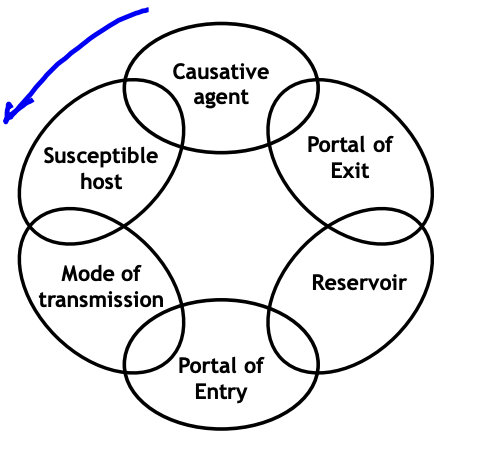
Identify and describe the portals through which pathogens invade the body.
3 major pathways (plus the parenteral route):
Skin: can enter through openings/cuts or by burrowing/digesting the outer layers.
Mucous membranes: Line moist, warm body cavities open to the environment. The respiratory tract (nose, mouth, eyes) is the most common entry site, while acid-resistant pathogens use the gastrointestinal tract.
Placenta: Usually an effective barrier, though some pathogens cross it to infect the fetus (e.g., syphilis, CMV, HIV, German measles).
Parenteral route: Not a true portal, but circumvents usual portals by depositing pathogens directly into deeper tissues (e.g., punctures, cuts, bites, deep abrasions, surgery).
Types of adhesion factors:
Specialized structures and/or attachment proteins
Viral or bacterial ligands, which are surface lipoproteins or glycoproteins
Adhesion Roles in Infection
Attachment to host cell(s) is generally required for the successful establishment of colonies.
Viral or bacterial ligands bind host cell receptors, which can determine host cell specificity.
Some bacterial pathogens attach to each other to form a biofilm (making them 1000x more resistant than the planktonic form).
Changing/blocking this interaction or introducing ligand and/or receptor mutations can prevent infection (avirulent).
Explain how a biofilm occur?
Biofilms occur when some bacterial pathogens attach to each other.
In this form, they are 1000x more resistant compared to the planktonic form, facilitating colonization and persistence.
Disease / Morbidity:
Results only if the invading pathogen alters the body's normal functions.
Pathogenicity
The ability of a microorganism to cause disease.
Virulence
The degree of pathogenicity as determined by the presence of virulence factors.
Symptoms
Subjective characteristics of disease felt only by the patient.
Signs
Objective manifestations of disease that can be observed or measured by others.
Syndrome
A group of symptoms and signs that characterize a disease or abnormal condition.
Etiology
The study of the cause of a particular disease.
Robert Koch
developed a set of postulates (Koch's postulates) that one must satisfy to prove that a particular pathogen causes a particular disease.
Germ theory:
Diseases are caused by infections of pathogenic microorganisms