The Structure of Bone
 Call Kai
 Learn
 Practice Test
 Spaced Repetition
 Match
 Flashcards
 Knowt Play
1/22

There's no tags or description
Looks like no tags are added yet.
23 Terms
Characteristics of bone
Highly vascular
Strong and durable connective tissue
Composed of 65% calcium salts (mostly calcium phosphate)
What is the use of calcium salts found in bone?
Makes up an inorganic, intracellular matrix which makes the bone hard.
Bone matrix
Makes bone hard
Interposed with a system of collagenous organic fibres - collagen is strong and gives bone its slight flexibility
2 types of bone
Compact, cortex, dense bone - forms the hard outer layers
Cancellous, spongy bone - porous inner layers

Where is compact bone commonly found?
In the shafts of long bones where a strong tubular structure is required
What type of bone makes up the majority of the body bone mass?
Compact bone
What is compact bone made up of?
Harversian systems - central canal contains blood, lymph, and nerve vessels
Lamellae are concentric rings of bone around the Haversian canals (osteon)

What percentage of body bone mass is compact bone?
80%
What percentage of body bone mass is cancellous bone?
20%
Characteristics of cancellous bone
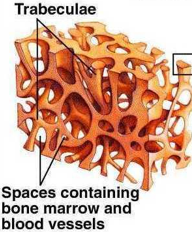
Honeycomb arrangement formed by trabeculae where red bone marrow can be found
What processes are involved in the development of bone tissue?
Osteogenesis or ossification
When does the development of bone tissue occur in the human body?
Before birth/intrauterine
At what age does the development of bone tissue finish?
Around 21 years old
How and where do long, short and irregular bones develop?
In the foetus from rods of cartilage
How and where do flat bones develop?
In the foetus from membrane models
How and where do sesamoid bones develop?
During childhood (around 8 years old) from tendon models
3 types of bone cells
Osteoblast - bone building cells
Osteoclast - bone re-absorbing cells
Osteocyte - mature bone cells

Where are osteoblasts found?
Sites where bone is growing, repairing, or remodelling
Role of osteoblasts
Bone forming cells that secret osteoid (organic bone matrix) and promote the deposition of inorganic mineral salts - mainly calcium phosphate.
As new bone is laid around them, some osteoblasts become trapped within small spaces called lacunae and differentiate into osteocytes
Role of osteoclasts
Breaks down bone
Release calcium and phosphate
Where are osteoclasts usually found
Areas of bone where there is active growth, repair, or remodelling
Role of osteocytes
Monitors and maintains bone tissue
What are osteocytes
Mature bone cells that do not divide, they are nourished by tissue fluid in the canaliculi that radiate from the haversian canals