History
 Call Kai
 Learn
 Practice Test
 Spaced Repetition
 Match
 Flashcards
 Knowt Play
1/173

There's no tags or description
Looks like no tags are added yet.
174 Terms
What was Lenin’s role in the development of the Bolsheviks party before 1917?
-Exiled between 1901-1917 where he created Bolsheviks and came into power 1917 and died 1924
What were the soviets?
-Established after 1905 revolution
-After Feb revolution Soviets ruled with the provisional government
-After Oct Revolution, succeed by Congress of Soviets
What was Russian congress of Soviets 1917-1930?
-Assembly of representatives of local councils, meet twice a year
-Defined + amended principles of soviet constitution
-Included the Bolsheviks rivals (Mensheviks + social revolutionaries)
What was the Sovnarkom and Politburo?
Sovnarkom- 13 people’s commissars which governed Russian on Day to day basis e.g. Stalin- head of national affairs, Trotsky head of foreign affairs.
Politburo- Operated as ruling body of Soviet Russia + USSR, elected and responsible for central committee with weekly meetings.
Give Brief description of Leon Trotsky.
-Already a revolutionary hero, Him and Lenin had disagreements but worked closely
-First year of USSR helped win civil war as head of red army + foreign sectary
-Seen as arrogant and unreliable and later pushed out of party and killed in 1940
Give brief description of Joseph Stalin.
-One of first members of Georgia RSDLP
-Lenin Respected Stalin though wasn’t seen as intellectual and played small role in civil war + Oct revolution.
Name all Decree’s Lenin brought in.
Decree of Land Oct 1917- Peasants had right to seize land they were on, decreased Bourgeoise power + increased peasants power
Decree of peace Oct 1917- Treaty of Brest-Litovsk signed, Russia lost Finland, Estonia and grain land in Poland + Ukraine, Population down 25%, 35% down in grain production, 70% of industry down
Decree for workers November 1917- 8 hour max day + Minimum wage, elect committee which ran factories
Name + Describe minority groups.
Mensheviks- created in 1903 after RSDLP, leader Martov #
Social Revolutionaries- Supporters of democratic socialist Russia, leader Alexander Kerensky
Describe the red army in civil war.
-Occupied 1/5 of Russia + most industrialised areas (northern + central Russia)
-Most densely populated areas e.g. Petrograd + Moscow
-use of railroads and more recruitment of workers
Describe the white army in the civil war.
-Fewer population + less densely populated areas
-Controlled less industrialised areas, lacked munitions + of workers
-Were Divided + less controlled compared with Reds
Strengths of Bolsheviks.
-More disciplined than whites- had ex-tsarist officers who were experienced
-Conscription in 1918 - 5 Million soldiers in Red army in 1920
-Trotsky was successful war leader, strategist + travelled to front line to boost troops morale
Weaknesses of Whites.
-Foreign support ended after WW1
-No unity + lots division with no central leadership
-Scattered geographically + Poor communications and lack of railways
Describe the government during Civil war.
-Government became more centralised + Economy more centralised
-Communist party became more powerful + Political centralised through Nomenklatura rather than democratic Soviets
-Trotsky made red army authorities through conscription
What was the 4 things Stalin did to consolidate his power?
-Ideological orthodoxy
-Authority at top of party
-Party Membership
Stalin’s Patronage System
Describe Stalin’s “Ideological orthodoxy.
-Created new Leninist ideas with Bukharin + discredited Trotskyites
-Stalin said Lenin would have wanted USS to construct socialism first instead of global revolution.
-Second he said that Lenin would want the NEP to be scrapped due to it not growing economy, state owned farms, Russia more industrialised
Describe what happened to authority at top of party.
-By 1928 all power was focused to Stalin
-Did this by creating new ideology, painting rivals as against Lenin
-Also, accused members of creating fractions (highly illegal)
Describe the new Party membership.
-New “Lenin Enrolment” in 1924, 128,000 workers joined, supported Stalin as he promised high paying Jobs
-People suspicious of the intellectuals in party + loyal to Stalin, better reputation for Stalin
Describe Stalin’s Patronage System.
-Created a “approved list” of people who could be a party congress and central committee meetings, 1/3 of people at meetings on the list
-As general secretary, gave low ranking officials well paid jobs, creating loyalty
-Also sacked + investigated people he didn’t like
Why did Stalin conduct the great terror + who were his targets?
-To remove opposition + create fear in population to not go against Stalin
-Targets = Politcal oppostion (Trotsky, Zinoviev, Kamenev) , Religious groups
Describe the Ryutin Platform.
-Document that was critical of Stalin’s polices
-Ryutin was spared execution and got sent to prison
-Supported by a man called Kirov
Describe the economic problems under Stalin.
-Major problems with Stalin’s agricultural + industrial issues
-Stalin accused workers + managers of being wreckers and sabotagers
-Wreckers + sabotagers sent to gulags
Describe the Gulags.
-Government operated forced labour camps
-Inmates condition extreme, lack of food, poor shelter
-13 million people died in gulags from 1929-39
Describe Stalin’s “totalitarian” government.
-Had complete control of economy+ media and used extensive propaganda
-Used wide spread political terror to remove opponents
-Stalin wanted heartfelt enthusiasm + commitment from his people
What happened at the congress of victors February 1934?
-Stalin came second to Kirov in vote at end of 17th party congress Kirov-1225, Stalin-927 votes
-Senior officials pressured Kirov to stand against Stalin, he refused
Describe Sergei Kirov murder.
-Kirov murdered in December 1934
-Removed Stalin’s main opposition, though he claimed a conspiracy
-All Leningrad officials purged, start of Great terror
Give reasons for Stalin’s purges.
-Driven by suspicion and paranoia
-Used Purges to settle scores with old bolehseviks
-Remove opposition
-Give Stalin “hero of revolution” image
Describe the show trails.
-Trail of 16, 1936- Zinoviev, Kamenev + 14 supporters killed
-Trail of 17, 1937- Execution + imprisonment of 17 Trotsky supporters
-Trail of 21, 1938- Bukharin + closest supporters executed
Describe the secret trails.
-1937, trail of 8 senior generals in Red army for treason, all executed as they worked with Trotsky
-Following trial more than 37,000 officers purged form army
Give consequences of great terror
-Eliminated rivals from 1920’s + removal of all current opposition
-New generation of communist party leaders loyal to Stalin
-NKVD became a powerful regime + Beria became powerful figure
What is party and state?
Party- Communist- based on leadership, power, membership and Ideologies
State- Soviet state- Deals with government structure, command, economy, unemployment, surveillance and security
Party + Sate relationship under Lenin.
-Lenin failed to define the relationship
-Lenin established state based on Soviets,
-Outlawed non-communists political parties
-Party was most powerful organisation in USSR
Party + State during WW2.
-Stalin became chair of Sovnarkom in 1941, leading role in both State + party
-Allowed state power to grow- shift in power
-Ministers joined Politburo, bring given important roles
-Creation of GKO- dealt with economic coordination + military and defence during war
How did Stalin create competition in party?
-Appoint rivals of officials to key positions e.g. Zhdanov made to check Beria policies, rivals
-Shifted power from party to state to party (Politburo → GKO → Council of ministers)
Describe the Leningrad affair 1949.
-Launched purge against Leningrad party due to fear they were gaining power
-100 officials shot + 2000 arrested + dismissed
-Beria may have influenced Stalin as got rid of rival Zhdanov
How did Stalin test Loyalty of officials?
-Imprisoned / sacked wives or daughters of senior figures
-For example, Stalin sacked Molotov wife from Party- first Abstained, she was then imprisoned in 1949, he had no objections
What happened after the death of Stalin?
-Stalin’s power personal, based on reputation + independent of party or the state
-Individuals who filled Stalin’s position could not claim undisputed leader
-Stalin left no testament nor indication for his successor
Describe Career of Nikita Khrushchev 1894-1971
-Developed good relations with Stalin, became head of communist party in Ukraine in 1935
-Believed in reforms from Stalin to ensure good living standard, great faith in Soviet socialism
Describe Career of Georgy Malenkov 1902-1988.
-Good allies with Stalin in 1920s + important role in fall of Yezhov, promoted to Politburo in 1941
-After Stalin death, was key contender but expelled from party + forced into exile in 1961
Describe Laverenity Beria’s career.
-Became head of NKVD in 1938, one of Stalin’s most trusted allies
-After WW2, involved in building A-Bomb + real contender for leadership
-Ultimately arrested and executed
What was the republics and Eastern Bloc?
Republic- single country comprising of 15 constituents republics e.g. Ukraine, Belarus, Baltic states, Kazakhstan
Eastern Bloc- Independent nations aligned with USSR e.g. Poland, Hungary, Bulgaria, Romania
What reforms did Beria Bring to Gulags?
-March 1953, amnesty for non-political prisoner’s under 9 months, Further extended to ‘counter revolutionaries
-Mining + factory construction was terminated
-Gulag population 2.4 million in 1953 to 1.6 million in 1956
What reforms did Beria bring to Republic’s?
-Senior officials had to speak language of the republic
-All official publications had to be available in republic’s language + Russian
What happened to Beria?
-Reform’s had weakened Beria’s power
-In Presidium meeting in June 1953, Khrushchev accused Beria of sharing documents to British
-Beria was arrested, tried and executed. Weakened MVD power + meant country ruled by Malenkov + Khrushchev
What personal changes did Khrushchev bring in after Stalin?
-Replaced Stalin’s supporters with Khrushchev loyalist
-Power as secretary of central committee, ½ of party secretaries + central committee replaced
-Secured his position within party + loyalist backed his reforms
What was the Anti-bureaucracy campaign?
-Designed to weaken the state + cut bureaucracy by developing power form soviet government to republican government
-Mid 1954 - Khrushchev restructured government, cut central soviet ministers from 55 to 25
-Increased economic power by republics + soviets industry control by central government was 68% to 44%
De-Stalinisation aims.
-Khrushchev + Malenkov wanted to humanise communism
-Leninists rejected the cult of personality around Stalin
-Wanted to improve standard of living, enriching soviet culture with new novels, plays and arts
First steps of De-stalinisation.
-Scrapped plans to turn Stalin’s dacha into a museum
-Celebrations of Stalin’s Birthday cancelled + Annual Stalin awards cancelled
-Newspaper Quoting Marx’s + Lenin rather than Stalin
Describe the cult of Stalin.
-Use of art, photography, books and newspaper’s to stress Stalin’s genius + Stalin responsible for every major Soviet victory
-Aim was to win loyalty of Soviet people
-Khrushchev used cult of personality to criticise Stalin style of personal dictatorship
What was the secret Speech?
-After 20th party congress of 1956, He spoke for 4 hours Critiquing Stalin- Focused on his cult of personality, purging of red army + Lenin testament
-Didn’t talk about economic policy or communist ideology
-Some so shocked had heart attacks + committing suicide
-Speech kept secret and only fully revealed in 1989
How did Khrushchev end terror?
-May 1954- Khrushchev + Malenkov set up commission to review political prisoners who were in Gulag’s
-First year - Only 4620/113,739 political prisoners released.
-In June 1956, 51439 prisons (26155 political prisoners) released
-By 1961, half of executed political prison by Stalin had been rehabilitated
What were some problems with De-Stalinisation?
-Communist parties in Hungary + Poland began De-Stalinisation process, Student’s protested + elected new leader
-Soviet troops crushed the revolution
-Student’s at Moscow university protested in 1957, supressed by Government
What was Khrushchev retreat 1957?
-Stalinists in Party + modules didn’t like De-Stalinisation
-June- Central committee issued statement to Party revising Khrushchev’s speech
-October- Questions of history magazine punished for publishing revelations about Stalin terrors
-Mid December- Established special commission, held by Brezhnev to supress anti-communist activities
What was Democratisation and Decentralision?
-Aim was to increase participation of workers in the government
-Members increased from 6.9 million to 11 million + introduced fixed terms (2/3 of Presidium replaced from 1957-1961)
-Abolished central minster that oversaw economy + devolved power to new economic council.
What’s the anti-party group reform?
-Party unhappy with reforms, led to overthrow attempt in June 1957, led by Malenkov, voted to remove Khrushchev
-He said decision should be made by central committee where he had most support
-Survived overtake, sacked opponents, took over PM in March 1958
-Power of party leader determined on central committee
Describe Khrushchev’s final reforms.
-At 20th party congress, decided to split party into two: one half dealt with agriculture + other half industry
-Spilt went right to the very top
Describe Khrushchev’s fall.
-People unhappy with reforms
-Poor handling of east Berlin + Cuba
-Overthrown in June 1964 due to poor economy + foreign policies
Describe Leonid Brezhnev career.
-By 1956, was first secretary of communist party of Moldova, promoted to Politburo in 1952
-Backed Khrushchev in anti-party group but key to downfall in mid 1964 during plot
-Known for vanity, encouraged journalist to praise genius + created his own cult of personality
Describe Alexei Kosygin career.
-He played prominent iterated role under Khrushchev + after him as well
-Advocate of economic reforms, but were short lived, eclipsed by Brezhnev in early 1970s, remained senior figure until 1980 when he resigned due bad health.
What is Restoration?
-Between 1964-5 leadership was based on informed pact between Brezhnev, had support in politburo + central committee.
-Brezhnev led this party as general secretary + Kosygin was premier .
-Divided key position in government roughly equally between supporters of Brezhnev + Kosygin
What was the Stability of cadres?
-Policy discouraged promotions and demotions within government, part of Brezhnev + Kosygin pact, less battles over patronage
-Replaced Khrushchev’s 1961 policy of limited terms, gave support to leader due to job security
Describe Restoration of party under Brezhnev.
-Brezhnev revered Khrushchev trying to decentralising of government
-Re-established all union-minister’s
-Ended industrial spilt in the party
-Article 6 of 1972 Soviet constitution- recognised parties leading role- Party over state
Describe Gerontocracy + Draw age table.
-Between 1964-71, two people promoted to Politburo + 1966-71, 80-90% of central committee member’s kept jobs
-Government no longer understand society it was governing, Senior officials became increasingly ill, can’t perform jobs
-Limited opportunities for promotion + no incentives to work harder

Describe corruption in party.
-Sackings were rare, context for huge corruption as people not disciplined
-Sokdov, director of Moscow food sate food sore took bribes for passing luxury food
-Brezhnev’s daughter had millions of pounds of diamond’s smuggled into country by lover, under Brezhnev’s watch
Describe Yuri Andropov career 1914-1984.
-Appointed head of KGB in 1967, Supressed dissidents + anti-Soviet activities
-In 1968, argued for Soviet intervention in Prague, promoted to Politburo in 1973 + played role in seeing soviet talents e.g. Gorbachev
Describe Andropov’s reform’s.
-Abandoned stability of cadres policy, replaced ¼ of senior officials
-Introduced small scale economic reforms focused on labour disciplined
-Anti corruption + Alcohol campaign
-Prosecuted Nikolai Shchelokav (red army general) + Boris the Gypsies
-Conducted Operation trawl
Describe Konstantin Chernenko career.
-Gained high office following fall, became senior figure in party in 1970’s
-Front runner for office in 1982, became leader in 1984, but had poor health, died not long after coming into office
Describe Chernenko reform’s
-Unwilling to consider major reforms
-Poor health caused Chernenko not to have major role in government
-Due to ill health- Gorbachev mainly led government meeting’s on his behalf
-Achieved very little as leader
Describe State Capitalism March-June 1918.
-Main aim was the nationalisation of the industry, Nationalised industries were controlled by Vesenkha
-Vesenkha- Ensure factories were property managed- Placed under control of well-paid specialised + Coordinate economic production
-Very unpopular
Give Background of War communism.
-Began at the start of the Russian civil war- replaced State capitalism
-Main Aims- High level of industrial production of war goods, efficient allocate for workers
-Food production- feed soldiers, workers + civilians
What was Food dictatorship?
-Introduced a series of measures to ensure food for soldiers + workers
-Grain requestioning - Cheka seize grain + other food from peasants, no pay
-Rationing- supply commissariat rationed seized food, largest portion to soldiers + workers, smallest to bourgeoisies
Describe Labour discipline.
-1918, working week up to 11 hours
-1919, work made compulsory for all able-body 16-50
-Later or slacking led to punishment
Describe what abolition of the market.
-Abolition of money- Government printed money, led to hyperinflation, workers paid through rations + public services free e.g. trams
-Abolition of trade- private trade made illegal
-Complete nationalisation- All business taken over by government
-Conscription- workers were assigned either to work in factories or fight in army
What were consequences of war communism?
-Succeeded in keeping red army supplied + allowing them to win civil war
-However, led to economic collapse + failed to abolish market

What were the aims of the NEP?
-Retain political power, economic retreat to stop political defeat
-Revive- Economy- stimulate grain production, end famine
-Build socialism- European revolution would not happen
Describe the measures of the NEP.
-Created mixed economy
-Agricultural production was left to free market, peasants could buy +sell grain, requisitioning stop, replaced by tax in kind
-Small factories + workshop <20 denationalised, trade freely
-large factories + major industries remained nationalised
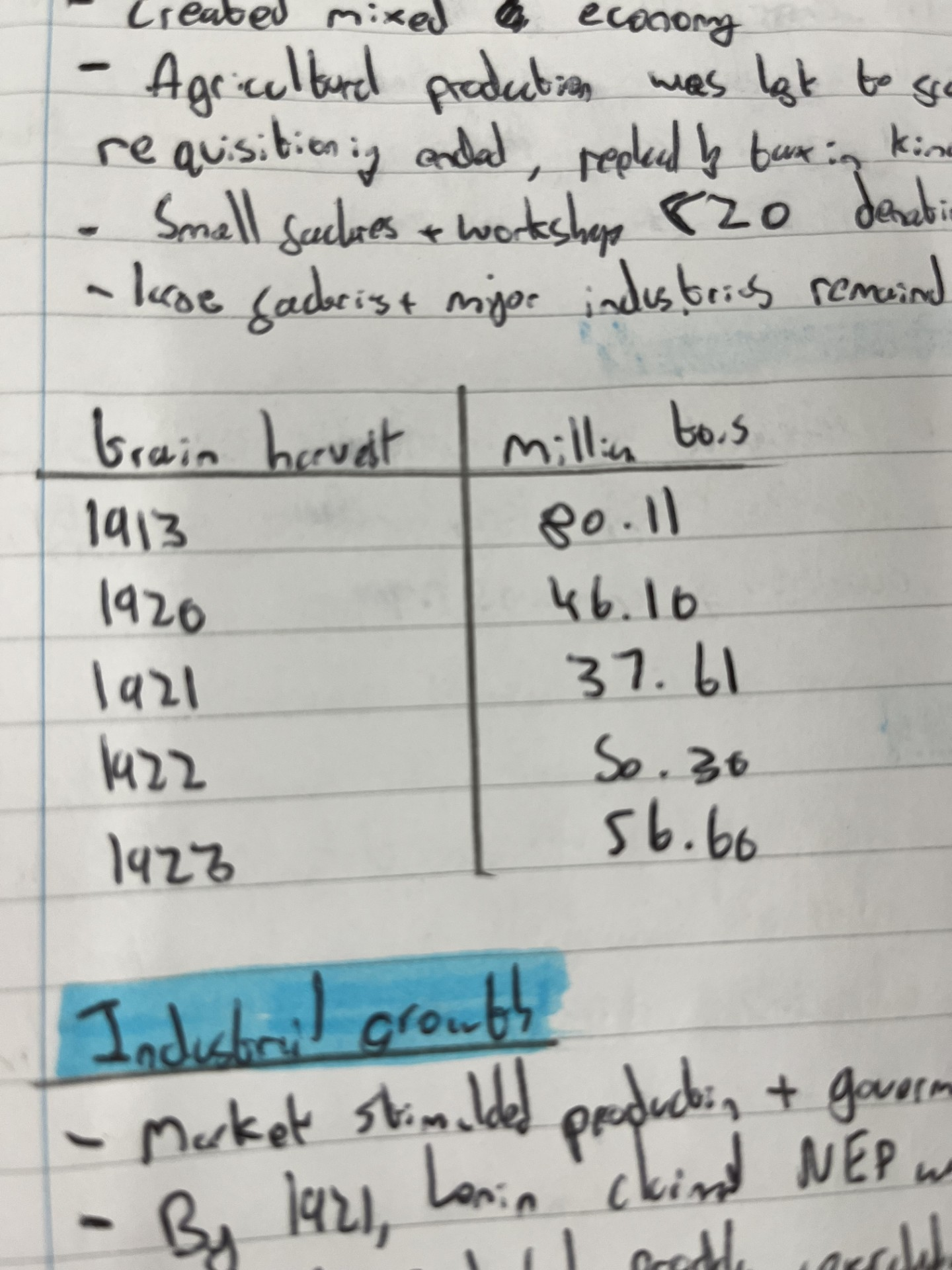
What industrial growth was their due to NEP?
-Market stimulated production + government invest peasants tax into reopening factories
-By 1921, Lenin claimed NEP was best way to lay foundations for socialism
-By 1926, industrial production, excluding iron +Steel had reached 1913 levels
-Tax peasants wasn’t fully efficient in building new large scale factories, reached plateau in 1926-28
Describe what the scissor crisis was.
-Industry prices went up, agriculture prices went down, created problem
-By 1923, gap so significant farmers couldn’t buy industrial equipment + create grain
-Government intervened, subsidised prices of industrial products
-Peasants back to making grain, but lost money to boost economy - showed NEP not capable of industrialising economy
Describe inequality + corruption under NEP.
-NEP led to “Nepmen”- trade of desired goods (illegal), seen as parasites, some arrest for profiteering- Became very wealthy
-More gambling, sex work + drugs under NEP, led to poverty among women, had to go into sex work
What did the left want for economy?
-Trotsky + left wingers wanted agricultural collectivisation- merge farms with all under state control- allowed to profit
-Argued scheme would end all private property + capitalist market and end equality
-However acknowledged that would led to peasants being unhappy
What did the right want for the economy?
-Right-wingers, like Bukharin argued NEP best way to industrialised USSR slowly
-Argued that slow growth kept peasants happy + keep harmonies society
-Left argued that could led to a overthrow of communism
What did the centre want for the economy?
-Pragmatic’s like Stalin argued correct policy was one that worked
-Believed it was a practical issue, not ideological
-Stalin supported NEP until 1927 when growth rates stopped and he switched positions
What is a command economy?
-Central government dictates the production level of goods +controls their distribution and prices
-Government control rather than private enterprise can ensure the fair distribution of goods + services
Describe the end of the NEP.
-1928, Stalin argued that USSR should abandon the (NEP)
-Russian economy stopped growing in the late 1920s
-Stalin argued that the right Leninist approach would be to end the NEP for a more radical approach
-NEP was abandoned in 1928
Give dates for the three 5 year plan’s.
-1st 5 year plan- Oct 1928- December 1932
-2nd 5 year plan - Jan 1933- December 1937
-3rd 5 year plan- Jan 1938- June 1941
Aims of 5 year plan before WW2.
-Industrialise Russia- USSR was 100 years behind Britain + USA and aimed to catch up in 15 years
-Eliminate inefficacies of the NEP - NEP helped to revive industry but didn’t led to development of new factories
-Reflected military concerns + need to defend Soviet territory, Stalin wanted to assert his own authority
What was nature of the 5 year plan’s?
-Initiative designed to increase production- every factory, mine had targets
-Mass Propaganda- heroic objectives, success of plan, ending capitalism
-Ultimately a set of targets, no attempt to ensure factories could reach target- command economy
List the achievements of the 5 year plans.
-Heavy Industry
-Transport
-Labour productivity
-Rearmenant
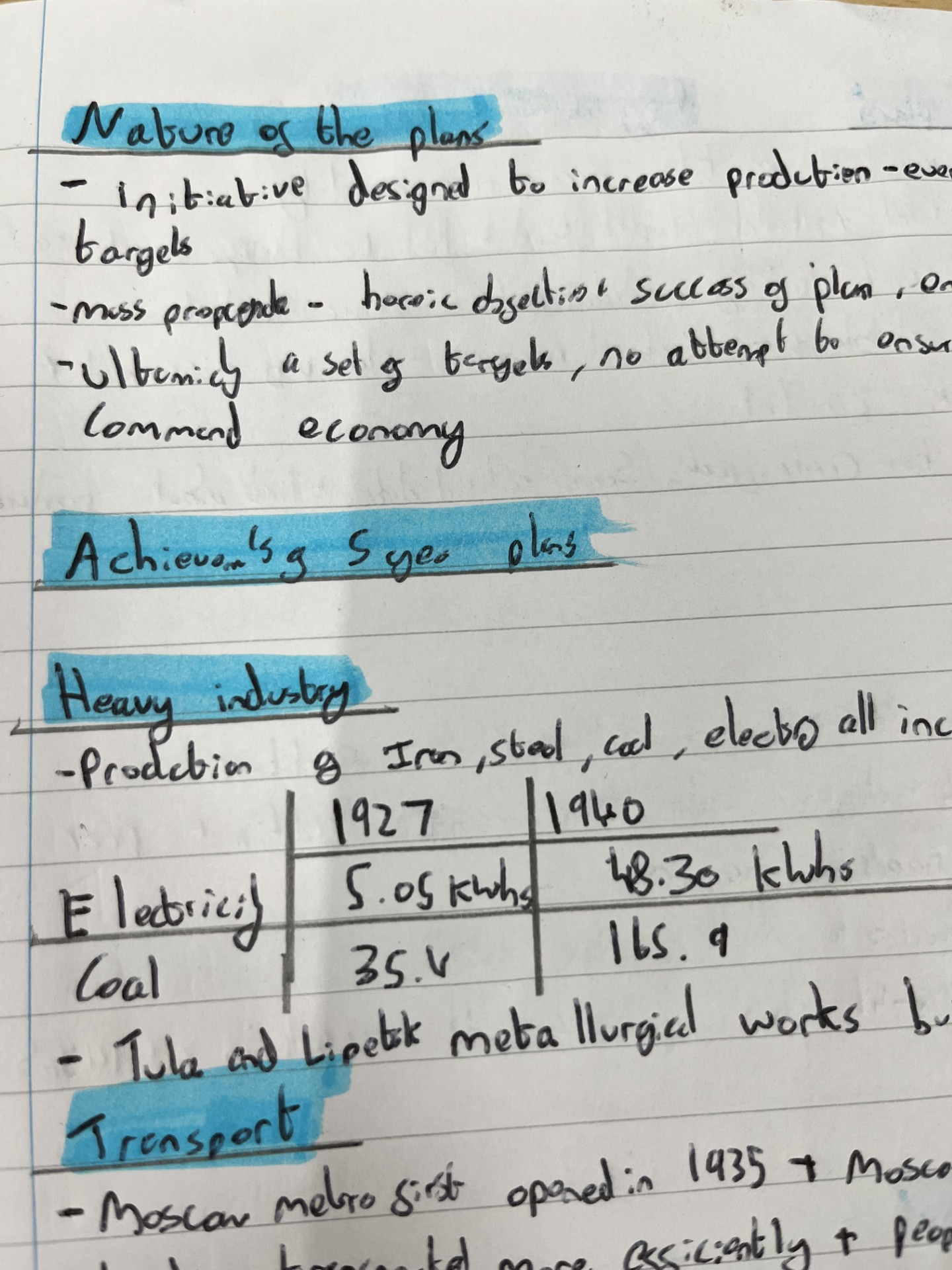
Describe heavy industry under 5 year plan’s.
-Production of Iron steel, coal electricity all increased massively
-Tula and Lipetsk metallurgical works built between 1929-36
Describe improvements in transport under 5 year plan’s.
-Moscow metro first opened in 1935 + Moscow-Volga canal built between 1932-37
-Goods transported more efficiently + people travel around easier
Describe Labour productivity under 5 year plan’s.
-At start work productivity very low pay to long hours + low pay and no incentives
-Stalin authorised higher payment + reward system
-Stakhanovites- Very productive workers- organise factories to be productive + teach others
-Disliked as got higher pay
-Chemicals +34% productivity, Coal mining +26% productivity, electricity production +51% productivity
Describe Rearmament.
-Arms production rapidly increased, by 1940 1/3 of spending on rearmament
-Mine military aircraft factories built between 1939-41, though steel storage held up steel production
Production problems with 5 year plans.
-Production quality very low as told, quantity over quality
-Not specification of what material should be used + lots materials left to decay, up to 40% of production wasted in some industry
-Due to purges of economic planners + industrial managers- plans very disorganised, third plan not fully finished
-Due to high pressure to create goods, some falsified data + lied about production levels
Give problems with the 5 year plans.
-Consumer goods
-Housing & living conditions
-Production problems
-Black market
Issues with consumer goods in 5 year plans.
-Shortage of goods 1928-41 e.g. clothes, shoes, furniture
-Stalin wanted heavy industry + defence rather than consumer goods + poor planning as underestimated needs of consumers
-Not a lot of skilled workers to make complex goods
-Led to ratioing off goods 1928-41, shoe ques in Moscow exceeded 1000 people due to shortages
Problems with housing + living conditions.
-People moving to urban areas had no housing + housing poor with no running water, not single bathhouse for 650,00 in Moscow
-In Magnitogorsk new housing built for US specialist to built factories, through workers lived in wooden shacks + mud huts
-Food rations, working conditions harsh with 7 day working week + lateness criminalised
Describe black market under 5 year plans.
-Plan failed to end free market shortages, increase in black market activities
-Workers steal goods + materials from workplace - sell to highest bidder, covered up by falsifying paperwork
Give communist ideology of an economy.
-Private property was seen as causing inequality + capitalist feature
-During NEP, peasants with large farms, able to become rich compared to peasants with smaller farms
-Collectivisation would end private property, create fairer, more efficient society
Describe Collectivisation in USSR.
-Small farms merged into large farms, comprising between 20-150 families
-State took over ownership of the farmland + farm’s resources
Describe leadership struggle due to economy.
-United opposition advocated for the left-wing polices of collectivisation + rapid industrialisation
-Stalin moved his polices towards the left wing to gain more supporters than Bukharin
Give the failures of the NEP.
-No market for additional formed goods
-Farmers produced more goods than the government wanted
-In 1927, Farmers produced less, which raised prices
-These farms were known as Kulaks due to putting their profits ahead of the USSR’s need for Industrialisation