8.2 Cyclic Forms of Monosaccharides
 Call Kai
 Learn
 Practice Test
 Spaced Repetition
 Match
 Flashcards
 Knowt Play
1/6

There's no tags or description
Looks like no tags are added yet.
7 Terms
Formation of Hemiacetals & Hemiketals
alcohol (-OH) + carbonyl (C=O) → hemiacetal/hemiketal
further addition of another alcohol to hemiacetal/hemiketal can yield a full acetal or ketal
formation of the monosacc’s cyclic form via this rxn yields a new chiral centre (carbonyl C becomes chiral in ring)
for aldoses:

for ketoses:

Monosaccharides will Adopt Cyclic Structures
→ in solution many monosaccharides will adopt a cyclic conformation thru an INTRAmolecular rxn
hydroxyl (OH) on chiral or non-chiral carbon acts as nucleophile & attacks carbonyl
carbonyl is converted to a hemiacetal in aldoses or a hemiketal in ketoses
anomeric carbon (c1 or c2) is chiral in cyclic form → THUS anomeric c becomes a chiral centre
forms:
pyranoses = 6 membered ring w 5C + O OR
common is larger structures & MORE stable than furanoses
fruanoses = 5 membered ring w 4C + O
common in ribose
note: shown by Hawthorne projections

→ 2 anomer’s of the cyclic form are in equilibrium in solution via mutarotation (interconvert)
Mutarotation = interconversion of α & beta forms in hemiacetals & hemiketals
which anomer is preferred is determined by which is the LOWER energy form
beta form is MORE likely to form bc it allows all the bulky substituents to be at equatorial positions (lower energy)
α = OH of anomeric c is on OPPOSITE side of ring as C6
beta = OH of anomeric c is on SAME side of ring as C6
Formation of hemiacetal in Monosaccharides: Ex. Glucose
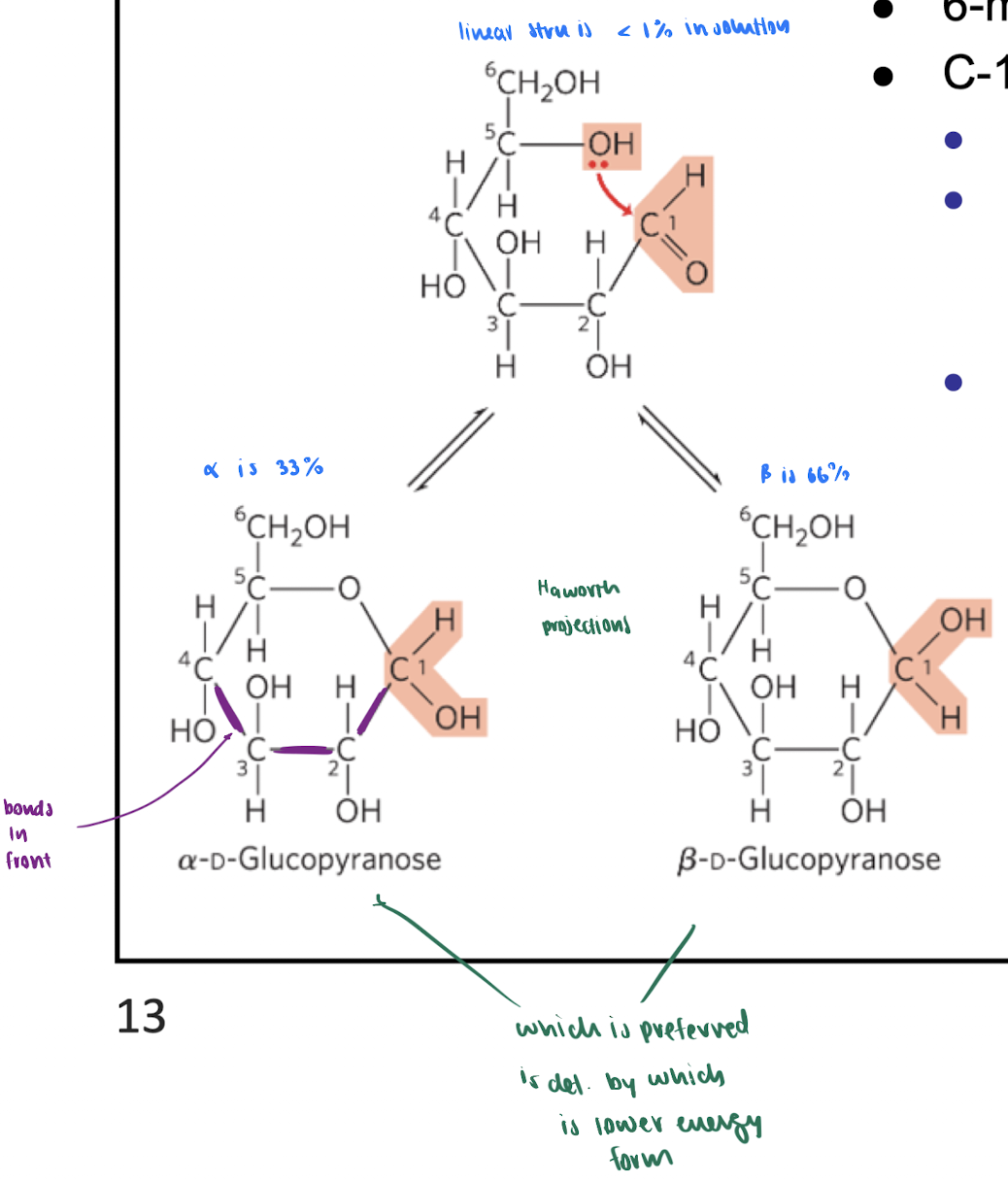
→ glucose’s linear C5 hydroxyl (OH) reacts with its C1 aldehyde → forms 6-membered pyranose ring
can form a furanose ring, but the pyranose is more stable thus more likely to form
c1 (anomeric c) becomes a new chiral centre
may be α- or beta- configuration (anomers that aren’t fixed, as its relative to the direction of C6)
α = OH of anomeric c is on OPPOSITE side of ring as C6
beta = OH on SAME side of ring as C6
percentages of Glucose’s structures in solution:
< 1% is linear in solution
33% is α-anomer (OH on opposite side)
66% is beta-anomer (OH on same side)
beta form is more likely to form bc it allows all bulky substituents to be at equatorial positions
Hawthorne Projections for Pyranoses & Furanoses
furanose = 5-membered ring (4C + O)
pyranose = 6-membered ring (5C + O)
→ aldoses w 5+ carbons (aldopentoses) may form pryanoses or furanoses
the larger pyranose ring is generally more stable

Hawthorne Projections = show stereochemistry more explicitly than Fischer projections
OH below the ring is on RIGHT side of a standard Fischer projection
OH on R of Fischer = below ring in Hawthorne
OH on L of Fischer = above ring
exception: OH forming the cyclic ether bond is the OPPOSITE:
OH on R of Fischer = above ring (thus H is below)
OH on L of Fischer = below ring
relation to D or L enantiomers:
C6 group is up on Hawthorne: D-
C6 group is below on Hawthorne : L-

Monosaccharide Cyclic Structure: Chair Conformations
→ monosaccharide rings ARENT flat, they exist in 1 of 2 possible chair conformations
DONT have to break bonds to interconvert the 2 conformations
substituents around the ring are in axial or equatorial positions
methyl & bulky groups prefer equatorial positions
saccharides with substituted OH groups tend to have bulkier substituents at the equatorial positions → THUS, predominates bc more stable
→ the chair conformation with bulkier groups at equatorial positions predominates bc of increased stability

Different Projections & Representations for Monosaccharides Cyclic Structure
Fischer of cyclic
if O involved in the ether bond is on the same side of the anomeric carbons OH = α anomer

Haworth
if C6 is above plane = D- enantiomer (means OH was on R in linear)
if C6 and anomeric OH are on same side = beta
if C6 and anomeric OH are on OPP side = α
each carbon alternates wether up or down is axial or equaltorial position
c1 up = eq & down = axial
c2 up = axial & down = eq
c3 up = eq & down = axial …

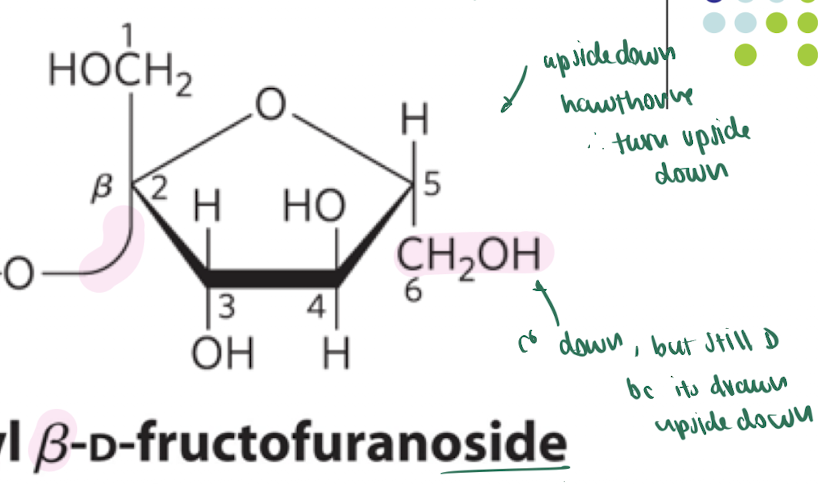
note: if Hawthorne is draw in non-standard form (c1 on left) its upside down
if C6 is down when c1 is on left of Haworth = D- enantiomer bc its upside down
Chair
axial = straight up or down
equatorial = angled
if C6 is up and anomeric OH is down = α anomer

Mills
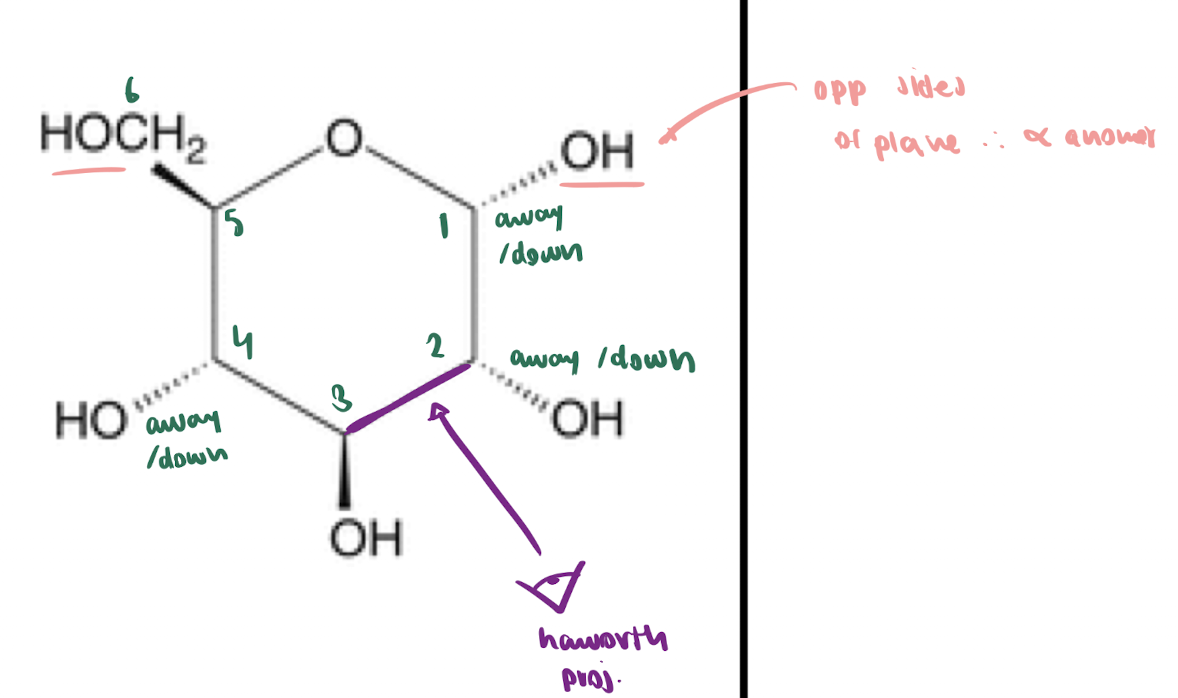
identify anomeric c as it is connected to 2 oxygens
# the sugars carbons from the anomeric c
determine up or down to identify units
wedged (twds) = up
dashed (away) = down
if C6 and anomeric OH are wedged & dashed = opp sides of plane, THUS α anomer

Q. Which ribose form do you expect to be the most abundant in solution?
a. beta-D-ribofurnaose
b. α-D-ribofuranose
c. α-D-ribopyranose
d. beta-D-ribopyranose
answer: D, beta-D-ribopyranose
D-ribose structure:

structures of D-ribose present in solution:

bc it FAVOURS the LOW energy structure:
pyranose (6-memb) are lower energy forms, THUS more favourable
deciding b/w beta & α: which has more Oh at equatorial?
beta bc groups in Haworth alternate b/w axial & equatorial → thus beta has more substituents in equatorial positions
beta form: anomeric OH up, down, down, down → eq, eq, axial, eq
α from: anomeric OH down, down, down, down → axial, eq, axial, eq
note: all 4 structures are present when D-ribose is in solution, just at DIFF frequencies