MCB CH6
 Call Kai
 Learn
 Practice Test
 Spaced Repetition
 Match
 Flashcards
 Knowt Play
1/35

There's no tags or description
Looks like no tags are added yet.
36 Terms
Microbial growth
Increase in population of microbes
Reproduction of individual microbes
Results:
Discrete colony - aggregation of cells arising from single parent cell
Biofilm - collection of microbes living surface in complex community
TEACHER: GROWTH = SIZE REPRODUCTION = NUMBER
Growth Requirements
Organisms use variety of nutrients - energy needs- to build organic molecules & cell struct
Most common nutrients: necessary elem: carbon, oxygen, nitrogen, hydrogen, sulfur, phosphorus
Microbes obtain nutrients from variety of sources
Nutrients: Chem & Energy Requirements
Sources of carbon, energy, and electrons
2 groups of organisms based on source of carbon:
Autotrophs — using INORGANIC carbon (CO2)
Heterotrophs — using ORGANIC carbon (Glucose, Sucrose, Amino Acid, Protein, Fat)
2 groups of organisms based on source of energy:
Chemotrophs — Oxidation of organic / inorganic molecules
Phototrophs — Light
E- Source (LAB):
Litho — INORGANIC E- (Chromium, Iron, Zinc)
Organo — NADH, FADH2, NADPH
BE ABLE TO IDENTIFY THESE TERMS
Nutrients Chem, Energy
2 groups of organisms based on source of electrons:
Organotrophs
Lithotrophs
“Belong together, order doesn’t matter as long as correct”
Oxygen Requirements
Oxygen essential for obligate aerobes
Oxygen deadly for obligate anaerobes
How true?
Toxic forms of oxygen high reactive + excellent oxidizing agents
Resulting oxidation causes irreparable damage to cells
4 Toxic Forms of Oxygen
Singlet Oxygen ½ O
Superoxide Radicals o3
Peroxide anion H2O2
Hydroxyl radical [-OH]
SOD’s NEEDED TO GROW IN PRESENCE OF OXYGEN
CATALASE — enzyme breaks down peroxide into water & free oxygen
H2O2 → H2O + O2
Organisms & Oxygen Concentrations
Aerobes
Anaerobes
Facultative anaerobes → grow w/ or w/o oxygen
Aerotolerant anaerobes = w/ or w/o oxygen
Microerophiles → require oxygen 2-10%
Liquid Identify Oxygen Req
Resazurin → Oxygen Indicator

Nitrogen Requirements
Anabolism often ceases due to insufficient nitrogen
Nitrogen acquired from organic + inorganic nutrients
All cells recycle nitrogen for amino acids + nucleotides
Nitrogen fixation by certain bacteria essential to life on Earth.
Other Chem Requirements
Phosphorus — DNA / RNA / cell membrane
Sulfur — met, cys (A.A.)
Trace elements - only req in small amts
Growth factors — necessary organic chemicals that cannot be synthesized by certain organisms
Growth Factors & Funct

Physical Requirements (Temp)
Temperature affects 3d structure of proteins
Lipid containing membranes of cells and organelles are temperature sensitive
— If too low, membranes rigid & fragile
— If too high, membranes too fluid
Temperature & Growth
37 is body temp
Organisms that grow best at body temperature = Mesophiles

5 Cat of Microbes - Temp

Physical Requirements (pH)
Organisms sensitive to changes in acidity
Hydrogen ions interfere w/ H bonding
Neutrophiles grow best in narrow range around neutral pH 6-8
Acidophiles grow best in acidic habitats <6
Alkalinophiles live in alkaline soils and water 8+
Phys effect of water
Microbes require water to dissolve enzymes and nutrients
Water important reactant in many metabolic reactions
Most cells die in absence of water
Some have cell walls retain water
Endospores and cysts cease most metabolic activity
Two physical effects of water:
Osmotic pressure
Hydrostatic pressure — Barophiles
Osmotic Pressure Phys effect of water
Osmotic pressure
Pressure exert on semipermeable memb by solution containing solute cannot freely cross memb
— Hypotonic solutions have lower solute concent
Cell placed in hypotonic solution swells
— Hypertonic solutions have greater solute concentrations
Cell placed in hypertonic solution shrivels
— Restricts organisms to certain environments
Obligate and facultative halophiles—(NEED SODIUM TO GROW)
Hydrostatic pressure Phys effects of water
Hydrostatic pressure
Water exert pressure proportion to depth
Barophiles live under extreme pressure
Membranes + enzymes depend on pressure to maintain 3d shape
Associations & Biofilm
Organisms live assoc w/ diff species
Antagonistic relationships — compete against each other
Synergistic relationships — mutualistic (benefit)
Symbiotic relationships — grow together
Biofilms
Complex relationships among numerous microorganisms
Form on surfaces, medical devices, mucous membranes of digestive system
— Form as result of quorum sensing (small molecule communication) IMPT
Many microorganisms more harmful as part of biofilm
Scientists seek ways to prevent biofilm form
Culturing
Culture — cultivating microorganisms / that are cultivated
inoculum — microoorganisms intro to medium containing nutritents
Inocula obt from various soruces
Environmental specimens
Clinical specimens
Stored specimens
Obt pure cultures
Cultures comp of cells arise from single progenitor
Progenitor termed colony forming unit CFU
Aseptic technique prevents contam of sterile subs / obj
2 common iso techniques:
Streak plate
Pour plate
Culture Media
Majority of prokaryotes have not been grown in culture medium
Variety of liquid & solid media used to culture microbes
Nutrient broth — common liquid medium
Agar — common addition to make media solid
used to make petri plates & slant tubes
6 types of culture media
Defined — every single component in media & concentration
Complex — remains unknown, concent / agent
Selective — inhibits growth of one while promoting other
Differential — distinguishing different microbes & phenotype
Anaerobic — allows growth for obligate anaerobes (reducing agent to prevent oxygen getting to sample)
Transport — swab & transport, keep stable for lab
Culture Media
Types of media:
EMB, MAC, SS, MSA
Know all 4 + Differential
Blood Agar (differential & enriched) VS Chocolate Agar (only enriched)
REVIEW changes in color (its meaning)

MAC agar selective & diff

Preserving Culture
Refrigeration
Stores for short periods of time —30 days
Deep-freezing
Stores for years -80c* DMSO
Lyophilization
Stores for decades
Growth of microbial populations
Most microorganisms reproduce by binary fission
One divides in half to produce 2 daughter cells
Involves 4 steps
Math Cells & Time
Cells present after time
At end use calculator to input formula
End result, 51,200
Formula Nt (cells present after time)= N(number of cells begin) x 2^n
***ALWAYS ROUND AT 2nd decimal place for TEST

Typical Population Growth Curve
BE FAMILIAR WITH GROWTH CURVE — EXAM

Continuous culture in chemostat
Chemostat — maintains microbial population in particular phase of growth
Open system
Requires addition of fresh medium + removal of old medium
Used in several industrial settings
Estimating # of microorganisms microbial growth
-Estimating number of microorganisms useful
Determine severity of certain infections
Determine effectiveness of food preservation techniques
Measure degree of contamination of water supp
Eval disinfectants & abx
-Direct methods not req incubation
Microscopic counts
Direct methods not req incubation microbial growth
Electronic counters
Coulter counter
Counts cells as they interrupt electrical current
Flow cytometry
Detects changes in light transmission as cells pass detector
Direct methods requiring incubation microbial growth
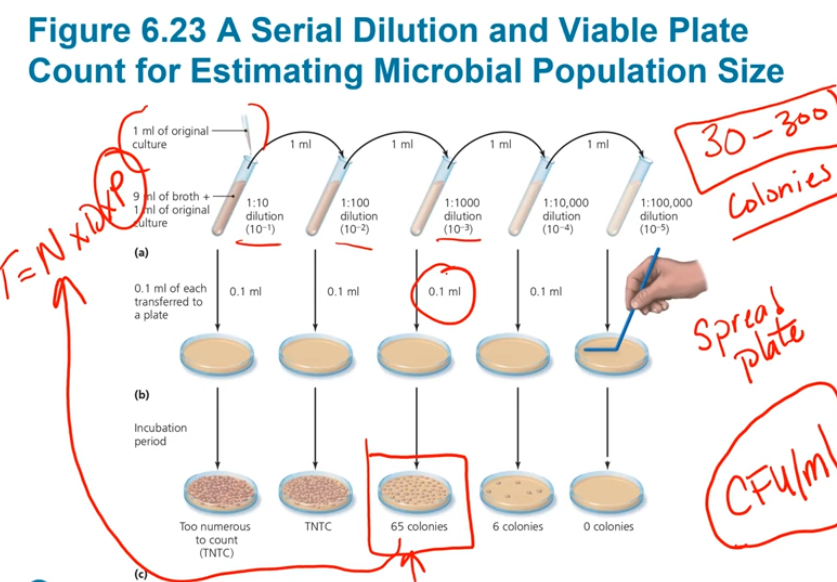
Serial dilution and viable plate counts ← titer
Membrane filtration
Most probably number
Serial dilution & viable plate counts
Indirect methods microbial growth
Turbidity
Often more turbid a culture, greater the bacterial population