Honors Biology Chapter 4 Gallo
 Call Kai
 Learn
Learn Practice Test
 Spaced Repetition
 Match
Match Flashcards
 Knowt Play
1/111

There's no tags or description
Looks like no tags are added yet.
Name | Mastery | Learn | Test | Matching | Spaced | Call with Kai | Chat |
|---|
No analytics yet
Send a link to your students to track their progress
112 Terms
Cells are the....
simplest unit of living things
Atoms are the....
simplest unit of matter
Are organelles alive?
no
Are cells alive?
yes
Microscopes make it possible to have a....
clear view of cells and cellular structure
How does a light microscope work?
Passes a beam of light through a specimen which travels through the eyepiece lens, allowing the specimen to be observed.
How high can a light microscope magnify?
1000x
What can scientists look at using a light microscope?
microorganisms, animal and plant cells, and some of the structures within cells
How does an electron microscope work?
It passes electrons, rather than light through the specimen and can give much better resolution
How high can an electron microscope magnify?
100,000x
What will happen if you use an electron microscope on a living thing?
It will die because of the stream of electrons hitting it.
What are the two types of electron microscopes?
transmission electron microscope (TEM) and scanning electron microscope (SEM)
What does a transmission electron microscope do?
Studies the details of internal cell structure
What does a scanning electron microscope do?
Studies the outside of cell structures
What does cell theory state?
1. All living things are made up of cells
2. Cells are the smallest units of life and can perform all characteristics of living things.
3. All cells come from other, preexisting cells.
Cells need to be large enough to store _______________, but small enough to have a surface to volume ratio that will allow _____________.
DNA, proteins, and structures needed to survive and reproduce; adequate exchange with the environment.
What does the plasma membrane or cell membrane do?
It forms a flexible boundary between the living cell and its surroundings.
The membrane is formed by a two layer sheet made of ________ and called the ___________.
phospholipids, the phospholipid bilayer

In the phospholipid bilayer, which part faces outward and which part faces inward?
The hydrophilic head faces outward, and the hydrophobic tail faces inward where it is shielded from water
Membrane proteins are either _______________ or __________________.
attached to the membrane surface, embedded in the phospholipid bilayer

What are protein channels?
Proteins that are embedded in the phospholipid bilayer that help things pass through the membrane

What do proteins that serve as pumps in the cell do?
Use energy to actively transport molecules in and out of cells
Most things that enter or leave a cell go through a __________, though some things are _______ enough to slip through the membrane.
protein channel, small
What are prokaryotic cells?
Cells structurally simpler than a eukaryotic cell, and don't have any true organelles and have a nucleoid.
examples of prokaryotic cells
Bacteria and Archaea
What are eukaryotic cells?
Cells structurally more complex than a prokaryotic cell, with a membrane-bound nucleus and many organelles.
What do both eukaryotic and prokaryotic cells have?
A plasma membrane and one or more chromosomes and ribosomes
Where is the DNA in a prokaryotic cell?
Coiled in a region called the nucleoid, not surrounded by a membrane
The surface of a prokaryotic cell may:
-be surrounded by a chemically complex cell wall
-have a capsule surrounding the cell wall
-have short projections called fimbriae or pili that help attach to other cells or the substrate
-have longer projections called flagella that may help propel the cell through its liquid environment
What are fimbriae and pili?
short projections on the outside of the cell wall that anchor and bind the cell to objects in the outer environment
What parts of a eukaryotic cell are involved the genetic control of the cell?
The nucleus and ribosomes
What parts of a eukaryotic cell are involved in the manufacture, distribution, and breakdown of molecules?
Endoplasmic reticulum(smooth and rough ER), Golgi apparatus, lysosomes, vacuoles, and peroxisomes
What part of animal cells is involved in energy processing?
Mitochondria
What part of plant cells is involved in energy processing?
Chloroplasts
What parts of Eukaryotic cells are involved in structural support, movement, and communication between cells?
Cytoskeleton, plasma membrane, and cell wall
The _____________ of eukaryotic cells partition it into compartments.
inner membrane
What occurs within organelles?
Cellular metabolism and the many chemical activities of cells
What organelles are found in animal cells but not plant cells?
Lysosomes and centrioles
What organelles are found in plant cells but not animal cells?
A rigid cell wall, chloroplasts and a central vacuole.

Plant Cell

Animal cell
What does the nucleus do?
It contains most of the cells DNA and controls cells activities by directing protein synthesis by making messenger RNA.
The DNA associated with many proteins in structures is called ______________.
chromosomes
What is the nuclear envelope?
A double membrane with pores that allow the flow of materials in and out of the nucleus.
What is the nuclear envelope attached to?
A network of cellular membranes called the endoplasmic reticulum(ER).
Does DNA leave the nucleus?
No
What is the nucleolus?
A spherical structure inside the nucleus that makes ribosomes(rRNA)
Ribosomes are made from ____________.
rRNA made in the nucleolus
What do ribosomes do?
They read mRNA and synthesize(make) proteins for use inside and outside of a cell.
Ribosomes can be _________ or __________.
free, bound
What are free ribosomes and what do they make?
Ribosomes floating in the cytoplasm that make proteins for use within the cell
What are bound ribosomes and what do they make?
Ribosomes attached to the endoplasmic reticulum(ER) that make proteins that are packed in certain organelles and exported from the cell
What is a vesicle?
A small membrane-bound sac that transports substances within a cell.
What is the endomembrane system?
a group of membranes and organelles in eukaryotic cells that work together to modify, package, and transport molecules
The endomembrane system includes...
Golgi apparatus,
lysosomes,
vacuoles,
the endoplasmic reticulum,
the nuclear envelope,
and the plasma membrane

Although physically _____________, rough and smooth ER differ in ____________ and ____________.
interconnected, structure, function
What is the rough ER?
It has ribosomes and lines the outer surface of membranes.
What is the smooth ER?
It extends from the rough ER to form a network of membrane tubules. Unlike rough ER, smooth ER does not have ribosomes on the outer surfaces of its membrane.
What do the enzymes made by smooth ER do?
They help synthesize lipids, oils, phospholipids, and steroids. They also help process drugs, alcohol and other potentially harmful substances.
Some smooth ER helps store ______________.
calcium ions, which are important for muscle contraction
What does rough ER make?
additional membrane for itself and proteins destined for secretions(to be released from the cell)

Golgi apparatus serves as a....
molecular warehouse and finishing factory for products manufactured by the ER
How do products travel from the ER to the Golgi apparatus?
in transport vesicles
What do the two sides of the Golgi apparatus do?
One receives products and the other ships them out

Products are ____________ as they go from one side of the Golgi apparatus to the other and travel in vesicles to other sites.
modified
What is a lysosome?
membranous sac that contains digestive enzymes
Lysosomes are only found in ___________.
animal cells
The parts of a lysosome are produced and transferred by the ___________ and processed by the ______________.
ER, Golgi apparatus
How do lysosomes digest food particles?
A food vacuole binds with a lysosome, and the enzymes in the lysosome digest the food, releasing nutrients into the cell.
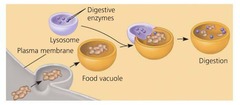
Lysosomes help _______________ or ________________ damaged parts of a cell.
remove, recycle
How do lysosomes help remove or recycle damaged parts of a cell?
The damaged organelle is first enclosed in a membrane vesicle. Then the lysosome fuses with the vesicle, dismantles its contents and breaks down the damaged organelle.

What are vacuoles?
Large vesicles with a large variety of functions
In plants, vacuoles may...
have digestive functions, contain pigments, or contain poisons that protect the plant

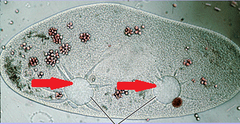
Some protists have ___________ that help eliminate water from the protist.
contractile vacuoles
What is the mitochondria?
organelles that carry out cellular respiration in nearly all eukaryotic cells
What does cellular respiration do?
it converts chemical energy in foods to chemical energy in ATP(adenosine triphosphate)
Mitochondria have ______ internal compartments(_______ membranes)
two

What is the intermembrane space?
The narrow region between the inner and outer membranes

What is the mitochondrial matrix and what does it contain?
The space inside the inner membrane of a mitochondrion, contains the mitochondrial DNA, ribosomes, and many enzymes that catalyze some of the reactions of cellular respiration

What are chloroplasts?
the photosynthesizing organelles of all photosynthesizing eukaryotes
What is photosynthesis?
Conversion of light energy from the sun into chemical energy.
Chloroplasts are partitioned into ____________ and have _______ membrane(s).
compartments, two
What are thylakoids?
saclike photosynthetic membranes found in chloroplasts
What is the stroma?
a thick fluid found in chloroplasts
What is a granum?
A stack of thylakoids in a chloroplast
What is in the inner membrane of a chloroplast?
-Stroma that contains the chloroplast DNA, ribosomes, and many enzymes
-Thylakoids, which are sometimes stacked and then called granums

Both mitochondria and chloroplasts have _________ and ____________, which are structured very similarly to the versions found in __________.
ribosomes, DNA, prokaryotic cells
What is the endosymbiont theory?
The endosymbiont theory suggests that mitochondria and chloroplasts were formally small, free-living prokaryotes that were engulfed by ancestral larger, eukaryotic cells.

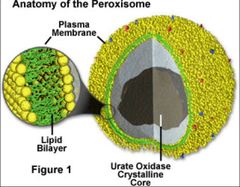
What are peroxisomes?
Organelles that look similar to lysosomes and break down waste into hydrogen peroxide and then into water and oxygen.
What is the cytoskeleton and what does it do?
A network of protein fibers that function in structural support and cell motility.
Scientists believe that ___________ and ____________ result when the cytoskeleton interacts with proteins called motor proteins.
motility, cellular regulation
What kinds of fibers is the cytoskeleton composed of?
Microfilaments(actin filaments), intermediate filaments, and microtubules

What are microfilaments and what do they do?
Threadlike structures made up of a protein called actin that support the cell's shape and are involved in motility

What are intermediate filaments and what do they do?
Filaments that reinforce cell shape and anchor organelles

What are microtubules and what do they do?
They are long hollow tubes that give the rigidity and act as "tracks" for organelle movement

While some protists have flagella and cilia that are important in _______________, some cells of multicellular organisms have them for ______________.
locomotion, different reasons
An example of a cell with a flagella
animal sperm
An example of a cell with cilia
Cells that sweep mucus out of lungs

The flagellum is _______________ than cilia, and propels a cell by a _______________, _______________ motion, whereas cilia work more like the _______________.
longer; undulating,whiplike; oars of a boat
What are flagella and cilia's common structure and mechanism?
movement