Lectures 9-10: Food Preservation
 Call Kai
 Learn
Learn Practice Test
 Spaced Repetition
 Match
Match Flashcards
 Knowt Play
1/23

There's no tags or description
Looks like no tags are added yet.
Name | Mastery | Learn | Test | Matching | Spaced | Call with Kai | Chat |
|---|
No analytics yet
Send a link to your students to track their progress
24 Terms
Remember: What are Koch’s Postulates? (G)
The microorganism must be found in diseased but not healthy individuals;
The microorganism must be cultured from the diseased individual;
Inoculation of a healthy individual with the cultured microorganism must recapitulated the disease;
The microorganism must be re-isolated from the inoculated, diseased individual and matched to the original microorganism.
How do Koch's postulates relate to food preservation and mass food production?
Koch's postulates established that specific microorganisms can cause specific diseases.
Food contaminated with pathogenic microorganisms can therefore cause foodborne illness.
Modern mass production and widespread distribution mean one contaminated batch can expose many people.
Therefore, food production requires microbial control and preservation methods to prevent microbial growth/survival and reduce foodborne disease.
Key connection: Microbes → disease → contaminated food → foodborne illness → need for preservation/control.
Food Microbiology and Mass Production (Past vs Future) (G)
Past:
Food grown or hunted (some primary processing)
Home preparation
If one batch became contaminated, the number of people exposed might be relatively small.
Today:
Mass production → central processing → central storage → widespread distribution → advance preparation → thousands/millions of consumers
If one huge batch of food becomes contaminated with a disease-causing microorganism. That one contaminated batch could be distributed across an entire province, country, or even internationally.
Leads to less incidents but many more infections.
Fewer separate contamination events… but a single event can affect far more people

What are the goals associated with food preservation? (G)
Safety - eliminate food hazards
Extended shelf-life - limit spoilage
Quality - nutritional and aesthetics
Availability and Variety
Convenience
Favorable economics- minimizing losses and waste
What are some Causes of Deterioration within food preservation? (G)
Pests
Insect, rodents
Microorganisms
Bacteria, yeasts, mold, viruses, parasites
Chemical and biochemical reactions
Oxidation, enzymatic activity
Physical factors
Light, temperature, moisture, damage by force
Time !
What is Preservation intended to delay? (G)
Decrease the rate of microbial growth (e.g., refrigeration)
Stop microbial growth (e.g., freezing)
Destroy or inactivate microorganisms (e.g., heating)
Restrict access of microorganisms to the food (e.g., packaging

How can microorganisms preserve food through fermentation? (G)
Bacteria or yeasts ferment sugars to produce products such as lactic acid, CO₂, and ethanol.
Fermentation preserves food because the acids, ethanol, and other products made by microorganisms create conditions that inhibit the growth of spoilage and harmful microbes.
Fermentation can:
Increase shelf life
Enhance food safety
Improve quality and flavour
Examples include cheese and sauerkraut.
Key idea: Microbial growth can be beneficial when controlled and intentionally used for food preservation.

What bacteria are used to produce yoghurt, and why is growth temperature important? (G)
Starter culture contains:
Lactobacillus delbrueckii subsp. bulgaricus
Streptococcus thermophilus
~43.3°C provides a balance that allows both species to grow.
Above 43.3°C: Lactobacillus predominates → yoghurt becomes too acidic.
Below 43.3°C: Streptococcus predominates → produces too strong a flavour.
Therefore, temperature controls the balance, acidity, and flavour of yoghurt.
How do Lactobacillus and Streptococcus work together during yoghurt fermentation? (G)
Fermentation is the process where microorganisms such as bacteria or yeast break down sugars, producing compounds like lactic acid, CO₂, or ethanol.
Lactose → glucose + galactose, which are metabolized during fermentation.
Both bacteria contribute to lactic acid production → lowers pH and helps create yoghurt's acidity and texture.
The species stimulate each other's growth:
Streptococcus produces compounds such as CO₂/formate that stimulate Lactobacillus.
Lactobacillus provides compounds such as amino acids that stimulate Streptococcus.
Metabolism also produces flavour compounds such as acetaldehyde and diacetyl.
Key idea: The two bacteria have a cooperative/symbiotic relationship that produces the desired acidity, texture, and flavour of yoghurt

How are organic acids used in food preservation? (G)
Major examples: lactic, acetic, and propionic acids
Provide flavour and increase shelf life
Inhibit a wide range of microorganisms, including bacteria, yeasts, and molds
Around 1–2% organic acids can help prevent spoilage

How does lactic acid concentration affect bacteria? (G)
~1% lactic acid = bacteriostatic → inhibits/limits bacterial growth
>2% lactic acid = bactericidal → kills bacteria
Bacteriostatic = stops growth; bactericidal = kills.
Reminder: pKa and pH
pKa = the pH at which an acid is 50% dissociated and 50% undissociated.
For a carboxylic acid:
COOH ⇌ COO⁻ + H⁺
pH < pKa → mostly COOH (protonated/undissociated)
pH = pKa → 50% COOH / 50% COO⁻
pH > pKa → mostly COO⁻ (deprotonated/dissociated)
So you can think of the pKa as the midpoint of the acid's dissociation, rather than a specific pH where it suddenly starts dissociating.
For your yoghurt example, lactic acid has pKa ≈ 3.8. At pH 4 it's already slightly more dissociated than undissociated; once the undissociated molecules enter the microbe at pH 6, they become overwhelmingly dissociated, releasing H⁺ inside the cell.
How do organic acids inhibit or kill microorganisms? (G)
pKa of lactic acid 3.8, propionic acid 4.9 and acetic acid 4.8
Vast majority of foods have a pH greater than 5
Undissociated organic acid (HA) crosses the microbial membrane.
Higher intracellular pH causes acid to dissociate → H⁺ + A⁻.
H⁺ lowers intracellular pH.
This disrupts proteins/enzymes and proton gradients → inhibits growth or kills the microbe.
Key idea: The undissociated form gets the acid inside the cell.

Spoilage
Reduced shelf life, lost revenue, and sanitation.
Production of exoenzymes degrades proteins, carbohydrates, fats, resulting in odours, off-flavours, colour degradation, colony formation, etc

What is foodborne illness and what are the three major types of food hazards?
Foodborne illness = any illness resulting from eating contaminated food.
Biological hazards: bacteria (Listeria, Salmonella), parasites, viruses, toxins
Chemical hazards: cleaners/sanitizers, lubricants, antibiotics, hormones
Physical hazards: glass, woodchips, plastic, metal

What are the four phases of bacterial growth? (G)
Lag phase: Cells adapt to their environment; little/no increase in cell number.
Log (exponential) phase: Rapid division by binary fission → population increases exponentially.
Stationary phase: Growth levels off because nutrients/space become limited and inhibitory waste products accumulate.
Death (decline) phase: Cells die faster than new cells are produced.
Note: Some bacteria form highly resistant spores to survive adverse conditions.

What intrinsic properties of food affect microbial growth? (G)
Biological structures: Natural barriers (e.g., fruit skin) prevent microbial entry.
Nutrient content: Organism specific – they all need energy, C, N,
certain vitamins, mineralspH & organic acids: pH 7, neutral – low, medium, high acid foods
and tolerances, acid production. Acidity can inhibit microbial growthWater activity (aᵥ): Amount of available water for microbial growth.
Antimicrobial constituents: Naturally occurring substances that inhibit microbes.
Key idea: Intrinsic = properties inherent to the food itself.
Why is Clostridium botulinum important in food preservation? (GGG)
C. botulinum is an anaerobic, spore-forming bacterium that can produce a potentially fatal toxin.
It can grow in low-acid foods (pH > 4.6) → these require pressure canning/high-temperature processing.
High-acid foods (pH < 4.6) prevent its growth, so less intense heat processing can be used.
Key cutoff: pH 4.6

What is water activity (aᵥ), and how does it affect microbial growth? (G)
Water activity (aᵥ) = amount of free/available water microorganisms can use.
aᵥ = 1.0: lots of available water → supports microbial growth
↓ aᵥ = ↓ microbial growth
~0.9: most bacteria stop growing
~0.8: most bacteria & yeasts stop growing
~0.7: most bacteria, yeasts & molds stop growing
Some specialized microbes can tolerate lower aᵥ (e.g., halophiles, xerophilic molds, osmophilic yeasts).
Lowering aᵥ immobilizes/binds water so microorganisms cannot use it for growth.
Key idea: It is water availability, not simply total water content, that matters.

What extrinsic factors affect microbial growth in foods? (G)
Extrinsic factors = conditions of the environment surrounding the food:
Storage temperature
Relative humidity
Presence/concentration of gases (aerobic vs. anaerobic)
Temperature groups - destroyed by heat - varies by species, can survive but not
grow at cold temperatures
Psychrotrophs: optimum ~20–30°C; can reproduce at ≤7°C
Mesophiles: optimum ~30–37°C
Thermophiles: optimum ~50–80°C
Generally, microbial growth increases with temperature until the organism's optimum is reached.
Intrinsic = properties of the food; extrinsic = properties of its environment.

What is the difference between an obligate aerobe and a facultative anaerobe? (G)
Obligate aerobe: Requires O₂ for growth and uses aerobic respiration.
Can tolerate a level of oxygen equivalent to or higher than that present in an air atmosphere (21% oxygen), and has a strictly respiratory type of metabolism
Facultative anaerobe: Can grow with or without O₂.
An organism that can grow well both in the absence of oxygen and in the presence of a level of oxygen equivalent to that in an air atmosphere (21% oxygen)
What is the difference between a microaerophile and an obligate anaerobe? (G)
Microaerophile: Requires O₂, but at lower levels than atmospheric O₂ (21%).
An organism that is capable of oxygen-dependent growth but cannot grow in the presence of a level of oxygen equivalent to that present in an air atmosphere (21% oxygen)
Obligate anaerobe: Does not use O₂ and cannot grow at normal atmospheric O₂ levels.
An organism that is incapable of oxygen-dependent growth and cannot grow in the presence of an oxygen concentration equivalent to that present in an air atmosphere (21% oxygen)
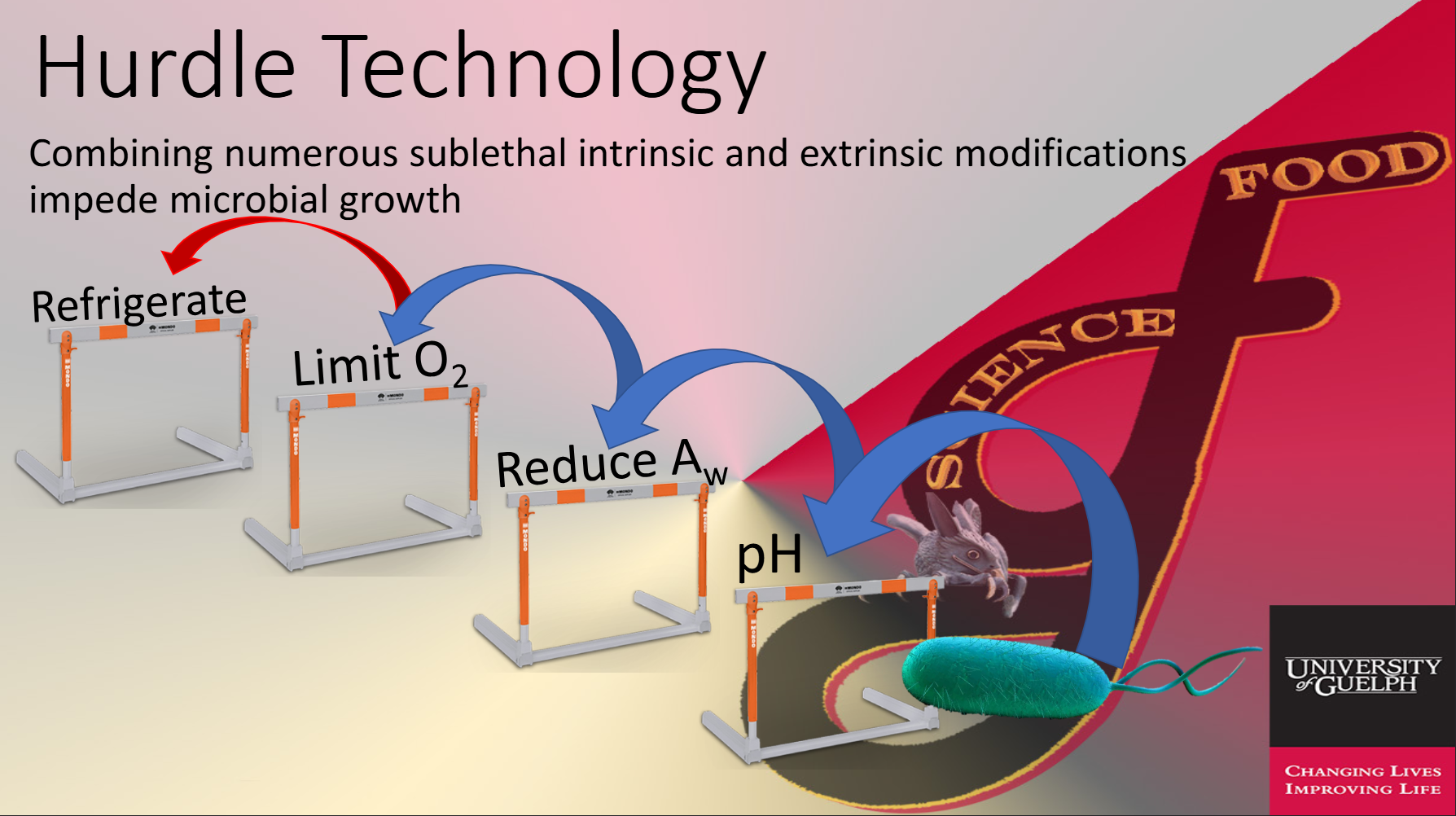
What is hurdle technology in food preservation, and how does it inhibit microbial growth? (G)
Hurdle technology combines multiple sublethal intrinsic and extrinsic factors that work together to prevent or slow microbial growth.
Examples of “hurdles” include:
Refrigeration → slows microbial metabolism and growth
Limiting O₂ → inhibits microbes that require oxygen
Reducing water activity (aᵥ) → reduces water available for microbial growth
Lowering pH → creates an acidic environment that inhibits many microbes
Key idea: Each hurdle alone may not stop microbes, but combining several hurdles makes the food environment much harder for microbes to survive and grow in.
What is a foodborne infection and how does it cause illness? (G)
A foodborne infection occurs when living pathogenic bacteria are consumed and colonize the intestinal tract.
Bacteria colonize and damage intestinal epithelial cells
Damaged epithelial cells cannot properly absorb solutes
This causes water to move into the intestine by osmosis → diarrhea
Damage to the intestinal lining can also cause vomiting
Gram-negative bacteria contain LPS (lipopolysaccharide), which can cause a pyrogenic effect → fever
Examples: Salmonella, Yersinia, Shigella
Onset: ~12 hours–2 days, depending partly on the number of bacteria ingested
Key sequence:
Eat living bacteria → intestinal colonization → epithelial damage → ↓ solute absorption → water enters intestine → diarrhea/vomiting
