3.1.2 Amount of Substance
 Call Kai
 Learn
 Practice Test
 Spaced Repetition
 Match
 Flashcards
 Knowt Play
1/25

There's no tags or description
Looks like no tags are added yet.
26 Terms
Define what is meant by the follwoing:
relative atomic mass
relative molecular mass
relative atomic mass - the average mass of an atom of an element relative to 1/12 the mass of an atom of carbon-12
relative molecular mass - the average mass of a molecule relative to 1/12 the mass of an atom of carbon-12
Explain what Avogadro’s constant shows us about the mole
the mole is the amount of substance in grams that has the same number of particles as there are atoms in 12g of carbon 12
Write the equation to work out the number of entities
No of particles = moles of substance (in mol) X Avogadro's constant
State how to work out moles given mass and Ar or Mr
moles = mass moles = mass
Ar Mr
State how would you work out moles given concentration and volume include units
moles = concentration ( mol dm-3 ) x volume (dm3)
State how would you convert the following
from cm3 to dm3
from mg to g
from kg to tonne
from g to kg
from oC to kelvin
cm3 —→ dm3 = divide by 1000
mg —→ g = divide by 1000
kg —→ tonne = divide by 1000
g —→ kg = divide by 1000
oC —→ kelvine = add 273
What is the number of moles in 75.0mg of CaSO4 .2H2O?
75mg —→ 0.075g
moles = mass / mr
Mr = 40 + 32 + 64 + (2 × 18) = 172
moles = 0.075 / 172 = 0.000436 mol
= 4.36 × 10⁻⁴ mol
Calculate the number of atoms of tin in a 6.00 g sample of tin metal.

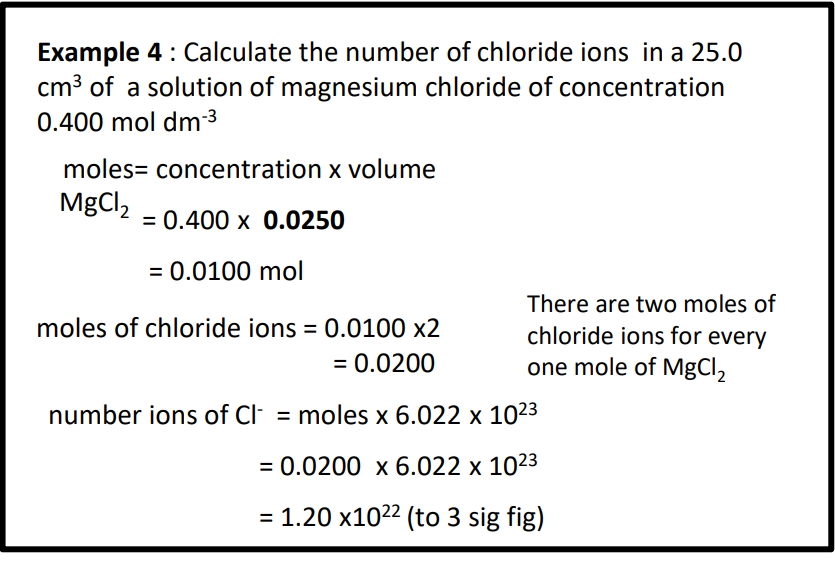
Calculate the number of chloride ions in a 25.0 cm3 of a solution of magnesium chloride of concentration 0.400 mol dm-3
Write down the ideal gas equation include units
PV = nRT
P = pressure - Pa
V = volume - m3
n = moles - mol
R = 8.31
T = temperature - K (kelvin)
Write down the equation that links:
Volume 1
Volume 2
Pressure 1
Pressure 2
Temperature 1
Temperature 2

Write down the equation that links:
Volume 1
Volume 2
Pressure 1
Pressure 2
Temperature 1
Temperature 2

A gas has an initial volume of 300m3 at standard atmospheric pressure (100kPa). Calculate the final volume of this gas if it’s pressure is increased by 400kPa at a constant temperature.
boyle’s law: P1 x V1 = P2 x V2
100kPa x 300 m3 = 500kPa x V2
V2 = 300,000 / 500 = 60 m3
Calculate the mass of Cl2 gas that has a pressure of 100 kPa, temperature 20 oC , volume 500 cm3 . (R = 8.31)

Write the equation to work out density
density ( g cm3 ) = mass (g)
volume (cm3)
Calculate the number of molecules of ethanol in a 0.500 dm3 of ethanol (CH3CH2OH) liquid. The density of ethanol is 0.789 g cm-3

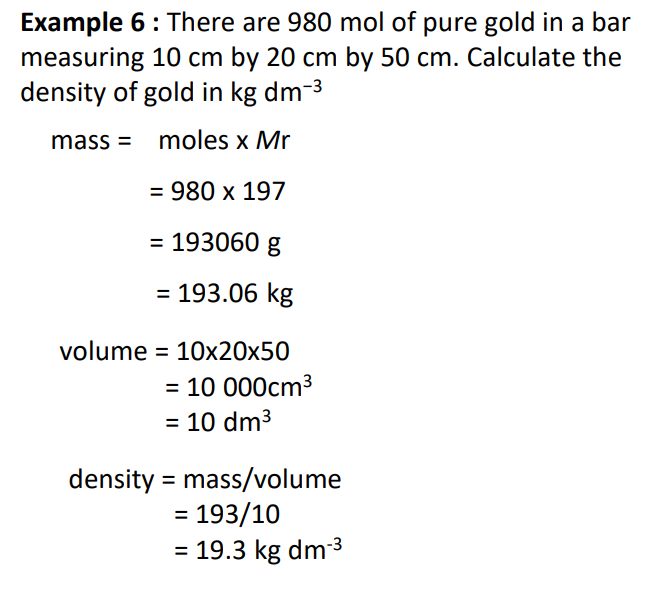
There are 980 mol of pure gold in a bar measuring 10 cm by 20 cm by 50 cm. Calculate the density of gold in kg dm-3
Define the following terms
emperical formula
molecula formula
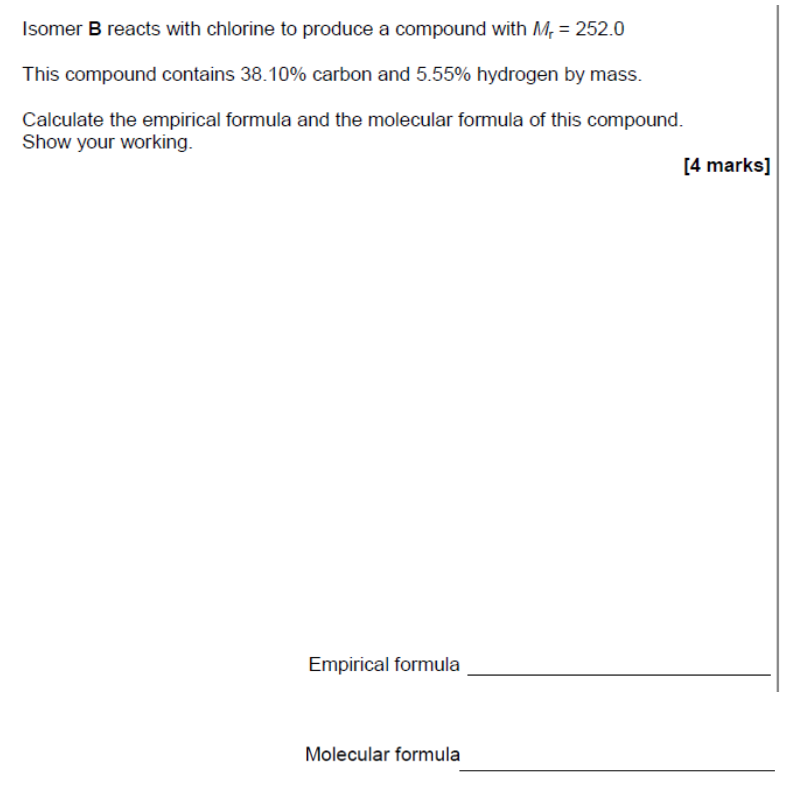
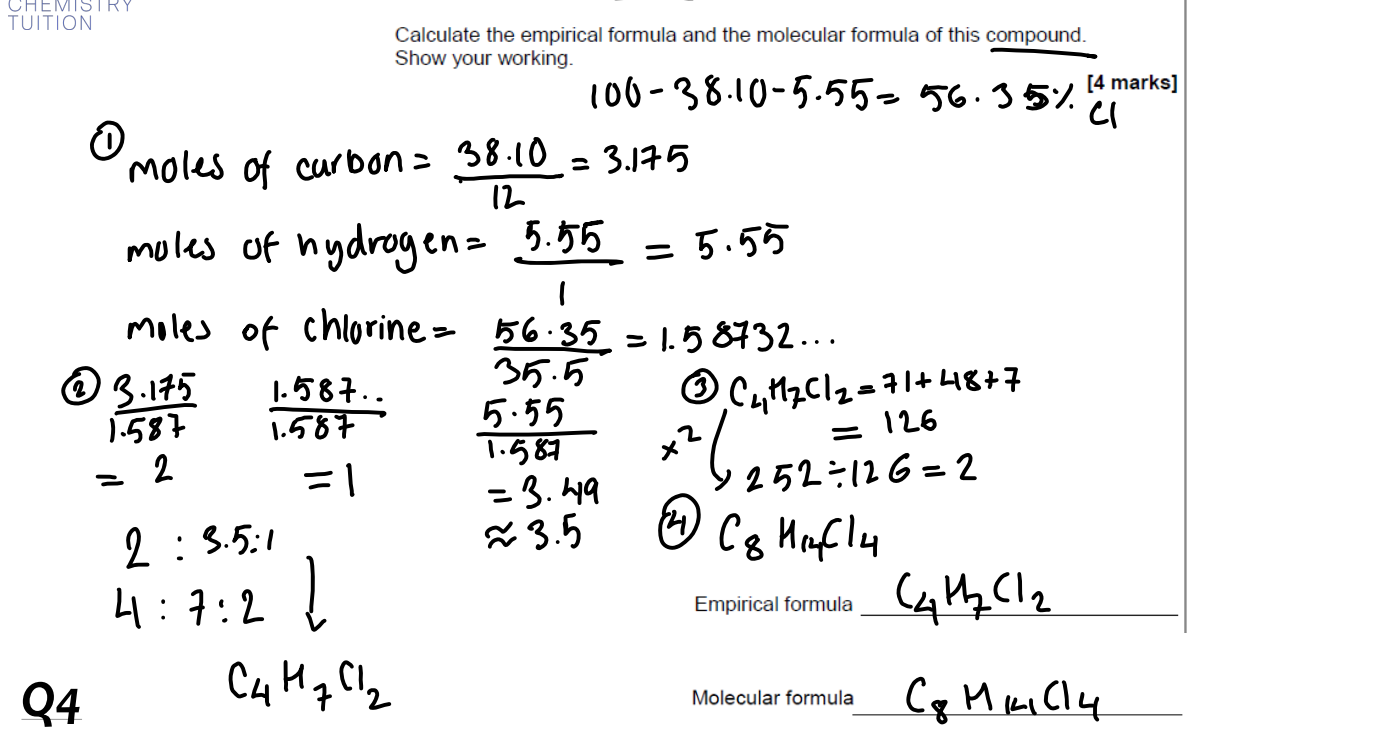
emperical formula - the simplest whole number ratio of atoms of each element in a compound
molecular formula - the actual number of atoms of each element in a compound
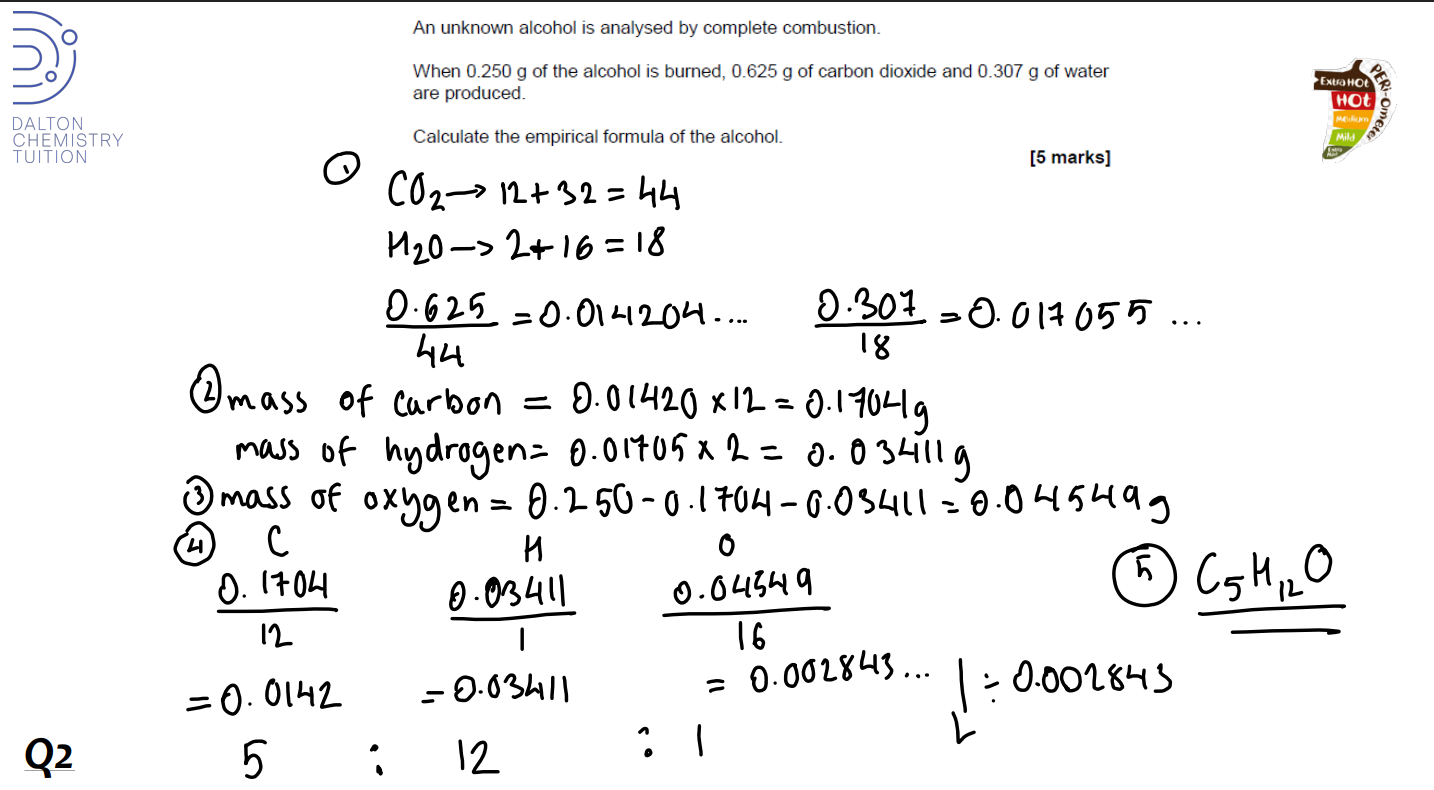
A compound contains 0.34g of carbon, 0.057g of hydrogen and 0.46g of oxygen.
Find the empirical formula and hence the molecular formula
(Mr = 180)




What is meant by water of crystallisation?
Water of crystallisation is when some compounds can form crystals which have water as part of their structure
A compound that contains water of crystallisation is called a hydrated compound
a compound that does not contain water is called an anyhydrous compound
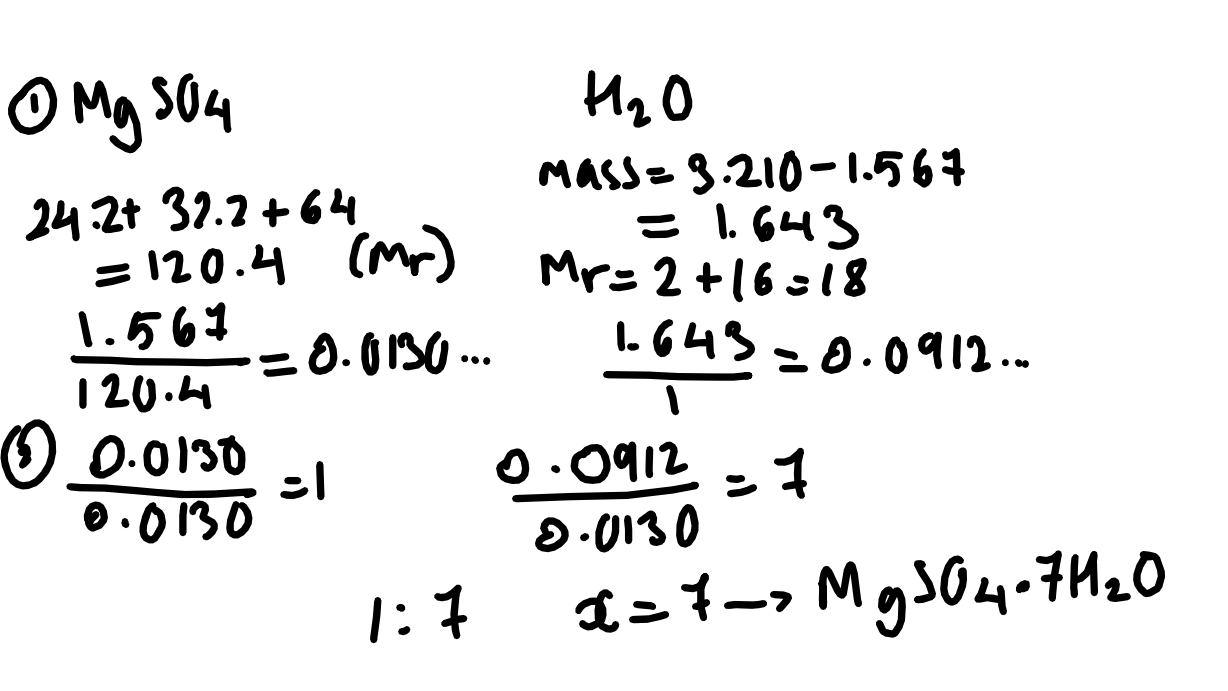
3.120g of hydrated magnesium sulfate MgSO4 .xH2O was heated to make 1.567g of anyhydrous magnesium sulfate. Find the vlue of x and hence give the formula of the hydrated salt.


0.58g of compound X containing only carbon, hydrogen and oxygen, gave 1.32g of carbon dioxide and 0.54g of water on complete combustion in oxygen.
What is it’s empirical formula?
What is it’s molecular formula if it’s relative molecular mass is 58.0?