Biostatistics Step 1
 Call Kai
 Learn
 Practice Test
 Spaced Repetition
 Match
 Flashcards
 Knowt Play
1/44

There's no tags or description
Looks like no tags are added yet.
45 Terms
A highly effect vaccine was created. What do you predict the incidence and prevalence would increase or decrease?
Both will decrease. An effective vaccine decreases both incidence (the number of new cases) and prevalence (the total number of existing cases) by stopping infections at the individual and population levels. An effective vaccine decreases the prevalence of a disease by blocking new infections and building because people are not susceptible.
Incidence measures the number of new cases of a disease
Prevalence measures the total number of existing cases (both new and pre-existing) in a population at a given point in time or over a defined period
What is the number of new cases called?
Incidence
What is the it called when you measure the current number of existing cases of a disease?
Prevalence

What is the equation for incidence?

How does survival rate affect Prevalence?
Increase
Survival time affects disease prevalence because it determines how long an individual remains in the diseased population after being diagnosed
When patients live longer with a chronic or life-threatening disease (due to better management, chronic stabilization, or effective care), they stay in the "pool" of existing cases for a greater length of time. This causes overall prevalence to rise, even if the rate of new diagnoses (incidence) stays completely flat or drops
How does increased diagnostic sensitivity affect prevalence and incidence?
It increases both because When sensitivity improves, people are diagnosed earlier in the disease course. This shifts when the "new case" is officially recorded, temporarily spiking measured incidence during the rollout of the new test (often called lead-time bias).

A study on cervical cancer recruits patients from a major hospital statewide, but picks the control group by going door-to-door near the hospital only during weekday working hours. Which bias is this?
Selection bias happens when the individuals or data points chosen for a study do not properly represent the target population.
Patients are enrolled on basis of ease of contact is what
Convenience sampling

People are asked to write down how many fruits and vegetables they ate last month; individuals often overestimate healthy habits or underestimate junk food consumption based on what sounds good or how they feel today. Which bias is this?
Recall bias refers to systematic difference in the ability of participant groups to accurately recall information

Participants change behavior is associated with which bias?
Measurement bias

Subjects in different groups are not treated the same is an example of which bias?
Procedure bias

Screening test detects diseases with long latency period, while those with shorter latency period become symptomatic earlier is an example of which bias?
Length time bias

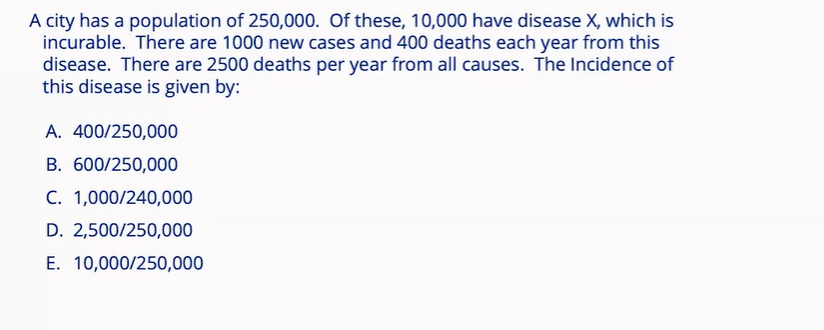


What is the rate for crude mortality rate?

What is the cause specific mortality rate?

What is the propionate mortality rate?

WHat is the equation for Attack rate?


What is the difference between point prevalence and period prevalence?
Point Prevalence
Definition: The proportion of a population that has a disease or condition at a single, specific point in time (such as a specific date or moment).
Numerator: Number of current cases (both new and pre-existing) alive and ill at that exact moment.
Denominator: Total population at risk at that exact same point in time.
Analogy: A "snapshot" of the population or the number of cars currently driving on a highway at a given second.
Best used for: Quick, real-time assessments during an acute outbreak or when a single-day measurement is needed.
Period Prevalence
Definition: The proportion of a population that has a disease or condition at any time during a specified interval (such as over the past 12 months, a year, or several years).
Numerator: All existing cases at the start of the period plus any new cases that develop at any point during that time. (If a person recovers and gets sick again within that period, they are generally counted only once).
Denominator: The average or mid-interval population during that timeframe.
Best used for: Chronic or long-term conditions (like asthma or diabetes) where a single day's snapshot might miss people who experience intermittent symptoms
what's the difference between endemic, pandemic and epidemic
Endemic
Definition: A disease or infectious agent that is constantly and consistently present at a baseline, predictable level within a specific geographic area or population group.
Epidemic
Definition: A sudden, unexpected increase in the number of disease cases above what is normally expected (the baseline) within a specific community, region, or country. (Note: A localized epidemic in a small area or single institution, like a school, is often called an outbreak).
Pandemic
Definition: An epidemic that has grown exponentially and spread across international borders, affecting multiple countries or continents.


What are the guidelines for a pap smear?

What age should a woman get a mammogram with no symptoms?
40-50
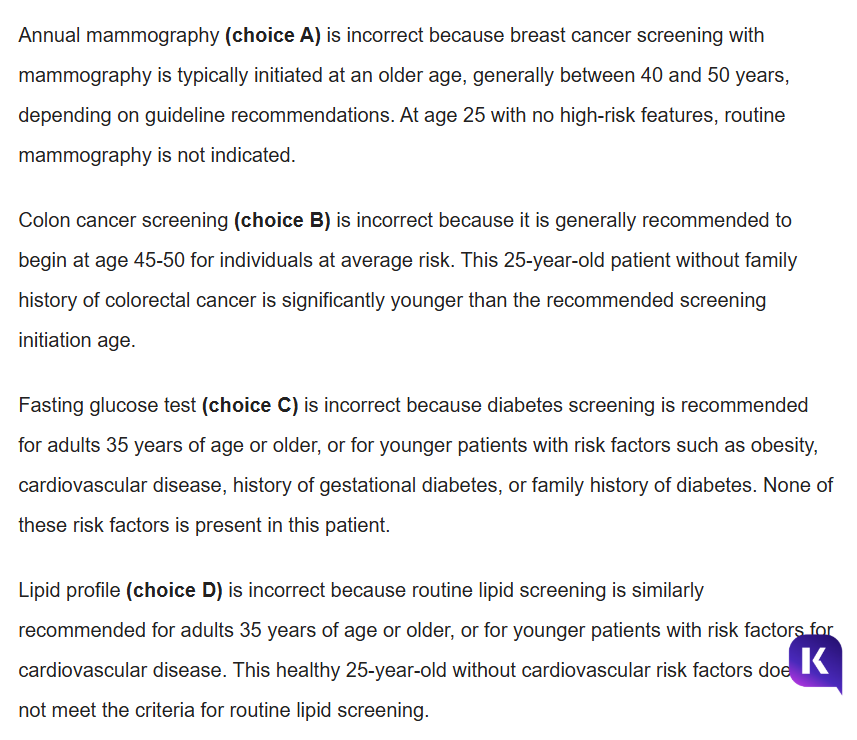
Which level of disease prevention is screen?
Secondary

Whats the difference between sensitivity and specificity?
Sensitivity is a test’s ability to correctly identify people who have the condition (true positives). It measures the proportion of positive results out of all truly positive samples.
Specificity is a test’s ability to correctly identify people who do not have the condition (true negatives). It measures the proportion of negative results out of all truly negative samples
WHats the equation for positive predictive value?

Whats the equation for negative predictive value?

What is the equation for sensitivity?

What is the equation for specificity?

A phenomenon in which the investigators' expectation influences the outcome of the study. The investigators' belief in the efficacy of treatment influenced data collection. To avoid this bias, study designs have to include placebo groups and investigators need to be blinded throughout the study.
The Pygmalion effect (observer-expectancy bias) is a phenomenon in which the investigators' expectation influences the outcome of the study.To avoid this bias, study designs have to include placebo groups and investigators need to be blinded throughout the study.
A screening test is the probability that a patient with a positive result actually has the disease,

What term is the probability that a patient with the disease will test positive?
Sensitivity
Specificity is the probability that a patient without the disease will test negative
The negative predictive value (NPV) is the probability that the patient does not have the disease when the test is negative
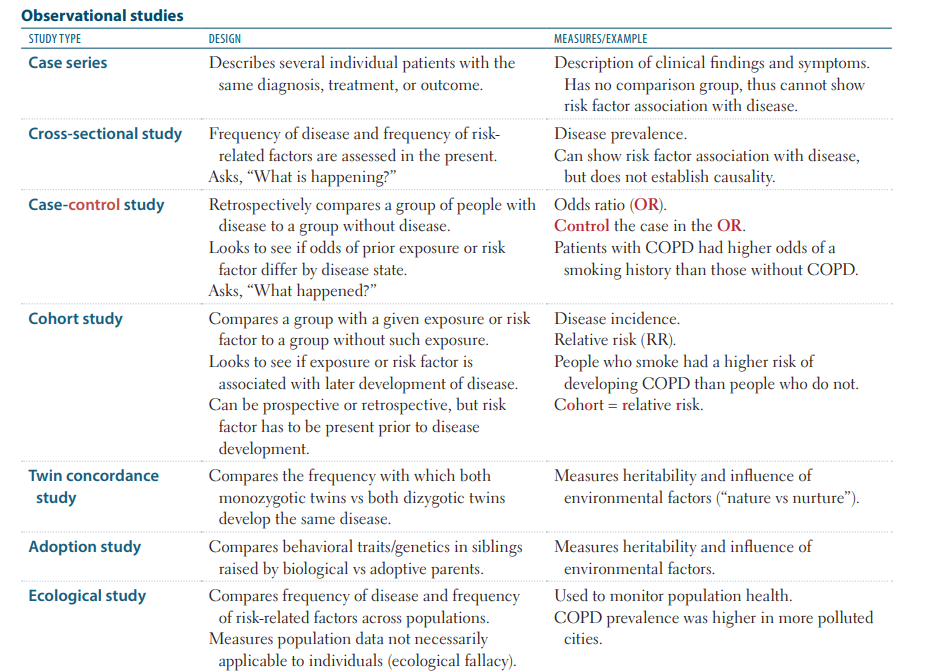
This studies Describes several individual patients with the same diagnosis, treatment, or outcome.
Case study
A case study is an in-depth, detailed examination of a specific real-world subject—such as a single person, a group, an organization, an event, or a community—within its natural setting.

What study: Frequency of disease and frequency of risk related factors are assessed in the present. Asks, “What is happening?”
Cross sectional study
A cross-sectional study is an observational research design in which an investigator measures both exposures (risk factors) and outcomes (health conditions or behaviors) in study participants at the exact same point in time

Compares a group with a given exposure or risk factor to a group without such exposure. Looks to see if exposure or risk factor is associated with later development of disease. Can be prospective or retrospective, but risk factor has to be present prior to disease development.
A cohort study is an observational research design where a group of people (the cohort) is followed over time to see how a specific exposure or risk factor relates to a health outcome.


What is Attributable risk percent?
The proportion of a disease that can be attributed to an exposure.


What is P Value?
Probability of obtaining test results at least as extreme as those observed in the sample, assuming that H0 is correct. Commonly accepted as 0.05 (< 5% of such repeated tests would show results that extreme just by chance alone).

What is the equation for attributable risk?


