Exam 2 - Encounters with the Arts of Global Africa
 Call Kai
 Learn
 Practice Test
 Spaced Repetition
 Match
 Flashcards
 Knowt Play
1/42

There's no tags or description
Looks like no tags are added yet.
43 Terms

Members of the British Punitive Expedition in the Benin Palace,1897.
Britain military forced themselves into Benin
Stole & looted sacred objects from the royal court
Needed to sell the items to cover cost of colonization efforts (to collectors & museums)
The founding of museums coincided with the colonization of Africa

Artist unknown, Equestrian Figure Benin 18 century.
Believed to represent the Yoruba prince who founded the 2nd dynasty (Prince Oranmiyan from Ife)
Even though he founded the dynasty, he never became a ruler/king, but his son did
He also introduced horses
Believed by some to be a northern figure
Has a headdress and regalia, the figure makes the horse look small (size hierarchy)

,
Artist unknown, Pendant Plaque, Benin, late 16th century.
Represents King Ewuare (great warrior king)
Sits in between 2 attendants or priests & has coral regalia, a pendant associated as being a healer, has a cloth wrapper, mask hanging off head that symbolizes royal ancestry, has 2 staffs
Has mudfish by feet (the marker of a king)
Has frogs and grasshoppers (symbol of transformation)
Influenced by medieval Yoruba art (lines on face)
Precise attention to detail
The head is disproportionately larger, its stylized

Artist unknown, Leopard Vessel, Benin, late 16 century
Used in parts of religious ceremonies
Made of copper
Associated with Ewuare
Leopards are signs of royal power, admired for strength, quickness, & beauty
Live leopards used to be in palace pre-colonization
Oranmiyan
The Yoruba warrior prince who founded Benin’s second dynasty
Oba
The name of rulers in Benin
Ewuare
A great warrior king of Benin

Artist unknown, Palace in the form of a box, Benin, 17'h - 18" century
Similar to Yoruba architecture
Turrets, representation of hornbill birds (cast in copper from live models), symbolized wellbeing & danger
Features a python in front, guards
2 men with rifles, Portuguese men ready for combat

Artist Unknown. Commemorative Head Benin, 19th Century
Chief
Can see regalia (coral chokers, headpiece
Made of wood
Meant to be an imitation of royal ancestral heads

Artist unknown. Royal Head from an Altar, Benin, c. 15'h century
Meant to convey physical and spiritual powers of king
Leans more to realism (proportional)
Made of grass
Neck has some coral regalia
Tiny cornrows (geometric)
Iris of eyes = iron (divine)
Scarification marks
Forehead has 2 iron bars

Artist unknown, A Head, Benin, late 16'h century
More grass used, bigger in size
A lot of coral regalia on neck, up to lip (more money and power)
New regalia introduced (crown)
More stylized, facial features are smushed
Long braids
Rosy cheeks

Artist unknown, Queen Mother Head, Benin, c. 1500-50
Made of grass
Both old and new style
Coral regalia
Beaded crown, has a pointed beak (chicken’s beak, hairstyle of high ranking women)

Artist Unknown, Ivory mask, Benin, c.1520
Created during rule of King Esigie
Represents his mother (instrumental in ending major civil war, would place on his hip (to honor her)
First “Great Mother”
Tight coils of hair
Portuguese heads & mudfish (pale skin color associated with death)

Artist Unknown, Warrior on a Pair of Brass Plaques, Benin, late 16'h Century.
Believed to be a very important military leader/chief
Leapord skin tunic, coral choker, collar/necklace with leapord claws, bell (icon of royal authority), cloth wrapper, headdress, spears & shields
Very tall, strong, intimidating warrior
Has a python & fish included
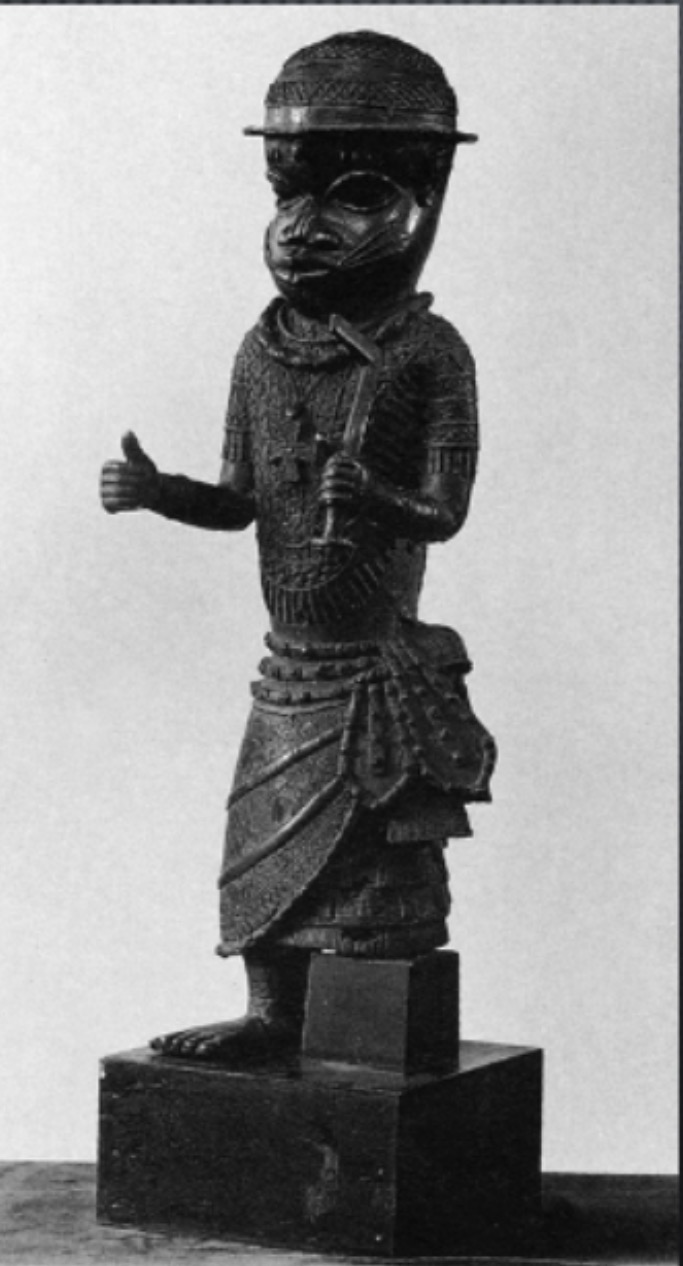
Artist unknown, Altar Figure Holding Axe, Benin, 17th -18th century.
Associated with King Esigie (placed on his alter)
A royal palace official wearing a cross (Benin symbol of the cosmos)
Holding an axe, a marker of their status
Wearing clothwrapper
One leg is shorter than the other
Very stylized

Artist unknown, Altarpiece Representing King Ewuakpe. Benin, 19' century.
Represents King Ewuakpe (important, he was very gentle & soft spoken, came into power during a civil war and then was taken over by the military)
Statue “redeems” him, looks strong & confident
Coral regalia, cloth wrapper (with cross), European style hat, crescent moon, ceremonial swords, portuguese head
Hold Ukhuche Staff & stone axe
Make and female attendants

Artist unknown, An Altar to the Hand, Benin, 18"h century.
Can fit in your hand, more mobile , often placed in private spaces of your home
Depicted are the descendants of King Ewuakpe
His son on top w/ leopards (one of the richest)
Grandson in the miedle

Artist unknown, Helmet Mask, Benin, 18" century.
Part of Yam Festival, masqueraders would wear this
Made entirely of grass
Worn to honor the royal dead
Different species of animals
Yoruba Earth Deity

Phyllis Galembo, Ekpo Masquerade, date unknown.
Ekpo Masquerade, enforced social norms
Ekpo: spirit
Not pleasing to the eye, meant to scare
Plant fibers & repurposed metal
Terrorized non members & woken and children
Esigie
Benin King associated with the altar figure holding an axe
Ewuakpe
The gentle and melancholic Benin King
Ukhurhe
A royal rattle staff
Ekpo Masquerade
A masquerade tradition that enforces social norms and gets people to conform to them

T.E. Bowdich, King's Sleeping Room in Palace, Akan, 1819
Straight street perfect for parades, ceremonies, etc.
Close to the palace
Businesswomen with children, female priestess, royal weaver
Materials used are moistended Earth woven with palm trees or cane
Royal courts had geometric motifs

The Queen Mother and Her Court, Akan, 19'th century
Queen mother = Asantehemaa
Matrilineal (identity through mother’s line) society
Important cultural & political figure, when the King was our the Queen would serve as the acting ruler
Young Queen in regalia, appears statuesque with feet not touching the ground
Court/entourage with some in European clothes (inevitable colonialization)

Nana Osei Bonsu, Mother and Child Sculpture, Akan, 1930s
Provided security & nourishment to child
Symbolizes the Queen as the “social mother” & the importance of matrilineage
These sculptures were a symbol of resistance to colonization
Osei Tutu
First ruler of the Asante kingdom
Akan
Predominant pre-colonial kingdom that was located in present-day Ghana. Also refers to the ethnic group.
Asante/Ashanti
Pre-colonial kingdom that was located in present-day Ghana. Asante is also the largest subgroup of the Akan ethnic group.
Kumasi
Capital city of the Asante kingdom
Asantehene
King of Asante
Asantehemaa
Queen (mother) of Asante

A Royal Stool, Akan, late 19th century
Made primarily with wood & metal
Royal members only allowed to sit on it
Under the seared portion is a central support (symbolizes the King) & 4 side supports (symbolized chiefs or directions)
Circular shapes (Sun)

Man Carrying Golden Stool, Akan, 1977
Gold represents the essence of the Sun
Golden Stool is the most important sacred object
Brought down from heaven from priest & became the symbol of all Asante people
Made almost entirely of gold
Not everyone can carry it & no one can sit on it

Goldweights, Akan, 18'h - 19" centuries
Important part of exchange or currency (gold nuggets or dust)
Part of weighting system to calculate the transaction
Adopted from North African Islamic traders (Arab imagery & pyramids)
Sun imagery

Kente Textile of the Type called Sika Futura (Gold Aweaneasa), Asante, 19th century
Made for a ruler (most likely the King) in the royal court
Made entirely of silk
The term Kente is connected to a the Akan legend of ananse spider (has split identity; wisdom & trickery)
Symbolic design of ananse spider web
Made by royal weaver
Actual pieces of gold used in a few threads
Most elaborate design reserved for King

Funerary Head, Akan, c. 19th century
Not everyone could get one created, only royal figures
Could be just head, bust, or full body
Portrait from memory, not meant to be realistic towards person (they are generic)

Akuba Figure, Akan, 19th-20"h century
Made in effort to reverse a woman’s ability to bear children
Named after Akuba, the woman who first requested one
Daughters are preferred
Color black reflects it to ancestry
Would be blessed by a priest
If the woman did become pregnant, she would give it to her kid or place it in a shrine
If unsuccessful, it served as a memorial

Atano Shrine, Asante
Pre-colonization shrines were in special buildings
Atano: the religion, gets name from Tano river
Brass pans on stools with Kente cloth, each pan holds sacred materials that make up the essence of the deity
12 akuba figures
Reflects what people are praying about in their everyday life’s
Adinkra
Text of the Asante/Akan royal court that is made primarily of cotton. It is named after the king of a defeated kingdom, and its stamped designs symbolize political themes
Akuaba Figure
A figure that is made in an effort to reverse a woman’s ability to bear children
Asafo
Military companies of the Akan state
Posuban
Shrines built for the Asafo companies