CHAPTER 12
 Call Kai
 Learn
 Practice Test
 Spaced Repetition
 Match
 Flashcards
 Knowt Play
1/20

Earn XP
Description and Tags
In progress (last updated Oct 20)
21 Terms
Mass Spectrometry (MS) Instrument
Gives:
exact molecular weight of compound
exact molecular weight of some fragments → provides structural information
Who built the first ever MS instrument? When?
JJ Thomson
1912
Who built the first fully functional MS instrument? Whenb?
Francis Aston (JJ Thomson’s student)
1919
3 Major Components of a Mass Spectrometer
(1) Ionization Source
Where sample molecules are injected
Ionization: An electrical charge is applied to sample molecules, producing ions (usually positive)
Ions may fragment
(2) Mass Analyzer
Separates ions according to their mass-to-charge ratio (m/z).
Middle part of instrument
(3) Detector
Detects and counts the separated ions
Number of ions detected determines the relative abundance of each peak in mass spectrum
Define “Ionizataion”
Process by which neutral molecules are converted into charged ions by applying energy.
Why are molecules ionized in mass spectrometry?
Molecules are ionized because only charged particles can be manipulated by the electric/magnetic fields of the mass spectrometer and separated according to their mass-to-charge ratio (m/z). Neutral species are not detected. [Chapter 12 Slides | PDF]
ANSWER THIS IN YOUR OWN WORDS, COME BACK TO THIS
T or F: The detector in a MS instrument cannot detect neutral fragments.
True.
T or F: During mass spectrometry, after ionization occurs, every single molecule has been converted into a charged ion.
False.
INCLUDE BRIEF/SIMPLE EXPLAANTION
Hard v.s. Soft Ionization Sources
Provide example of each
Hard Ionization Sources
Uses high energy
Causes extensive fragmentation of the molecule
Useful for obtaining structural information from fragment patterns
E.g: Electron Impact (EI) ionization
Soft Ionization Sources
Uses lower energy
Preserves the intact parent molecule
Produces less fragmentation
Useful for determining molecular weight, especially for large molecules
E.g.
Electrospray Ionization (ESI)
Matrix-Assisted Laser Desorption Ionization (MALDI
Memory Trick: Hard = Hits Hard → Lots of fragments (EI)
(a) Is hard ionization or soft ionization more commonly used nowadays.
(b) What is the main reason why someone would chose to use the less common option
(a) Soft ionization is more commonly used nowadays.
(b) Because hard ionization sources produce extensive fragmentation, which provides…
valuable structural information about unknown compound
fragmentation pattern which can help determine how the atoms are connected
Which came first:
(a) Hard ionization sources
(b) Soft ionization sources
___________________ was the first ionization technique used in mass spectrometry. Since then, newer ionization methods have been developed, including ___________________ and ___________________, which provide alternative ways of ionizing molecules while often producing less fragmentation (i.e. preserving parent molecule better).
Electron Impact (EI) ionization was the first ionization technique used in mass spectrometry. Since then, newer ionization methods have been developed, including Electrospray Ionization (ESI) and Matrix-Assisted Laser Desorption/Ionization (MALDI), which provide alternative ways of ionizing molecules while often producing less fragmentation (i.e. preserving parent molecule better).
T or F: Both and hard ionization can give information about a parent compound’s molecular weight.
Briefly justify your answer.
True.
Diff b/w them is that…
soft ionization → better at preserving parent ion
hard ionization → better for generating fragments
Soft ionization sources minimize fragmentation & help preserve the molecular ion, making determination of the parent compound's molecular weight easier. Hard ionization methods (EI) produce extensive fragmentation, providing structural information about the molecule.
Describe process of Electron Impact (EI) ionization and why its beneficial.
Hard ionization technique.
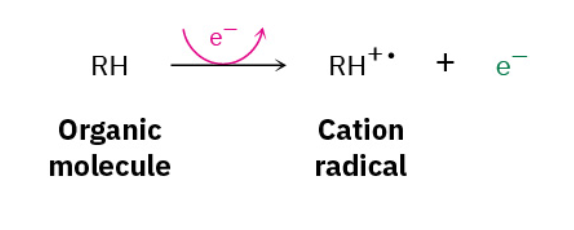
Molecules bombarded w/ high-energy e- → some are ionized
Collisions b/w molecules & e- causes e- (usually 1) to be knocked off from the molecule → forming a radical cation
Radical cation = Ion with an unpaired e-
Radical cation is AKA a molecular ion (M⁺)
Extensive fragmentation often occurs, producing many fragment ions.
Fragmentation patterns → Provide useful info in determining molecular structure of compound
Describe role of Magnetic Sector Mass Analyzer
Type of mass analyzer
Charged ions pass through a magnetic field
Neutral fragments are not affected and are not detected
Ions are separated according to m/z
Only positive ions reach the detector
Mass of ion is the m/z value
Most cation radicals have a charge of ___, so what differentiates them is their _____.
Most cation radicals have a charge of 1+, so what differentiates them is their mass.
Since the charge of most fragments/molecular ions are ___________, their _____________ are essentially what determines their masses.
Since the charge of most fragments/molecular ions are the same, their mass-to-charge ratios (m/z) are essentially what determines their masses.
X-Axis of Mass Spectrum
Y-axis of Mass Spectrum