Unit 3 Atoms
 Call Kai
 Learn
 Practice Test
 Spaced Repetition
 Match
 Flashcards
 Knowt Play
1/56

There's no tags or description
Looks like no tags are added yet.
57 Terms
Matter
Anything that has mass and takes up space
What is matter made of?
Atoms, which can combine to form molecules and compounds
Atom
The smallest unit of an element that retains its chemical properties
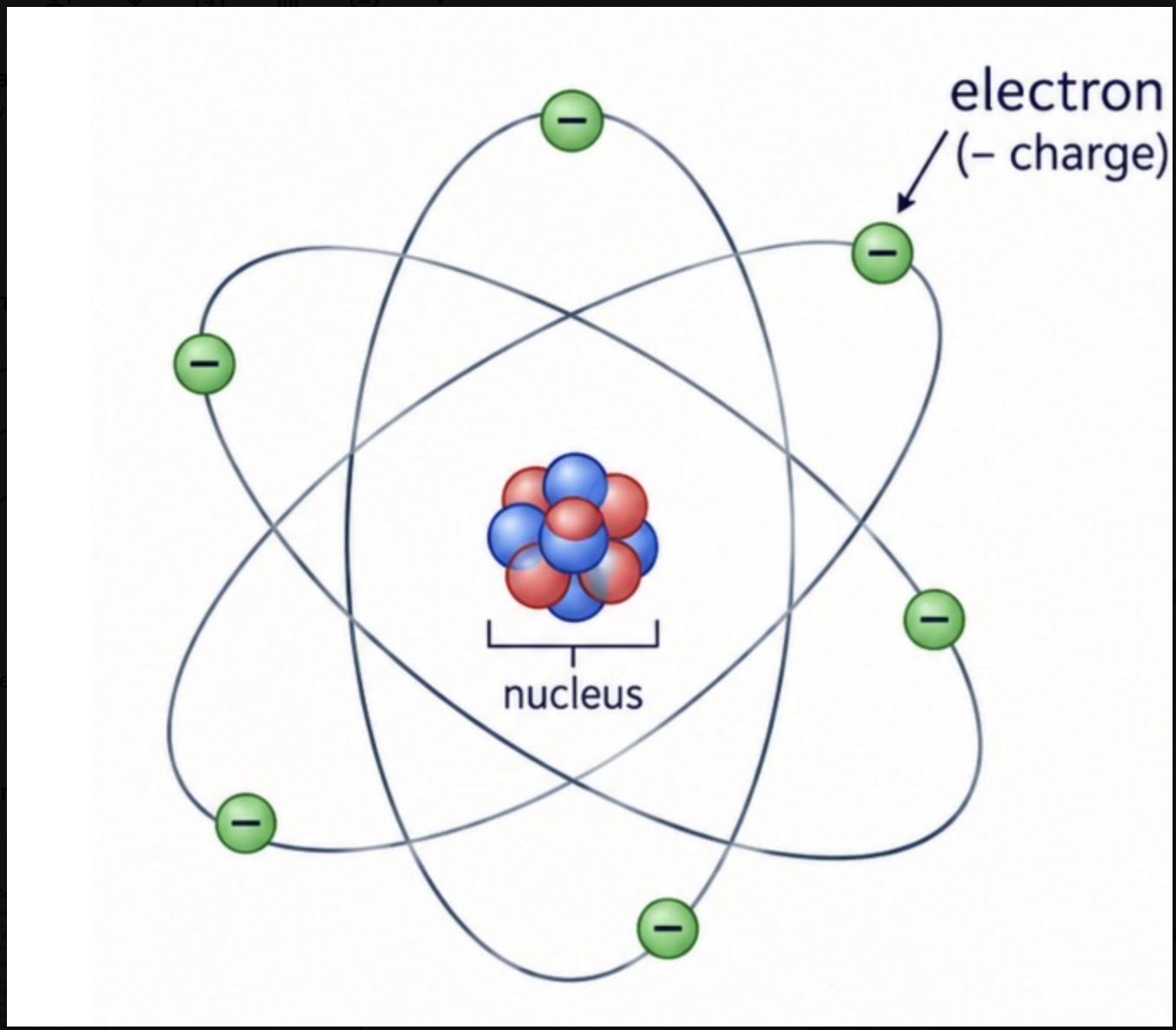
What are the three main subatomic particles?
Protons, nuestrons, electrons
What are protons charge, mass and location?
charge-positive +1, mass- 1 amu, location-nucleaus
What are neurtons charge, mass and location?
Charge- nuetral,0 mass- 1 amu, location nucleus
What are electrons charge, mass and location?
Charge-negative, -1, mass- 1/836 amu location- electron cloud
What does the atomic number tell you?
The number of protons, it identifies the element
How do you find neutrons?
mass number-atomic number
How do you find elecrons in a neutral atom?
electrons=protons=atomic number
How did Democritus explain matter?
Matter is made of tiny, individual particles called atoms

What was Dalton’s atomic model?
Solid Sphere Model: model is made of atoms, each element has its own type
What evidence supported Dalton’s atomic theory?
Chemical reactions and fixed ratios showed matter combines in predictable ways.
What did J.J. Thomson’s cathode-ray experiment discover?
Electrons, showing atoms contain smaller negatively charged particles

What was Tompson’s atomic model?
PLum Pudding model, electrons embedded in a positively charged sphere
What did Rutherfords gold-foil experiment show?
Most postively charged particles passed through the gold foil, but a few deflected. This showed atoms are mostly empty space with a tiny, dense, positive nucleus.

Whats was Rutherford’s atomic model?
A tiny, positive nucleus surrounded by mostly empty space.

What was Nagaoka’s atomic model?
A saturn- like model with electrons surrounding a massive central positive region, it was later replaced

What did Bohr’s model propose?
Electrons occupy specific energy levels around the nucleus

What does Schrödinger contribute to atomic theory?
The Quantum-mechanical model: electrons occupy orbitals or probaility regions
What did Chadwick discover?
The neutron, a neutral particle in the nucleus
How has Chadwicks atomic theory change over time?
New experiments revealed electrons, the nucleus, neutrons and quantum electron behavior
How are elements organized on the period table?
By increasing atomic number, repeating properties reflect repeating electron arrangment
What does the atomic number tell you?
protons
How can the period table help find subatomic particles
Atomic number=protons; rounded atomic mass—atomic number=neutrons;neutral electrons =protons
What happens if an atom gains or loses protons?
It becomes a different element
What happens if an atom gains or loses neutrons?
it becomes a different isotope of the same element
What happens if an atom gains or loses electrons?
it becomes an ion;gaining makes it negative, losing makes it positive
What is an isotope?
Atoms of the same element with equal protons but different numbers of neutrons
How do isotopes affect atomic mass and stability?
They have different masses; some isotopes are stable, while others are radioactive
How do you write isotope notation?
Writr mass number upper left and atomic number lower left of the element symbol
How do you calulate an isotope’s neutrons?
mass number -atomic number
How does a positive ion form?
An atom loses electrons, leaving more protons than electrons
How does a negative ion form?
An atom gains electrons, giving it more electrons than protons
In isotope/ion notation, what do mass number and charge mean?
mass number=protons+neutrons
charge=protons-electrons
What is the average atomic mass?
The weighted average of an element’s naturally occuring isotope masses
How do you calculate average atomic mass?
multiply each isotope mass by its decimal and abundance, then add the products
What is electron configuration?
The arrangement of an atom’s electrons among energy levels and sublevels
What is a longhand electron configuration?
it lists every occupied sublevel
What is a shorthand electron configuration?
Use the previous noble gas in brackets, then lists the remaining sublevels
What is Aufbau principle?
electrons fill the lowest-energy orbitals available first
What is the Pauli exclusion principle?
An orbital holds at most tow electrons, with opposite spins
Whats is Hund’s rule?
Equal-energy orbitals fill singly before electrons pair up
How many electrons fit in s,p,d, and f sublevels
s=2 p=6 d=10 f=14
What is an orbital
A region where an electron is likely to be found; each orbital holds up to two electrons
What is a valence electron?
An electron in the outermost occupied energy level; it affects bonding and reactivity
How can you find valence electrons for main-group electrons?
Use groups: group 1-2, have 1-2; groups 13-18 have 3-8 (helium has 2)
What is the ground state of an atom?
The lowest level-energy arrangement of its electrons
What is an excited state?
A state where an electron has absorbed energy and moved to a higher energy level
What happens when an excited electron releases energy?
It drops to a lower energy level and emits a photon
What is a photon?
A packet of electromagnetic energy
What does quantized energy mean?
Electrons can occupy only specific allowed energy levels, not energies in between
Why does an excited atom emit particular colors of light?
Electron energy drops release photons with specific energies and wavelengths
What did the light lab demonstrate?
Different light sources produce different spectra; bright line correspond to specific electron energy changes
Why do elements produce different flame-test colors?
Heat excites electrons; when they fall back, they emit element- specific wavelengths of light
What happens during a flame test, step by step?
Heat excites electrons→ electrons drop to lower energy levels→ photons are emitted→ colored light appears
What are real-life examples of light from excited electrons?
Neon signs, fireworks etc