Lab Exam 3
 Call Kai
 Learn
 Practice Test
 Spaced Repetition
 Match
 Flashcards
 Knowt Play
1/97

There's no tags or description
Looks like no tags are added yet.
98 Terms
Are astrocytes in the PNS or CNS?
CNS
What are astrocytes basic function?
Link capillaries and neurons to form blood brain barrier
Are oligodendrocytes in the PNS or CNS?
CNS
What are oligodendrocyte’s basic function?
Produce myelin sheath wrapping around neurons of CNS
Are microglial cells in the PNS or CNS?
CNS
What are microglial cell’s basic function?
Defense cells to protect CNS
Are ependymal in the PNS or CNS?
CNS
What are ependymal basic function?
Production of cerebral spinal fluid
Are schwann cells in the PNS or CNS?
PNS
What are schwann cell’s basic function?
Myelin sheath around axon helps maintain, protect, insulate, and speed up conduction
Are satellite cells in the PNS or CNS?
PNS
What are satellite cell’s basic function?
Surrounds cell bodies of neurons

What is the pointer on?
Nucleolus

What is A pointed at?
Nucleolus
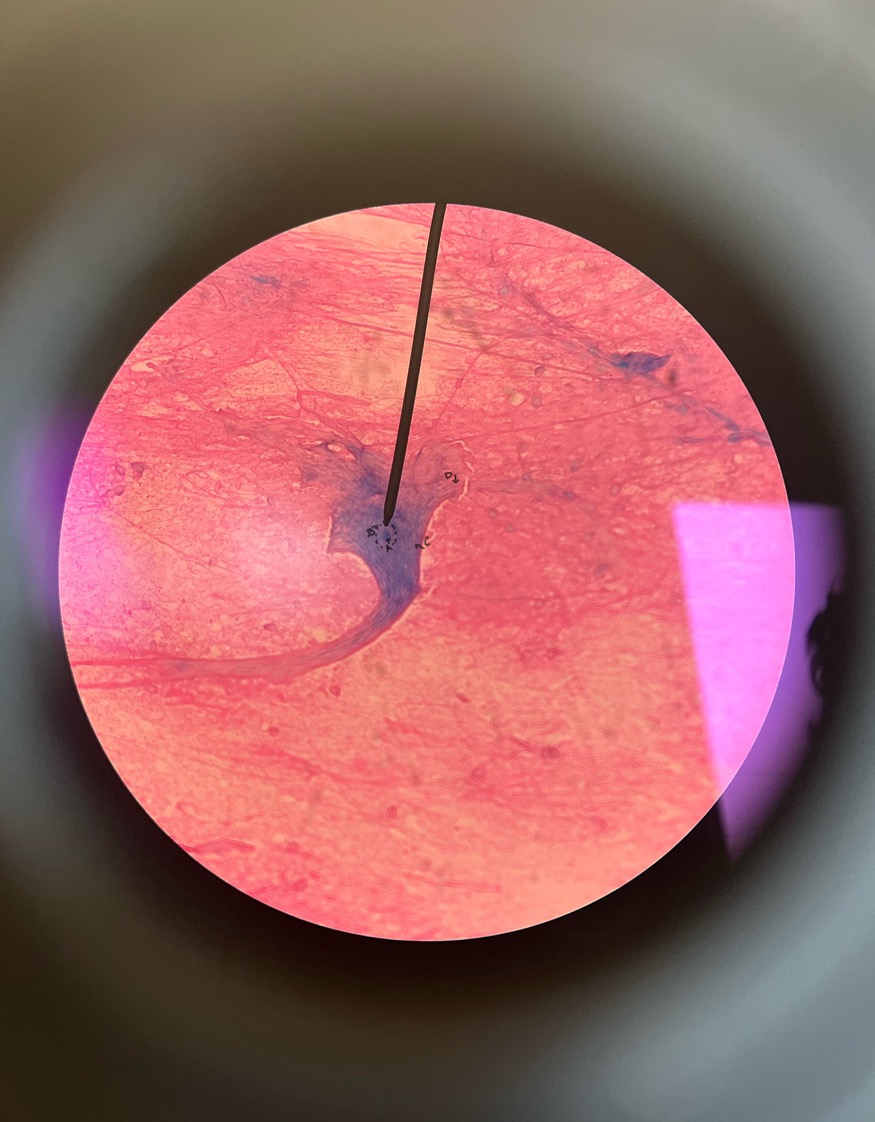
What is B pointed at?
Nucleus

What is C pointed at?
Cell body

What is D pointed at?
Dendrites

What is A pointed at?
Nodes of Ranvier

What is B pointed at?
Myelin Sheath of Schwann Cells

What is C pointed at?
Axon Cylinder
What’s the function of Nodes of Ranvier?
Increase speed of conduction
What substances are Myelin made up of?
Protein - lipoid
What are 3 Myelin functions?
Insulates, protects, increases speed of conduction
What are the three STRUCTURAL classification types for neurons?
Multipolar, bipolar, and unipolar
Number of processes off of cell body of MULTIPOLAR neurons
3 or more
Number of processes off of cell body of BIPOLAR neurons
2
Number of processes off of cell body of UNIPOLAR neurons
1
Examples of where MULTIPOLAR is found in the human body
CNS, cerebellum, mostly motor neurons
Examples of where BIPOLAR is found in the human body
Retina of the eye, inner ear, olfactory areas
Examples of where UNIPOLAR is found in the human body
Dorsal root ganglia, mostly sensory neurons
What are the three FUNCTIONAL classification types for neurons?
Sensory (afferent), motor (efferent), and association
Where do SENSORY neurons go to and from?
From viscera, muscles, skin, etc., to CNS
Where do MOTOR neurons go to and from?
From CNS to effectors (muscles, glands)
Where do ASSOCIATION neurons go to and from?
From sensory/afferent to motor/efferent
What structural types are SENSORY neurons typically?
Unipolar, bipolar
What structural types are MOTOR neurons typically?
Multipolar
What structural types are ASSOCIATION neurons typically?
Multipolar

What is in brackets?
Fascicles

What is circled?
Neurons

What is the yellow pointer?
Endoneurium

What is the red pointer?
Perineurium

What is the green pointer?
Epineurium
Where is Endoneurium’s location in Nerve?
Surrounding each myelinated axon
Where is Perineurium’s location in Nerve?
Surrounds each fascicle (bundle of nerve fibers/axons)
Where is Epineurium’s location in Nerve?
Surrounds the entire peripheral nerve

Is this a longitudinal section or a cross section?
Longitudinal section

Identify stations and nuclei

What is the pointer pointing at?
Perimysium

What is A?
Epimysium

What is B?
Perimysium

What is C?
Endomysium

Is the endomysium, perimysium, or epimysium the most outer layer?
Epimysium

Does the endomysium, perimysium, or epimysium go around the individual muscle fiber?
Endomysium

Does the endomysium, perimysium, or epimysium go around the individual muscle fascicles?
Perimysium
What are the 4 muscle classification types?
Prime mover/agonist, antagonist, synergist, and fixator
Definition of Prime Mover/ Agonist
Is the muscle (or muscles) primarily responsible for a specific movement
Definition of Antagonist
A muscle (or muscles) that oppose the action of the agonist/prime mover
Definition of Synergist
Aid the action of agonist
Definition of Fixator
Immobilize the origin of a prime mover
Example from Elbow Flexion for Prime Mover / Agonist
Biceps brachii, and brachialis
Example from Elbow Flexion for Antagonist
Triceps brachii
Example from Elbow Flexion for Synergist
Brachioradialis
Example from Elbow Flexion for Fixator
Trapezius
Flexion
Decrease angle and distance
Extension / Hyperextension
Increase angle and distance
Abduction
Away from midline
Adduction
Closer to midline
Lateral Rotation
Rotation away from midline
Medial Rotation
Rotation towards midline
Prime Movers for eyes (closing, blinking, squinting)
Orbicularis oculi
Prime Movers for mouth (closing, kissing, pursing)
Orbicularis oris
Prime Movers for eyebrows (raising or elevating)
Frontalis (epicranius)
Prime Movers for jaw (closing or chewing)
Masseter
Prime Movers for neck flexion (chin towards chest)
Sternocleidomastoid
Prime Movers for neck hyperextension (chin away from chest)
Splenius
Prime Movers for neck lateral rotation (turning left or right)
Sternocleidomastoid
Prime Movers for torso (flexion of upper vertebral column, anteriorly (abdominal crunch))
Rectus abdominus
Prime Movers for torso/abdomen (compression of abdominal wall (flattening/tightening abdominal muscles))
External oblique,